1965 – Alphaville

1965 – Alphaville

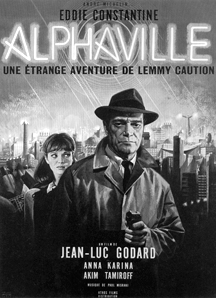
Also titled “Une étrange aventure de Lemmy Caution (A Strange Adventure of Lemmy Caution)”, it’s a French New Wave film written and directed by Jean-Luc Godard. It stars Eddie Constantine as Lemmy Caution and Anna Karina as Natacha von Braun. It deals with a reporter visiting a supposed city of the future in another galaxy (although, funnily enough, it simply depicts 1960s modernist Parisian architecture), but it turns out to be a dystopian nightmare. It combines elements of science fiction, film noir, satire and of course those typical Nouvelle Vague elements. I rented it on Amazon Prime Video for €2.99 (SD).
Warnings about the dangers of AI are everywhere these days. There are massive protests against data centers – nobody wants them in their state. n particular, the backlash is strong in the US, with legislature being introduced by AOC to halt data-center construction. Of course, this is nothing new in movies or literature. Blind trust in technology and dystopian futures have always been present. Even George Méliès’ famous 1902 short film “Le Voyage dans la lune” (you know with the rocket in the eye) warns about scientific hubris.

While the moon-trip movie and its critique were heavily influenced by Jules Verne and colonialism, in the 1960s there could be two types of backlash against technology. was directed at the kind of techno-optimism that existed at the time. Big firms were just beginning to acquire large computers that promised to solve the “big problems”. Walt Disney kept promoting his utopia, the “Experimental Prototype Community of Tomorrow” (EPCOT) which promised that technology would take care of your problems. Side note: I visited EPCOT Center in 1994 before they discontinued that ridiculous 1960s ride one year later – it had such an uncanny-valley look to it. Walt Disney passed away in 1966 without his community ever becoming a reality (thank God), but his faith in technology never wavered, so he is frozen in case we develop something that could revive him. The other backlash was related to the race between the two ideologies: capitalism vs. communism. Were we going to be ruled by money or by central planing? I am not going to rehash those arguments, let’s just say that the ground was very fertile for criticizing both ideologies.

So along comes this movie which critiques this technology-driven approach. In that experimental city, everything is ruled by logic – emotions and art are considered inferior to progress so they are discarded. Words like “conscience” and “love” are erased from dictionaries, which the call Bibles; so they must be replenished constantly. Citizens who cry or show too many feelings are either killed or pressured into killing themselves. The whole city is ruled by a supercomputer named Alpha 60 – hence the name Alphaville for the city.
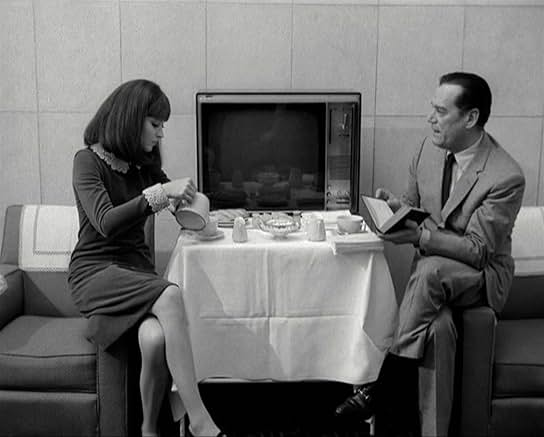
Within all that techno-critique, it is also a satire – what’s the most modern city you can think of? Paris, of course, haha – it is just shown through its most modern buildings. Even within that there is, of course, is a critique towards the development of “La Defense” a soulless Paris district, just outside the city limits. But there are also noir tropes in the film, with the hard-boiled detective (this time it’s a journalist) exposing everything, the femme fatale who could lead him to perdition if he tries to save her.

But then the movie is also really weird. The Alpha 60 computer is everywhere, hears everything and talks to you in a guttural, monotonous voice. The imagery sometimes switches to negative. The protagonists act as if they’re falling out of nowhere. There are a lot—and I do mean a lot—of weird things, some funny, and some definitely not! So, all in all, the movie was ok, but it will not be one of my favorites. For 2026, there were no groundbreaking messages that I needed to hear – illogical things like love and art and feelings are what makes life worth living for (“Florals? For spring? Groundbreaking!“). But still, I liked this shift in mood that I have been seeing in these last few movies: from people in the 1950s fighting for their ideals and rights to the much more cynical way of looking at the world in the 1960s.
1964 – Dr. Strangelove or: How I Learned to Stop Worrying and Love the Bomb

1964 – Dr. Strangelove or: How I Learned to Stop Worrying and Love the Bomb

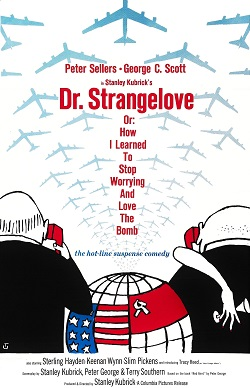
It’s a political black comedy satire co-written, produced and directed by Stanley Kubrick. It is loosely based on the novel Red Alert by Peter George. It stars mainly Peter Sellers in three roles: Group Capt. Lionel Mandrake, President Merkin Muffley and the titular Dr. Strangelove. Its story deals with trying to contain the damage by an US general going rogue and ordering a preemtive nuclear attack on the Soviets without knowing that this will set off a doomsday device killing all life on Earth. I rented it on Apple TV for 3.99 Eur.

During my PhD studies, I completed them mostly in the Lawrence Livermore National Lab. While our little unsecured corner of the lab dealing with astronomy had little to do with atomic bombs, it was nevertheless a daily surreal experience. Together with my bright red foreigner badge, I had to carry around a little Geiger counter to make sure I wasn’t contaminated by nuclear waste. Similarly, we were constantly monitored on our online activity, our cars were randomly searched, we had to carry out bi-annual security trainings and right until I left in 2008, it was forbidden to have a phone with a camera on site. The site was also weirder than our sister Lawrence Berkeley National Lab, since our founding director was mainly the “crazy” and ostracized Edward Teller (the father of the hydrogen bomb) rather than the more nuanced Ernest Lawrence, even though both laboratories are named after the latter.

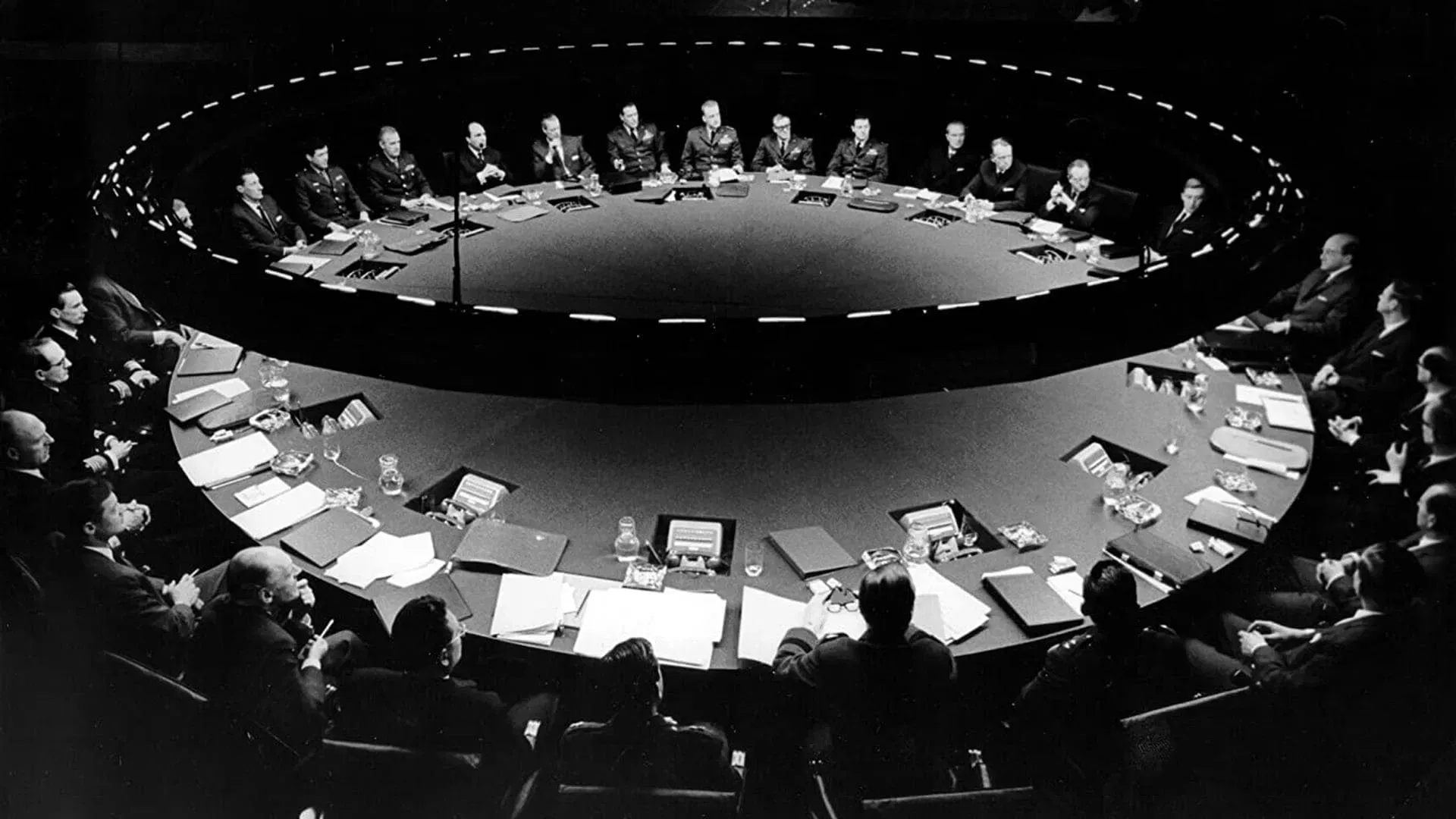
Everybody in the lab knew that Dr. Strangelove was a mixture of Wernher von Braun, but especially Edward Teller. His extreme stance in support of ever bigger and more powerful nuclear weapons and later of Star Wars was legend around the lab. When I was applying to work at the lab and was being background checked, one of his last speeches basically boiled down to: “Let’s bomb the islamists out of existence after September 11th!”. The town of Livermore embodied this strange discord – cowboys, nerds, military and hippies all living next to each other. By the time I finally began working at the lab (right around Teller’s death, hehe), I justified my joining with the fact that actual nuclear testing was banned (only simulations) and that the National Ignition Facility run by the lab could one day solve the energy crisis. Still, the movie and its message were always present at the lab, its satirical message serving as a reminder that maybe we were the baddies. I had to chuckle when my summer student named her research summary: “Quasar searches or: how I learned to stop worrying and love the Bob!” (Bob was my advisor’s name).

It is then ironic when I tell you that I had not seen the movie before. I knew so many of the jokes (“no fighting in the war room!”), so many of the images and yet I had never seen the whole thing. So now I finally sat down and watched the whole thing, rather quickly since it’s only 95 minutes long. Already the opening credits, which I didn’t know had me laughing, since the fuelling of a plane mid-air was presented so phallically.

So, what can I say? Brilliant! The phone calls between the American president Muffley and his Russian counterpart, Dimitri are the sweetest and funniest: “I’m sorry too, Dimitri. I’m very sorry. All right, you’re sorrier than I am! But I am sorry as well. I am as sorry as you are Dimitri, don’t say that you’re more sorry than I am because I’m capable of being just as sorry as you are! So we’re both sorry, alright?”. The motivation of the general (Jack Ripper, haha) to start the attack because he’s convinced that the Russians are contaminating the water via fluoridation sounds very similar to arguments you hear today against vaccinations, so the movie is as prescient as ever – we often have some truly crazy people at the top. And yet, I can’t give it full marks, but only because I knew so much of it. It’s as if you listen to a story about the Holocaust; the first time you learn of it, it’s shocking. But by the 7th Holocaust Oscar Bait movie, you might roll your eyes just a tiny bit. So nothing against this satire, I have heard all and even better jokes criticizing the nuclear arms race at the lab already.

1963 – The Great Escape

1963 – The Great Escape

It is an American war epic movie that deals with the escape of English and American prisoners from a German war camp during WWII. Produced and directed by John Sturges, it is adapted from Paul Brickhill’s non-fictional book of the same name, which narrates the real mass escape by British prisoners of war from the Stalag Luft III POW camp. The film made numerous compromises for its commercial appeal, including its portrayal of American involvement in the escape. It stars a big ensemble of actors, most notably Steve McQueen as Hilts, “The Cooler King”, James Garner as Hendley “The Scrounger” and Richard Attenborough as Roger Bartlett “The Big X”. I watched it on YouTube for free here.

I’ve been traveling a bit these last few weeks, attending conferences. One of them was about presenting the next flagship projects that the European Southern Observatory will undertake once it has finished the Extremely Large Telescope, a massive 39m telescope – more than three times the diameter of the current largest telescope in the world. The institute I work at advocates for a massive spectroscopy telescope, where the impressive thing is not the size of the telescope, but the enormous amount of spectral information that it will get (WST).

It is truly a crazy project, but I have worked with the Principal Investigator before and it has been great to be part of the team. It’s so great to be part of a team, where everybody has their assigned role, each equally crucial in the completion of the project. So regardless whether you are an optical engineer making simple fiber tests or the project manager putting the whole monster together, you feel valued and inspired to be part of the project. Also with the last project, it was a challenging work package, but you always were eager to tackle the difficulties.

Needless to say, I also love these kinds of movies where everybody comes together to work on a project, whether it’s science, Oppenheimer, The Imitation Game and the recently amazing Project Hail Mary, or a heist, Heat and Inside Man, or even sports movies, F1 and Moneyball, everybody in the ensemble has a small, but important role. I had heard good things about this movie, where an ensemble has to work together, especially the Americans with the English to escape a Nazi POW camp.

I have to admit, I was bored by this movie for the first two thirds of it. It’s almost 3 hours long and around the end of the second hour, they are just actually executing the escape. Surely those first roughly 100 minutes could’ve used a good editor. For example, they say they need wood for the tunnel, they show where they need wood in the tunnel, they then discuss how to get the wood, then show how they get the wood – just like they discussed it – and then show how the wood is implemented in the tunnel.

Yes, I am probably exaggerating it, but that’s the job of a good editor. Look at how effectively the heist is explained in Ocean’s 11 or the escape after the fact in The Shawshank Redemption. I don’t need Charles Bronson exposing us to his suffering from claustrophobia for the 3rd or 4th time. And then the music is a jarring contrast to the supposed bleakness they are enduring. The Nazi camp commander treats them with compassion, why is everybody so gung-ho about escaping?

But if you have seen the rest of the movie, you finally get the crux of it. It is often remembered as a lighthearted adventure, but within that juxtaposition lies its genius. Because the last 45-60 minutes the stakes become sky high and finally I understood what the prisoners were doing, where the true defiance lay. The true victory lay not in reaching home, but the refusal to remain passive in the face of captivity. Sadly it takes a long time to get there, so I almost gave up on the movie, but the ending, where it finally clicked for me, is definitely worth it!

Due to my travels, this blog is a week late. Now that I am a bit closer to vacation time, I will try to publish a post next Sunday, otherwise I will be a week short in the blog.