1964 – Dr. Strangelove or: How I Learned to Stop Worrying and Love the Bomb

1964 – Dr. Strangelove or: How I Learned to Stop Worrying and Love the Bomb

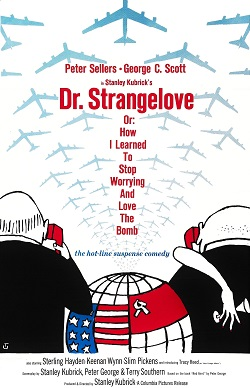
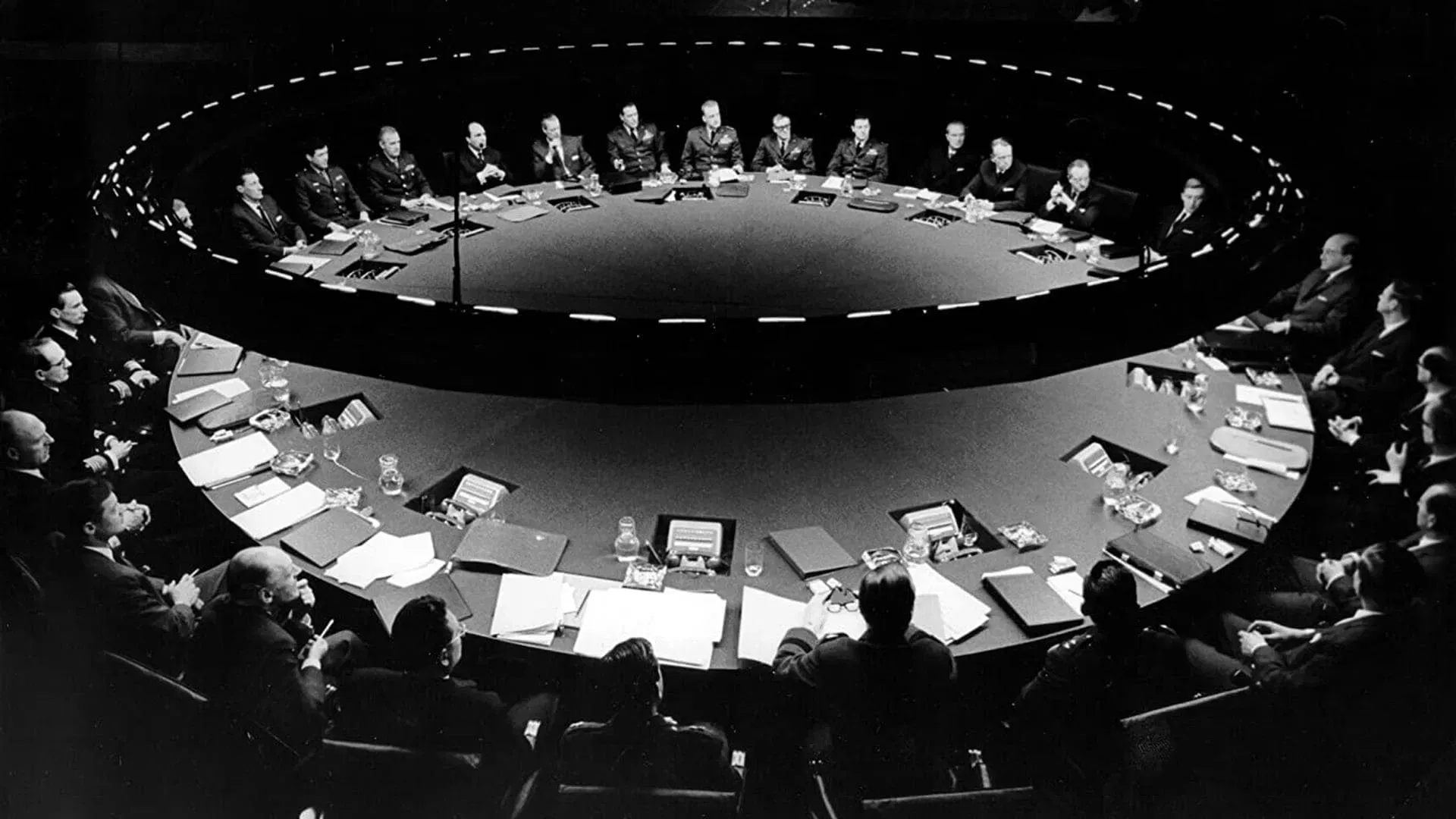
It’s a political black comedy satire co-written, produced and directed by Stanley Kubrick. It is loosely based on the novel Red Alert by Peter George. It stars mainly Peter Sellers in three roles: Group Capt. Lionel Mandrake, President Merkin Muffley and the titular Dr. Strangelove. Its story deals with trying to contain the damage by an US general going rogue and ordering a preemtive nuclear attack on the Soviets without knowing that this will set off a doomsday device killing all life on Earth. I rented it on Apple TV for 3.99 Eur.

During my PhD studies, I completed them mostly in the Lawrence Livermore National Lab. While our little unsecured corner of the lab dealing with astronomy had little to do with atomic bombs, it was nevertheless a daily surreal experience. Together with my bright red foreigner badge, I had to carry around a little Geiger counter to make sure I wasn’t contaminated by nuclear waste. Similarly, we were constantly monitored on our online activity, our cars were randomly searched, we had to carry out bi-annual security trainings and right until I left in 2008, it was forbidden to have a phone with a camera on site. The site was also weirder than our sister Lawrence Berkeley National Lab, since our founding director was mainly the “crazy” and ostracized Edward Teller (the father of the hydrogen bomb) rather than the more nuanced Ernest Lawrence, even though both laboratories are named after the latter.

Everybody in the lab knew that Dr. Strangelove was a mixture of Wernher von Braun, but especially Edward Teller. His extreme stance in support of ever bigger and more powerful nuclear weapons and later of Star Wars was legend around the lab. When I was applying to work at the lab and was being background checked, one of his last speeches basically boiled down to: “Let’s bomb the islamists out of existence after September 11th!”. The town of Livermore embodied this strange discord – cowboys, nerds, military and hippies all living next to each other. By the time I finally began working at the lab (right around Teller’s death, hehe), I justified my joining with the fact that actual nuclear testing was banned (only simulations) and that the National Ignition Facility run by the lab could one day solve the energy crisis. Still, the movie and its message were always present at the lab, its satirical message serving as a reminder that maybe we were the baddies. I had to chuckle when my summer student named her research summary: “Quasar searches or: how I learned to stop worrying and love the Bob!” (Bob was my advisor’s name).

It is then ironic when I tell you that I had not seen the movie before. I knew so many of the jokes (“no fighting in the war room!”), so many of the images and yet I had never seen the whole thing. So now I finally sat down and watched the whole thing, rather quickly since it’s only 95 minutes long. Already the opening credits, which I didn’t know had me laughing, since the fuelling of a plane mid-air was presented so phallically.

So, what can I say? Brilliant! The phone calls between the American president Muffley and his Russian counterpart, Dimitri are the sweetest and funniest: “I’m sorry too, Dimitri. I’m very sorry. All right, you’re sorrier than I am! But I am sorry as well. I am as sorry as you are Dimitri, don’t say that you’re more sorry than I am because I’m capable of being just as sorry as you are! So we’re both sorry, alright?”. The motivation of the general (Jack Ripper, haha) to start the attack because he’s convinced that the Russians are contaminating the water via fluoridation sounds very similar to arguments you hear today against vaccinations, so the movie is as prescient as ever – we often have some truly crazy people at the top. And yet, I can’t give it full marks, but only because I knew so much of it. It’s as if you listen to a story about the Holocaust; the first time you learn of it, it’s shocking. But by the 7th Holocaust Oscar Bait movie, you might roll your eyes just a tiny bit. So nothing against this satire, I have heard all and even better jokes criticizing the nuclear arms race at the lab already.

1962 – Whatever happened to Baby Jane?

1962 – Whatever happened to Baby Jane

It is an American psychological horror thriller directed and produced by Robert Aldrich. It stars real-life rivals Bette Davis as “Baby” Jane Hudson and Joan Crawford as Blanche Hudson as rival aging sisters that were at one point famous in the entertainment scene. The movie is famous for its kicking off the “hagsploitation” or “hag horror” genre in the 60s and for supposed feuds on the set between the two leads, which they later denied. I rented it on Apple TV for 3,99 Eur.

There are a few movies that completely changed my way of watching movies. The earliest one was when I was only 4 years old: E.T., which held my wonder even if I didn’t understand everything and showed me that movies weren’t all easy cartoons. One was 1927s Metropolis, which I watched with fellow students, because we were visiting the film studios where it was shot in Potsdam – how can such an old movie have such a prescient message!?! And one was 1950s All About Eve: Bette Davis was such a diva, such a grand personality, she stole the movie, it made all the supposed modern stars around me seem like children.

I’ve since watched quite a few Bette Davis movies, but was always afraid of this one, since she supposedly really leans into the “jezebel hag” persona. The big feud(s) between the actresses are also exaggerated for this movie, when the body of work of both is so rich – watch Izzy’s video on the 1963 Oscar race, for more info on that and also the movie itself. The feud between the actresses continues to compel the public, however, how else would you explain an entire series with 2 seasons and quite good reviews dedicated to that (Jessica Lange and Susan Sarandon playing those icons? Yes, please).

In any case, the plot of the movie is quite simple. There are two sisters, Jane experienced success early on as a Vaudeville performer, was very bratty, while Blanche stood in the background. During the 30s, Blanche became the more successful actress, while executives made fun of Jane, that she had no talent and destroyed the pictures she was in by drinking too much. A mysterious accident leaves Blanche in a wheelchair; rumors have it that it was Jane that did it. In the present day in the 60s, both have grown old, Jane supposedly taking care of her wheelchair-bound sister. Her resentment explodes during the movie as she tortures her sister, slowly killing her, while she tries to mount a comeback to her old act from 50 years ago. Will her crazy plan succeed?

Does it work? Ironically, Bette Davis immediately saw through the camp that it was and really leaned into the hag persona giving an amazing performance, while Joan Crawford didn’t take the bait, so naturally Davis thoroughly outshines Crawford, even though she is the villain of the movie. It really is a reason, why Davis continued to work for decades after that, while Crawford became a recluse. So, yes, even though the plot is ridiculous, the movie is too long, the whole thing just works due to Davis’ performance. She manages to also rack up the tension in the question whether Blanche survives, as seeing her supposed suffer by spinning around in her wheelchair was quite ridiculous. Davis even gets her Gloria Swanson Sunset Boulevard moment as she crazily dances around on a beach while spectators stare at her in horror.

A little social critique also lingers at what the entertainment industry does with children. The constant performance of Jane of that same ridiculous “Daddy” song, the doll merchandise, the persistent push by the father, it ruined Jane at a young age. And yet, we do not learn: Judy Garland in the 30s, Natalie Wood in the 50s, Brooke Shields in the 70s, plus a whole host of things coming out in the 80s and 90s. I kept thinking about this while watching the movie, Davis making me even empathetic towards her horrifying villain. What a performance!

1960 – Psycho

1960 – Psycho

It’s an American horror film produced and directed by Alfred Hitchcock, with a screenplay by Joseph Stefano based on a novel by Robert Bloch. It stars Anthony Perkins as Norman Bates and Janet Leigh as Marion Crane, a woman on the run who stops by the Bates Motel. It’s considered one of the most influential horror movies of all time. I rented it on Apple TV for 3.99 Eur.

The 60s! We’ve arrived at a new decade where in the beginning there will be huge movie productions: sandal epics like Ben-Hur or big production musicals, but then a slump will hit by the end of the decade, be it because of the decline of the studio system, because of the rise of TV at home or because of a general disillusionment of the Boomer generation. No matter, the 70s will give us gritty, realistic cinema, so I am quite ready for the ride from glamour to rawness.

Heh, we’ve arrived at yet another one of my big gaps in my filmography, one of the most famous horror movies ever and considered a true masterpiece by Alfred Hitchcock. I did try to see it once, when I was like 12 or so and found it boring, because it wasn’t about somebody being stabbed at all, it was about this boring secretary – did I get the right movie? Watchingw it live on some movie channel in 1991, I couldn’t just stop and check and quickly switched to something else. Now, in 2026, I have been thoroughly spoiled, on both the famous scene (the one I was looking for) and the resolution. I did still want to see it, though, and make up my own mind whether it was good.

Look, horror isn’t my favorite genre. I was fascinated by the forbidden fruit of it, staying up late to watch the Nightmare on Elm Street or Friday the 13th movies and other horror movies when I was way too young. Just recently, I was recalling a particularly gruesome scene from Puppetmaster with the Leech Woman – I was not supposed to watch this so young. Needless to say, more than 35 years later, it still is in my mind, yeech. But by the time most people enjoy horror movies, I was way grown out of it. I still enjoyed Scream in high school (mostly for the hot actors), but just laughed at people being scared by The Blair Witch Project. It seems horror is having a small renaissance currently with Obsession and Backrooms conquering the box office way over other fare like the Star Wars Mandalorian movie, so let’s go with the vibe of horror 2026 and complete my filmography in the process – Psycho it is.

What can one say about such a famous movie that hasn’t been said before? Well, it is a bit dated on the horror front. There is maybe one sequence where I would’ve been on the edge of my seat, had I not been spoiled. So, even though it created a lot of the horror tropes, those forbidden horror movies from the 80s have desensitized me so much that some suspense from a 1960 movie sequence elicits only a small raised eyebrow from me. Psycho supposedly is based on Ed Gein, the butcher of Plainfield, a local hermit who stole bodies from graveyards and kept bones and other body parts as keepsakes in addition to murdering two women. So I think just 3 years after the discovery of his disturbing home, it would’ve been more horrific in people’s minds, especially before other notorious serial killers from the 1970s.

What really stands out, however, are the technical details. Already in Vertigo, the fall from the tower was dizzying, but here I felt even more disoriented by a fall from the stairs. The music score is classic, yet hits perfectly. The shadow play on Norman Bates’ face is just perfect – makes one totally uncomfortable; I really like that he went back to black and white for this one as it emphasized the feeling of confinement very well. And Anthony Perkins really puts on a great performance, the whole transformation from “oh, that poor boy, he really seems quite nice” to “oh my god, psycho…” is masterfully executed. Happy to have really seen it and not just parts of it. It was an enjoyable time, albeit not going to be on my top movies of the year – I was just too spoiled for it.

1959 – Ben Hur

1959 – Ben Hur

It’s one of those definitions of an Epic – a sprawling story, about the life of the hero and all the trials he has to go through to fulfill his mission. It was directed by William Wyler (hi again, after Roman Holiday), produced by Sam Zimbalist (15 million dollar gamble paying off wonderfully) and starring Charlton Heston in the main role as Judah Ben Hur. It won 11 Academy Awards, the most before Titanic and Lord of the Rings: The Return of the King matched it. I rented it on Apple TV for 3.99 Eur.

One of the big reasons I love movies is the love my parents had for them. We were one of the first families to get a VCR and would drive to the only Video Store in Town. As a small child, it was an easy Sunday activity to go to the theaters and once we got cable, we would often watch movies with my dad from breakfast to 3pm, when we would be hungry for lunch. Yeah, so many movies discovered with my dad. As you know, there was no Video on Demand and they became lazy going to the Video Store, since movie channels showed them 24/7. However, you had to be lucky to sort of stumble into one movie beginning and there was no curations, so there was a lot of crap, often.

Yet, I look fondly at those Sundays, me watching stuff, I probably shouldn’t have. Just recently I was having a debate about The Color of Money being a good movie, actually! Who did I watch it with? My billiard playing dad. Obscure stuff, which I still love, like Moon Over Parador making fun of dictatorships in Latin America, but also cinephile stuff like Cinema Paradiso, which he would endlessly comment over. One Sunday that I still remember fondly is when we watched Spartacus, I immediately rolled my eyes at him, complaining that we shouldn’t watch these old, long movies and asking why we couldn’t watch a comedy. He just said calmly that this is supposed to be good and this is what we were going to watch today, and man, did I love it. I always loved movies I didn’t fully understand as a kid; they gave me room to grow and keep asking questions.

That movie and many Epics like it, are often what we watch them for – taking us to faraway places, times and cultures. And since I loved Spartacus that much, I figured I fill that gap in my filmography and watch another Epic of that time – one that is mostly known for the chariot scene, its long runtime, the many Academy Awards it won and the many extras the movie employed (8000). I did not know it also involved Jesus in a big way, so was a bit surprised my mom told me it’s more of an Easter movie when I told her I was watching it (now I get it).

Man, it did not disappoint. The chariot scene was awesome, of course, but more than that, the way he navigates the circumstances, Also impressive the scenery from Jerusalem, to the ships, to Nazareth, to grand Rome. The way the friendship between Messala and Judah deteriorates to hatred – the major gay energy in their first scene together, apparently wanted by the screenwriter Gore Vidal unbeknownst to Charlton Heston. The way leprosy was depicted. And of course, the major theme of how you find peace in yourself after your life has been filled with revenge.

I was afraid of the runtime, of course, and I did have to stop a few times along the way. But that was, because we have guests this weekend and not because the movie was boring. The music was a bit corny (especially that 50s choir style at the end of the movie), well, compared to the similar Gladiator, but when I see how far we have come in comparison to The Adventures of Robin Hood, this is miles above. Some of the costumes look cheap, but that doesn’t distract from the movie (I’m looking at you The Odyssey criticism by just looking at costumes). Charlton Heston was not a savory character, especially with his politics later in life, but here he plays the role he is supposed to superbly. Somebody recently said to me that she can’t really watch movies like Indiana Jones or similar anymore, what with the male hero prancing around and letting everybody know he is the “male hero of the movie.” I disagree; the escapism is exactly the point.

All in all, well deserved of its many Academy Awards and even though it’s not a perfect movie, it’s super entertaining and its mission to transport us away from our modern worries for a few hours is accomplished well!

1957 – Paths of Glory

1957 – Paths of Glory

It’s an American anti-war film, directed by Stanley Kubrick when he was just 28 years old (wow). The screenplay he co-wrote with Calder Willingham and Jim Thompson is adapted from the 1935 novel of the same name, which in turn is based on the true Souain corporals affair that happened during WWI. The film mainly stars Kirk Douglas as Colonel Dax, the commanding officer of soldiers who refuse to continue to act out a suicide attack. I watched it on YouTube (free in Germany) here.

Is it even possible to make an anti-war film? That was the question media commentator Broey Deschanel asked herself in this video essay in a reaction to Alex Garland’s Warfare from last year. It’s supposed to be gritty, raw and show war exactly how it is, and in doing so critique its pointlessness. The essay goes on to cite many more examples, e.g. All Quiet on the Western Front or Platoon, but argues that war from the soldier’s point of view always comes with a caveat, with a point of view, there may be deceit on how these soldiers came to war, but never 100% innocence. Only movies like Grave of the Fireflies can truly be anti-war, since they depict the consequences of war on children.

Fair point, but this movie is pretty damning in its critique, especially for an almost 70-year-old movie. When I started watching it, with the typical trench warfare scenes we are accustomed to and which are marvelously depicted in 1917, for example, I thought it was going to be the typical “war is hell” type of story. I wondered why the prologue with the two generals was there in the beginning, it didn’t seem anti-war at all.

But then around a third of the movie in, it dawns on you that it’s not about the horrible trench fighting at all, but an indictment of the rulers at the top. They treat battles like pieces on a board, casualties are rattled off as percentages to be moved around – all before they go back to their civilized parties and gatherings. If some inconvenience is discovered it gets buried under legalese or the offended party gets bought off with a promotion. All the while the simple soldier is just fodder, where your fate is decided by the (un)luck of the draw quite literally.

I liked this movie so much. So quiet in its portrayal of injustice, yet so adept at simply showing it. Add to that an amazing battle scene, where a part of a company is seen storming onto the barbed wire battlefield, most soldiers knowing it is a suicide mission, a mistake, with the chances of success slim at best. The desperation of the three soldiers, who are chosen for all the wrong reasons to take the fall for the blunder of the general is also shocking to see. That Kubrick guy has a bright future ahead of him, but even this, his first so-called masterpiece is really that!

Add to that the nagging discomfort that it is based on true events – a French general really did order his artillery to fire on his own trenches after demoralized soldiers refused to leave them and he ordered the execution of seemingly random soldiers of the company resulting in the death by firing squad of four of them (in the movie it’s three). Only 2 hours later would their sentences have been commuted and 19 years later they were fully exonerated. The whole ordeal changed the way military courts were held in France. And this movie was banned in Switzerland and France until the 70s. It shows you how even 40 years later, the establishment would rather get rid of uncomfortable situations than address the mistakes made by the senior commanders and upper class rulers.

So is it a truly 100% anti-war film as the thesis above proclaimed there aren’t any? No, it valorizes the soldier too much to be truly that, but it’s quite effective otherwise and in that I commend it!