1965 – Alphaville
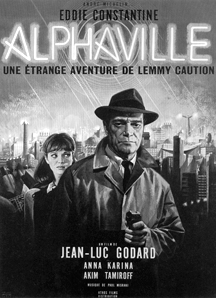
Also titled “Une étrange aventure de Lemmy Caution (A Strange Adventure of Lemmy Caution)”, it’s a French New Wave film written and directed by Jean-Luc Godard. It stars Eddie Constantine as Lemmy Caution and Anna Karina as Natacha von Braun. It deals with a reporter visiting a supposed city of the future in another galaxy (although, funnily enough, it simply depicts 1960s modernist Parisian architecture), but it turns out to be a dystopian nightmare. It combines elements of science fiction, film noir, satire and of course those typical Nouvelle Vague elements. I rented it on Amazon Prime Video for €2.99 (SD).
Warnings about the dangers of AI are everywhere these days. There are massive protests against data centers – nobody wants them in their state. n particular, the backlash is strong in the US, with legislature being introduced by AOC to halt data-center construction. Of course, this is nothing new in movies or literature. Blind trust in technology and dystopian futures have always been present. Even George Méliès’ famous 1902 short film “Le Voyage dans la lune” (you know with the rocket in the eye) warns about scientific hubris.
While the moon-trip movie and its critique were heavily influenced by Jules Verne and colonialism, in the 1960s there could be two types of backlash against technology. was directed at the kind of techno-optimism that existed at the time. Big firms were just beginning to acquire large computers that promised to solve the “big problems”. Walt Disney kept promoting his utopia, the “Experimental Prototype Community of Tomorrow” (EPCOT) which promised that technology would take care of your problems. Side note: I visited EPCOT Center in 1994 before they discontinued that ridiculous 1960s ride one year later – it had such an uncanny-valley look to it. Walt Disney passed away in 1966 without his community ever becoming a reality (thank God), but his faith in technology never wavered, so he is frozen in case we develop something that could revive him. The other backlash was related to the race between the two ideologies: capitalism vs. communism. Were we going to be ruled by money or by central planing? I am not going to rehash those arguments, let’s just say that the ground was very fertile for criticizing both ideologies.
So along comes this movie which critiques this technology-driven approach. In that experimental city, everything is ruled by logic – emotions and art are considered inferior to progress so they are discarded. Words like “conscience” and “love” are erased from dictionaries, which the call Bibles; so they must be replenished constantly. Citizens who cry or show too many feelings are either killed or pressured into killing themselves. The whole city is ruled by a supercomputer named Alpha 60 – hence the name Alphaville for the city.
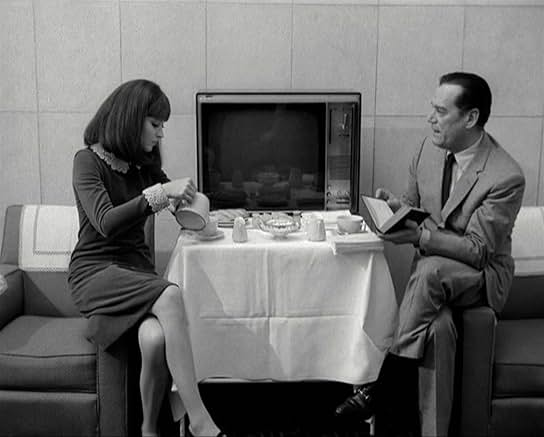
Within all that techno-critique, it is also a satire – what’s the most modern city you can think of? Paris, of course, haha – it is just shown through its most modern buildings. Even within that there is, of course, is a critique towards the development of “La Defense” a soulless Paris district, just outside the city limits. But there are also noir tropes in the film, with the hard-boiled detective (this time it’s a journalist) exposing everything, the femme fatale who could lead him to perdition if he tries to save her.
But then the movie is also really weird. The Alpha 60 computer is everywhere, hears everything and talks to you in a guttural, monotonous voice. The imagery sometimes switches to negative. The protagonists act as if they’re falling out of nowhere. There are a lot—and I do mean a lot—of weird things, some funny, and some definitely not! So, all in all, the movie was ok, but it will not be one of my favorites. For 2026, there were no groundbreaking messages that I needed to hear – illogical things like love and art and feelings are what makes life worth living for (“Florals? For spring? Groundbreaking!“). But still, I liked this shift in mood that I have been seeing in these last few movies: from people in the 1950s fighting for their ideals and rights to the much more cynical way of looking at the world in the 1960s.

