1956 – The Searchers

1956 – The Searchers

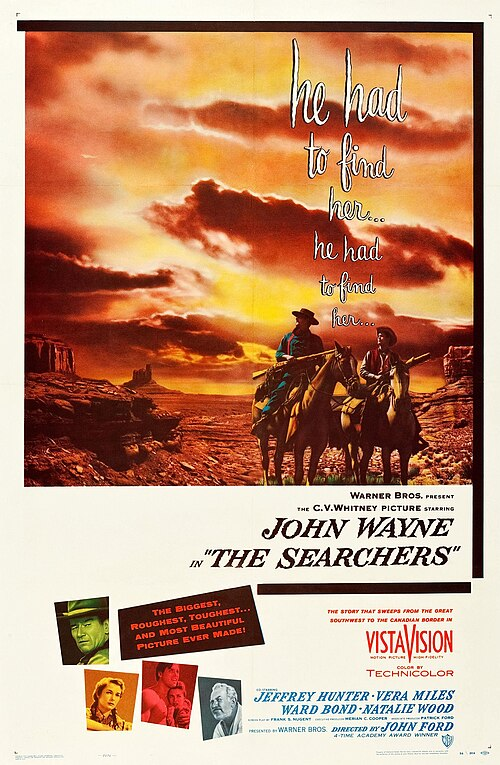
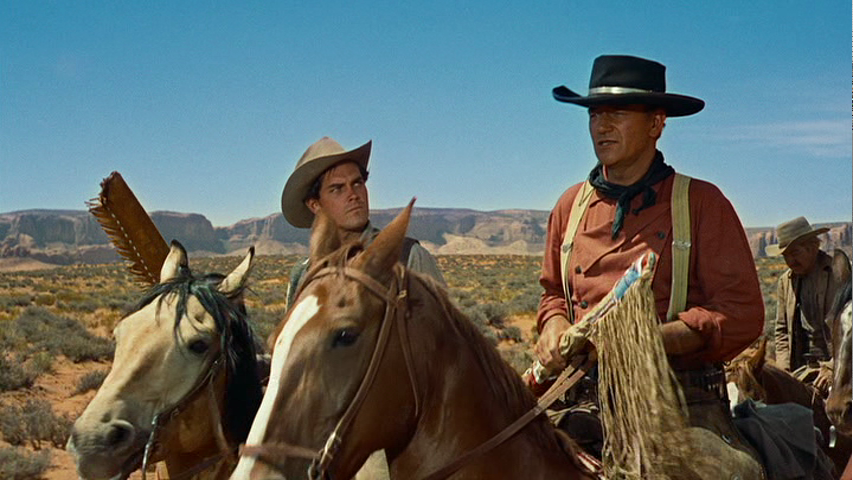
It’s an American epic Western directed by John Ford and written by Frank Nugent based on the 1954 novel by Alan Le May. It stars John Wayne as Ethan Edwards and Jeffrey Hunter as his adopted nephew Martin Pawley as they spend years searching for their abducted niece / sister. It was shot on VistaVision and processed by Technicolor making the landscape of Monument Valley really stand out for this movie. I rented it on Apple TV for 3.99 Eur.
Look, I have never been a fan of Westerns. It’s probably unfair to them, because I never gave them a chance, but already as a kid, I had no interest in playing “cowboys and indians”. By now, similar to Superhero / comic book movies, I have seen a few, but by far not many, especially none of the classics of Sergio Leone and/or Clint Eastwood. And often it is, because revered stuff, I just find boring: the stoic hero, spouting wisdoms like “that’s the way of life” or the hours of scenery on horseback. I recently came across this critique of Yellowstone by SkipIntro. Oh, my guy, I don’t even care about the conservative bend, I just found it boring, even though everybody was raving about it. The treatment of Beth was so problematic, it’s like that girl that says: “hey, I wasn’t groomed, I CHOSE to sleep this much older guy when I was 15”. I saw like 3-4 episodes and turned it off.

Anyway, perhaps I was wrong. Perhaps there is something I am missing in these Westerns. Perhaps, now that I am a bit older myself, I will understand “the old ways”, finally get what John Wayne was all about. I already missed Stagecoach (see my 1939 post on how I seem to have missed most iconic movies of that year), but perhaps this movie, that some say is the greatest Western of all time, will do?

So what are the themes here? A confederate soldier Ethan Edwards comes to his brother and big family in Texas. The going is tough and many have given up making a living out in the land there. There are some other families, like some Swedish immigrants (the Jorgensens), who are good friends with the Edwards family. They have also adopted an orphan, half white, half comanche named Martin Pawley. Already in this introduction, you are made to think that these families are more righteous, because they are out here living the hard life. Add to that the threat of the Indians, who are mad that the white man is taking their land away and murdering their people. And that is exactly what happens; while the men are out on a distraction, the Indians raid the Edwards farm, burn it, kill the parents and son and kidnap their two daughters. The elder is raped and killed quickly, but the younger Debbie is taken by the chief ‘Scar’.

So begins a 7 year search by Ethan and the adopted son Martin to find Debbie. By the time they finally find a 15-year old Debbie, she has assimilated and doesn’t want to go home at first. Here is where the other theme of the movie comes in – the deep-seated hatred of Ethan of the Indians. His racism is so big that he considers murdering his own niece, because she is tainted in his head. But it’s a constant struggle. For example, in the beginning he is barely capable of talking to “half-breed” Martin, but by the end he leaves him everything he owns in his will.

You are not supposed to root for the jerk that is Ethan. He is a wanderer and self-righteous asshole. First, he remains unapologetic Confederate, even wearing the coat 3 years after the war has ended (who goes to their family only 3 years after?). Also, even in the very beginning, you see there is something going on between him and his sister-in-law. And that is before he goes on his 7-year search. But Martin isn’t without blame either – he leaves the girl he is supposedly in love with and only writes her one letter in 5 years. In that sense, it makes it super hard to be on the side of the two: a bigoted prick and a sexist idiot. Apparently that is wanted by the director and it is what gets the conversation going.

And I get that, people are complicated and you can’t go through life with a 2020s lens and I can also do nuance. But the treatment the movie makes of Look (an Indian woman Martin betroths by mistake) is not one bit funny, but super tragic. In that sense, it seems that Ford went out of his way to explain the racism and circumstances of violence between the Whites and the Indians, that he conveniently forgot about the whole sexism thing, which doesn’t get a nuanced take.

Unfortunately that means that I am still not enamoured with Westerns. Very entertaining watch, but not easy and it left me mostly angry (maybe if movies are supposed to elicit emotions out of you, perhaps it was successful). The scenery is great, especially for 1956, the cinematography and action scenes are amazing. But I have to mention my favorite movie of all time Thelma and Louise again and how they drive through Monument Valley, which is most of the scenery here. I’d rather have the modern setting, than the brooding cowboy.

1950 – Born Yesterday

1950 – Born Yesterday

It’s a romantic comedy directed by George Cukor. It’s based on the 1946 play by Garson Kanin of the same name. Since Cukor apparently disliked Kanin, he did not share credit with him or the playwright Albert Mannheimer. It stars Judy Holliday as Billie Dawn (in her Oscar winning role), Broderick Crawford as Harry Brock and William Holden as Paul Verrall. I rented it on YouTube for 3.99 Eur.

Happy New Year, everybody. I never did write that summary of my first year of “100 years of movies”. Ah, never mind; it wasn’t going to be that interesting anyway. The theme is mainly that working on scratching out a list let’s you in on so many amazing movies (like “M” or “To Be or Not To Be”), but also some real clunkers (I am still stewing on how unlikable the protagonist of “Bicycle Thieves” is). You need the patience to go through it, so that the discovery of gems is even more rewarding. In summary, I am really happy, I undertook this project and I am really interested what I will discover in the 3rd year (movies from the 80s and 90s are my most-watched decades). Anyway, my essays in 2026 will cover the movie years 1950-1974, a period of significant change in cinema. It starts with Hollywood still being in a high, but very soon will be attacked by HUAC and people having TVs in their homes. But it will come out of the slump at the end of the 60s with a whole of individual auteurs, away from the rigid studio system into a more gritty, realistic cinema. I am really interested in the journey. Let’s begin.

One of my favorite TV shows is Better Call Saul. I could go wax poetic about it, especially now that Rhea Seehorn is finally getting awards recognition for Pluribus, but a major standout is the cinematography. Colors, shapes, angles and costumes all have meaning. The references within the show are also superb, from the books characters read and the songs they listen to, down to the food consumed. And, of course, the movies. In the climax of the final season, the midpoint of the season and the real breaking point of the whole series is Plan and Execution (just look at that IMDB score 9.9!). Before the shocking final act, Jimmy and Kim are just relaxing, celebrating, having some wine and watching a movie. Which movie? Well “Born Yesterday”, of course – the scene where Billie goes “the proper study of mankind is man (’cause that includes women, too)”. In the next episode the movie comically goes on playing, but I won’t give anything away. In any case, the choice of that movie and that quote made me curious about it.

I had seen the middling remake with Melanie Griffith before. Look, I do have a soft spot for Melanie Griffith, I don’t know why, but I can hardly recall anything about the movie, only that she wanders to the dictionary time and time again – so it’s forgettable, but not as bad as many people say. But what finally put this movie on my big watchlist was BKR’s 1950s Oscar race video essay. All About Eve is without a doubt the movie that turned me towards old movies, how good they could be. Bette Davis was just so fascinating to watch, so magnetic. It was unfathomable how anybody else could’ve won the race. But then, that 1950s race supposedly was legendary, because it also included Gloria Swanson for Sunset Boulevard, which was also amazing (though I am still on the Bette Davis train). What could’ve surpassed those performances?!?!? Judy Holiday’s performance apparently – so I had to watch it.

And yes, all three lead performances are amazing. Judy Holliday does have a natural charisma, and slips into the role very comfortably. At first I thought that voice would be grating on me, but she manages to change it ever so slightly over the course of starting to become a bit more educated that at the end you wanted to hear what she was going to say for herself, it had a touch of assuredness. Her “ditzy, dumb blond” performance is so iconic, she played it just a year later in front of the Pat McCarran’s Senate Internal Security Committee for apparently sympathizing with communists – no idea whether the Senate bought her performance or whether she didn’t really have any connections with communists, but she never suffered any consequences in her acting career from that subpoena. In any case, also also Broderick Crawford’s performance was amazing. I immediately bought his unlikable, but powerful dumb oaf performance. The scene where Harry and Billie are playing cards is mesmerizing: her for winning every hand and having a weird system in shuffling the cards; him, for wanting to assert power, but still yearning for those minutes with her, the way he slams the deck, but then looks at her. Fascinating! And William Holden? He is okay, but let’s face it, he is mainly eye candy. Haha.

Ok, so how about the themes of the movie? They are quite simplistic. The movie implies that Billie had her awakening through the study of politics in just a few weeks. That’s not how it works, of course, education takes time. In that sense, the process is presented almost childishly, packaged with sexism and derision and an odd Americana tinge (glorifying the architecture of Washington DC). But the lines the movie delivers are powerful. The way they equate selfishness to fascism immediately makes one think of the current president of the United States. The way Billie tells the senator that money shouldn’t put any person above his constituents immediately brings up images of Elon Musk. Her journey of self-discovery is fascinating to watch, even if it is not realistic.

In that sense, the delivery of the message is a little too plump. Harry is a convenient villain – loud and couth. The audience from the first scene knows he’s the bad guy, the way he treats the hotel staff and splashes around with his money. Of course, the breaking moment is when he hits Billie, of course he gets his comeuppance through his greed in the end (that is the mildest of spoilers, come on, you know the moral center will win).

So the theme of the movie seems to be that “knowledge is power,” yadda yadda, very liberal values, which is why the movie is often loved in liberal circles. Yet the movie conveniently forgets about the silent villain in the back, the knowledgeable lawyer Jim. He knows which politicians to buy and exactly how far to go with the law without getting into trouble. He could have been Assistant Attorney General, yet he willingly lets himself get lured to the dark, but very lucrative, side. Conveniently, the movie ties the main story up too neatly with a bow and just scratches the surface of the matter. If it is an invitation to further educate oneself, it is very superficially delivered; if it is a warning to stand for your principles no matter the lure of riches, it’s not very successful. I am probably being too harsh on the movie in this last paragraph, but that’s how I felt about the delivery of the message. But it is an entertaining romp, so I should not dissuade you to watch it from that viewpoint.

1944 – Arsenic and Old Lace

1944 – Arsenic and Old Lace

It’s a dark screwball comedy directed by Frank Capra and starring mainly Cary Grant as Mortimer Brewster. It’s based on a play with the same name by Joseph Kesselring, which was very successful, so it was stipulated that the film would not be released until its Broadway run ended. I rented in on YouTube, since both Apple and Amazon only had the German version here for sale.

The leaves have been falling like crazy these last few days here in Berlin. Fall is here and with it pumpkins (soups, pies, lattes, jack-o-lanterns, …), corn mazes (though there aren’t as many as in the past…) and Halloween stuff! Also movies; from marathons the streaming services releasing a bunch of horror movies to the over the air TV channels issuing their Halloween night schedule (apparently it’s actual Halloween marathon this year). So this movie fit right into the season, its whole plot unfolding over Halloween night. Plus, it’s not scary, but a macabre, black comedy.

As to what makes it dark – well it’s two extremely sweet, old ladies murdering lonely older gentlemen (they just bagged their 12th victim in the windowsill) out of pity. It’s wrong, but when you look at them, how they prance around the hall with their arsenic infused wine, you can’t help but laugh. They’re pleasant, give toys to the poor, are in good standing with the police and clergy, how can you not love them? And in their sweetness, they don’t feel remorse either. In fact, there’s quite some commentary over how some people do some truly horrible things in the name of pity, going over the heads of the victims, but present themselves as honorable citizens.

But the movie doesn’t linger on this too long. It’s more on the desperation of their nephew to save his aunts from the police by trying to pin it on his delusional younger brother “Teddy”, who things he’s the actual Teddy Roosevelt. Teddy has buried the bodies in the basement (no, that’s not a metaphor) thinking it’s Panama and they were victims of yellow fever. Getting him interned in an insane asylum is a way to bury… ahem… to keep the skeletons in the closet.

But then hilarity ensues when Mortimer’s other estranged brother Jonathan shows up with his sidekick Dr. Einstein (Peter Lorre is really becoming my favorite actor in this blog, he again is a reason why the whole plot doesn’t fall apart). He’s become quite a killer, I mean criminal on his own also claiming a dozen murders on his side of the ledger. Can Mortimer remain sane with all things crashing upon his once very simple world? The murderous aunts, the crazy brothers, one evil, one naive, his new wive, the police, the director of the asylum, the taxi driver in front of his house, etc., etc., Yes, at a certain point it becomes slapstick and the conclusion is also quite rushed, but in the middle it is quite funny, being punctuated by Cary Grant’s excellent over-the-top acting. His “deer in the headlights” look is especially great and we feel for him when he mumbles to himself trying to hatch a scheme to get out of the newest comeuppance driving a dent into the old plan.

It is quite clear that the movie was born out of a play. The whole thing takes place in the main room of the aunts’ house, with some elements on the outside or the stairs, but which can fit the stage quite comfortably. It’s a plus and minus an some points. Plus, because it keeps everything contained and there are no long excursions into a distraction to the main plot, but minus, because it retains too much of the play character. It’s not like filming the play of Hamilton and calling it a movie and there are some cinematic elements (close-ups, the shot from the stairs, the music, …), but overall the movie made me even curiouser about the play. There was even a line where the brother Jonathan grows incensed because the plastic surgery has made him look like Frankenstein’s monster. Everybody says: “He looks like Boris Karloff!”, which makes him angry. Well, in the Broadway play, he was played by the actual Boris Karloff.

So, final verdict. I laughed in quite a few places, so yes, very successful in that, but don’t go around looking for the heart we see just 2 years later in Frank Capra’s It’s a Wonderful Life. It never leaves its screwball roots and as such is a good time and some very good, funny lines, but not much more behind it. Hey, it’s Halloween in 1944, sometimes you just want amusement!

1943 – The life and death of Colonel Blimp

1943 – The life and death of Colonel Blimp

It’s an english epic biography of an english soldier, with elements of war, romance and friendship. It was produced by Michael Powell and Emeric Pressburger. It stars Roger Livesey as Clive Candy, Anton Walbrook as Theo Kretschmar-Schuldorff and a very young Deborah Kerr in 3 pivotal roles in Candy’s life. This movie also, thankfully was on YouTube.

We have now reached 1943 and while on the outside World War II is raging, also the number of movies being produced are certainly going down; there were only a third of many movies being made that year than in 1939. Also the themes are changing to include the raging war, but just as last year’s movie, one has to be careful not to fall into outright propaganda movies.

So, this one fit the bill, which was a quite critical of the English mindset of the beginning of the 20th century, with its colonialism, its supposed noblesse oblige, but all through the eyes of a quite naive English soldier stuck in the 19th century with allusions to honor and a carefully smoothed over history (for example, making light of the Boer concentration camps). One aspect I liked, is that that the movie didn’t tell you about it, you’re like two thirds of the way in and it dawns on you, “oh, that’s why it doesn’t sit right, it’s a critique of the old chap, not a celebration!”.

The way his obsession for a woman is manifested in him falling for the same type over and over again – heh, Deborah Kerr playing three roles in three important phases of Clive’s life. Creepy, but sweet at the same time. Thankfully, they’re all three quite independent women, the one in the middle marrying him to go off to see the world.

Another eye-rolling aspect is the “wall of trophies” he has in his own and which serves as a plot device to mark the passage of time. It is quite ridiculous how he accumulates these taxidermy mounts, the most cringe worthy being a whole elephant head. He even puts up a picture of his dead wife prominently in that room. We feel the uncomfortableness that Theo displays when he is shown the room.

But the most poignant point of the movie comes in the form of a speech comes right at the end. Clive is still steeped in his old ways of fighting right until the start of the Second World War. It reminded me of some aspects of Hillary Clinton’s campaign: Michelle Obama’s “When they go low, we go high” or her bringing up the dead Syrian toddler on the beach breaking he heart. It was a dirty fight and to a dirty fight you don’t bring appeals to honor or dignity. The movie explicitly has a speech about it from Theo:

“i don’t think you won it. we lost it — but you lost something, too. you forgot to learn the moral. because victory was yours, you failed to learn your lesson twenty years ago: this is not a gentleman’s war. this time you’re fighting for your very existence against the most devilish idea ever created by a human brain: nazism. and if you lose, there won’t be a return match next year… perhaps not even for a hundred years.”

And he’s like that the whole movie, surprised that the Germans would torture the English to get the location of a bridge, while his own soldiers do the same as soon as he leaves. When he greets Theo in a sea of Germans in the English POW camp like he was running into a friend at the movie theater and is surprised that his counterpart is quiet and reserved.

It’s Theo that ends up being the most fascinating protagonist of the movie. Even when he doesn’t appear through large parts of the movie, his presence is there on Clive throughout. And when he does come back to plead to be accepted by the English we learn how his whole world (view) has been slowly, but surely been destroyed. The sadness of eyes, when he says he lost his two sons… they’re now good Nazis.

I saw “One Battle After Another” last weekend, excellent movie, highly recommend it! And it told the themes of fighting for justice, how sometimes you have to fight dirty or perhaps to go against “the rules” to do right, precisely because the rules are often done by evil people. Also here, in the end, the Colonel sees the need to fight for what’s right, not for the ceremonial rules.

Lastly, some more technical aspects that need to be mentioned, but I’d rather let Scorsese introduce them for me. For a movie about someone’s life, the movie is actually very sparse in telling the most traditional aspects of it – battles won, marriages, deaths – they all get hinted at in newspaper clippings, but never shown. Rather, it is more a collections of meetings which at first don’t seem to mean much, but will define him for the rest of his life. Even the significant duel between Theo and Clive has a ceremonial and ritualistic preparation aspect that goes on for many, many minutes, but when the duel starts, the camera cuts away to the snow. It isn’t important, the build-up is, because it tells us about the type of battle and consequences that it will have.

The other aspect, is the behind the scenes stuff. Clive was supposed to be played by Laurence Olivier, but this was opposed to by Winston Churchill. Roger Livesey brings an amazing performance – this typical english speech, where they don’t even unclench their jaw – so authentic, but so jarring it made me like the movie less. The movie in general was opposed by the war department for the sympathetic depiction of a German soldier and its English critiques detailed above. In a recollection from Powell, he says that he had an interview with the war minister and he had to bluntly ask him if they were going to forbid them outright to make the film. He said something like: “Oh my dear fellow, we can’t possibly forbid you. That wouldn’t do at all. But don’t make it or you’ll never get a knighthood.” So they made it and Powell never got his supposed knighthood. Very on the nose, that one. Ha!

1939 – The Wizard of Oz

1939 – The Wizard of Oz

It’s an american fantasy musical produced by Metro-Goldwyn Mayer. The movie is based on 1900 kids book “The Wonderful Wizard of Oz” by Frank Baum with illustrations by W.W. Denslow. It was “mainly” produced by Victor Fleming and stars Judy Garland in her breakout and most famous role as Dorothy. I rented it on Apple for 3,99 Eur.

Some movies are so influential that you tend to know them by osmosis. I have watched exactly one half Avengers movie (the 2012 one, did not finish, don’t like Marvel movies), yet I know of Thanos and the snap. I have not and don’t plan to watch any of the Avatar movies, yet I know it’s blue Pocahontas. And so we come to 1939, where I am embarrassed to say that I haven’t seen the two most famous movies of that year: Gone with the Wind and The Wizard of Oz. Or at least not consciously – I have seen hundreds of clips of both movies, know of the controversies, the significance of both. I have read the Margaret Mitchell’s really well written book of the former (and the unrealistic, kitchy, but very entertaining sequel Scarlett) when I was like 13-14, it opened this whole new world for me – surviving as a woman in the 19th century. So with the Wicked and Wicked: For Good movies being in the conversation, I thought I should go with the latter of the two movies.

Boy, I wasn’t wrong about the osmosis. And it’s not the “Yellow Brick Road” or “Somewhere over the Rainbow”, those I could understand. It’s knowing the lyrics to “Ding Dong, the Witch is Dead”, even though I didn’t know the context of the song. It’s knowing “I’m melting, oh what a world” from Who Framed Roger Rabbit and realizing I never questioned its origin. It’s my friend from high school often saying: “Are you a good bitch or a bad bitch?” and now getting she was quoting Glinda (with “w” and “b” changed). And I do think, I have seen this movie running in the background when I was a kid at my best friend’s place, but I think I never made it to the Emerald City, I stopped at the lion joining the gang. Or maybe I am confusing it with Alice in Wonderland, which I also saw at her place (guys, I was like 6 or 7)?

So, how can I rate this? I mean, if I see it with kids eyes, just like 2 weeks ago Robin Hood, then the transition from the black and white Kansas to the bright Technicolor Fantasyland of Oz, must have been absolutely breathtaking (I found it almost blindingly so). The musical was not as entrenched as it would become one or two decades later and having musical numbers for kids must have been quite something. I saw that movie somewhat tired before falling into bed and I had quite psychedelic dreams that night trying to escape Oz, so the movie stays with you, heh!

The story is easy to understand and the movie has an easy to grasp message: “There is no place like home!”, a comfort after the devastating years of the Great Depression and the World War looming over the horizon. Even though the poverty is clear in Aunt Em’s farm in Kansas, it’s family that we long to get back to.

But that message? I don’t like it very much – it’s not quite the meanness that comes out in this article from The Guardian, in that Americans fall for a charlatan like Oz. It’s more that every journey away from home changes you and Dorothy has not resolved one single of her problems at home. For example, Toto will still be impounded (unless perhaps Miss Gulch really was killed in the tornado?). In 2001, Hayao Miyazaki released Spirited Away in which Chihiro undergoes her own journey in a fantasy world. Even though in principle she returns to her normal life with her parents, she is a changed girl, has matured immensely and us with her, through her work in the washhouse and especially that train ride. And it’s exactly those moments of calm that stand in contrast to the frenzy of hopping from one thing to the next in the Wizard of Oz. It’s relentless and never stops and in the end it turned out to be a hoax, all she had to do was to tap her heels.

But I have spent already so much thinking about this movie, its message and its impact, that I do understand it to be one of the “great movies”. One can understand the cultural value of something, even though it’s not your value. Sometimes, it’s better the movie evokes a reaction of anger out of you instead of indifference. I am glad I saw this.

P.S.: I know, I just glossed over the troubled production this movie had, the everlasting bad effects it had on its cast, chief among them Judy Garland being propped up by a cocktail of drugs (amphetamines, barbiturates and other diet pills) which eventually resulted in her death. I can only recommend Be Kind Rewind’s video on the making of the movie.