1968 – Planet of the Apes
It’s an American science-fiction film directed by Franklin J. Schaffner, loosely based on the 1963 French novel by Pierre Boule (La Planète des singes). Its main protagonist is George Taylor, played by Charlton Heston, an astronaut who lands on a planet where a simian society rules over the planet’s human-like race. I rented in on Apple TV for 3.99 Eur.
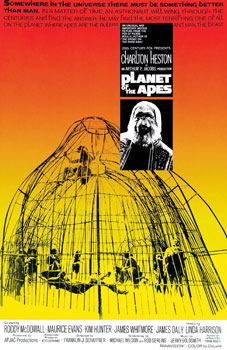
We are still in the transition of Hollywood in 1968, and this year we’re going into space. We are in the middle of the space race in that year; the American Apollo program is in full gear. For a while, I had set out “2001: A Space Odyssey” as my film for that year, but I had been warned that is a quiet and meditative movie and yesterday I just felt restless. So I went with this movie. It can’t be that bad if countless sequels and reboots (of which I sadly have seen none) have been made out of it, can it? Add to that the fact that I heard Charlton Heston is a jerk in the movie, even if he is the main protagonist “hero” figure. Heh, that should be interesting! I liked the self-righteous “Ben-Hur” quite a lot, but seeing him thrown off his pedestal a bit seemed intriguing.
We are still fully entrenched in the rebellious side of Hollywood. Much like the protests against the Vietnam war in real life, the themes in Hollywood kept on questioning authority and the way society has always functioned. And again, just like last year’s example of “Bonnie and Clyde“, you are along for the ride and not just critiquing from the sidelines. ome of it is funny – in one scene Taylor shaves off his beard, which had been growing for two years while in cryosleep. The older apes are disgusted, while Taylor explains that in his world it’s actually the young humans who are the ones growing beards. It’s the young nephew ape that then chimes in that he finds the smooth skin intriguing – of course, he had to go against the elders!
There are many other societal themes that get addressed in the movie: authority, religion, righteousness, society, rules, compassion, etc. Some of them resonate, some of them are exposed a bit clumsily.
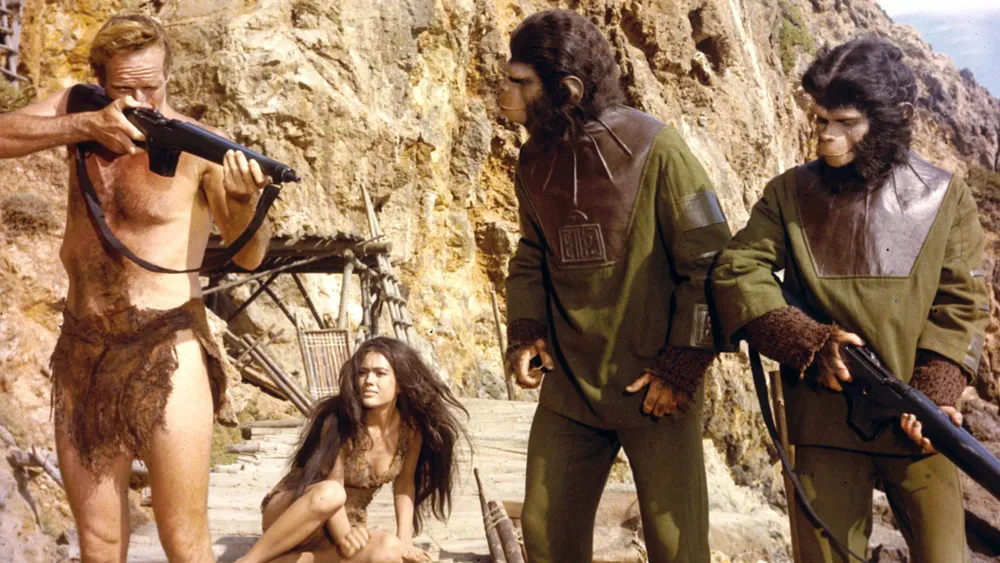
So, the execution is clumsy, the acting is wooden, and the costuming is ridiculous. Add to that the seeming contradiction in the depiction of women (which added to the prick personality of Taylor): for example, there is the female astronaut commander, respected by at least one of the crew members, but whom Taylor reduces to an Eve who is supposed to carry on the human species. On the planet itself, we have Dr. Zira, a renowned psychologist and veterinarian specializing in the study of humans – she then gets constantly denigrated by Dr. Zaius, the minister of science and chief defender of the faith, underlining the strict patriarchal society (they may be advanced, but they are still sexist apes). And don’t get me started on Linda Harrison’s Nova character, a mute human who is supposed to be the mating partner for Taylor. I can only shake my head at the “noble savage” story they’re going for there.
But then… the movie is thoroughly entertaining. Its message is overt, but subtle enough not to be preachy. I had a great time watching the movie, and it is not for nothing that it became a juggernaut of a franchise. Its sequel came out only 2 years later and it led the way in changing the way Hollywood operated. In the past, sequels were considered B-movies, so of lower quality and interest, with no expectation of critical acclaim (think of the Tarzan, Frankenstein, etc. franchises). This movie changed that dynamic and paved the way for other science fiction blockbuster franchises, such as Star Wars.
Add to that the ending of the movie, which by now has been overly spoiled in general culture (think of the vacuum lady in Spaceballs, for example), but then supposedly packed such a punch, that it left the audiences flabbergasted. Before, it was a slight adventurous sci-fi movie with power inversion themes, the ending felt devastating, an apt critique about the human greed, evil and destructive tendencies.

