1971 – McCabe and Mrs. Miller

1971 – McCabe and Mrs. Miller

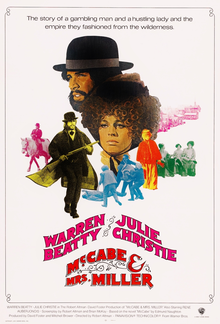
It’s an American Western, but it takes place in the mining mountains of Washington State rather than in the desert Southwest we’re used to. Directed by Robert Altman, it stars Warren Beatty as John McCabe, a gambler trying to make it big in a mining town by building a saloon, and Julie Christie as Constance Miller, a sex worker who goes into business with McCabe, managing both the brothel and the bathhouse. Their lives are upended when a big mining company wants to buy them out. I rented it on Apple TV for 3.99 Eur.
For my 23rd birthday, my boyfriend (now husband), my best friend, and I went to visit Gdańsk, staying in a hotel in the beach town of Sopot. I’m sure Gdańsk is beautiful and everything, but the weather wasn’t very good that long weekend in early November. It was a mixture of rain, hail, and snow, and the streets were pretty much empty.

After stomping through the city center for a bit, we ended up in a cozy café. I remember it was crowded, but we had amazing coffee and cake and ended up spending a few hours there. One reason is that the owners were playing Leonard Cohen on repeat – they must have gotten the newest album back then. It’s such a nice memory. I barely remember the architecture, but I do remember the café, how happy our dog was there, and how I told my friends about listening to Leonard Cohen as a kid. I

That’s exactly the feeling this movie evoked in me: the cold outside as a constant companion, while the people inside find happiness together. Nothing fancy, just a good stew that makes everybody happy, except the big corporate people who say it tastes rancid. And always in the background, there’s Leonard Cohen’s soundtrack. Especially Winter Lady gives one that melancholic, but loving feeling.

It’s a subversive Western: people run away from gunfights, the gambler hero actually loses at poker sometimes, and people say dumb stuff and talk over one another (an Altman signature) instead of delivering noble, perfectly thought-out lines. I ended up liking it much more than most Westerns.
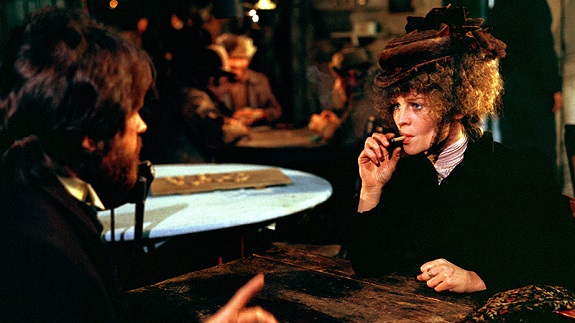
A lot of that comes down to its distinctive setting. The town is like an additional protagonist, and you feel proud watching it grow, both in buildings and population. And yet there’s that constantly oppressive, howling wind and the ever-present mud. The rest comes down to the flawed human beings Altman captures, whom you love nonetheless. At the end, the whole town comes together to save a burning church. As you look into the faces of the people you’ve gotten to know over the course of the movie, you can’t help but feel a great love for them. McCabe and Mrs. Miller finds warmth and community in a cold, unforgiving place and makes you care deeply about the imperfect people who create them.

This wasn’t my first Robert Altman movie, but it’s been a while, and it was nice to recognize his style immediately. It’s a testament to his anti-establishment themes that you immediately side with the blundering gambler and the cunning Mrs. Miller over the big-shot executives, even when the executives offer McCabe a pretty good deal. I think I’ll watch a few more of Altman’s films now!
1970 – The Conformist

1970 – The Comformist (Il conformista)

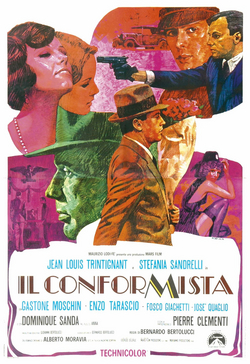
It’s a political drama written and directed by Bernardo Bertolucci (before Last Tango in Paris infamy and The Last Emperor‘s huge Oscar run). It’s an Italian, French, West-German co-production and is based on a based on the 1951 novel by Alberto Moravia. It stars Jean-Louis Trintignant as Marcello Clerici, a weak-willed closeted homosexual who seeks some sort of salvation from his perceived differences by embracing fascism. I saw it on YouTube here.

Vintage Italian film poster featuring a woman, armed men, a train, and a colorful collage of dramatic scenes.

Boy, picking a movie from 1970 was a chore. Often, there is a year where I have five or six movies I really want to see and it is difficult to pick just one, but this year? Not really. So, I went a bit by popularity and reviews, and this arthouse movie’s themes seemed interesting. It’s been a few days since the midterms in the USA, and the blue tsunami just overran MAGA-world. In addition, elections in Hungary, Serbia, and Brazil have been rejecting the narrative that the world is descending into fascism. Still, the question remains: why is it so alluring? Its siren song is looming over next year’s elections in France, and who knows how long our government in Germany will hold before new elections are sparked. So, looking over the life of somebody who willingly participates in that ideology seemed interesting to me.

Already in the first few minutes of the movie, he gets asked why he is joining Mussolini’s movement. Some join because of fear, most join because of money, and just a very few join because they truly buy into the ideology. But this guy remains a mystery to the Italian government. He comes from money; we see his mother languishing her days away in a lavish mansion. He definitely doesn’t believe in anything, neither the church nor the ideology. He’s not afraid—we later see what a coward he is, but he’s not afraid of the other side. No, for him, it’s the allure of being “normal.” He wishes to have a normal life, a normal wife, and a normal government job—no sticking out! We slowly find out all he is repressing: his homosexuality (or bisexuality?) for one, his obvious intellect (which we see when he’s debating his leftist professor), and his friendship with misfits, such as a group of blind people throwing him a bachelor party. Repress, repress, repress; he becomes a walking contradiction.

He is supposed to kill his former leftist professor, now based in Paris, but he enjoys his company—and especially the company of his wife, Anna—too much. He plays his part well, even fooling his handler for a while, but we see what a small, petty man he is inside. It’s here where the movie becomes hard to watch; he’s not a hero, he’s outright despicable. At the climax of the movie, there is such a heartbreaking scene where he simply turns away, leaving the viewer entirely disgusted and filled with contempt toward the weakling.

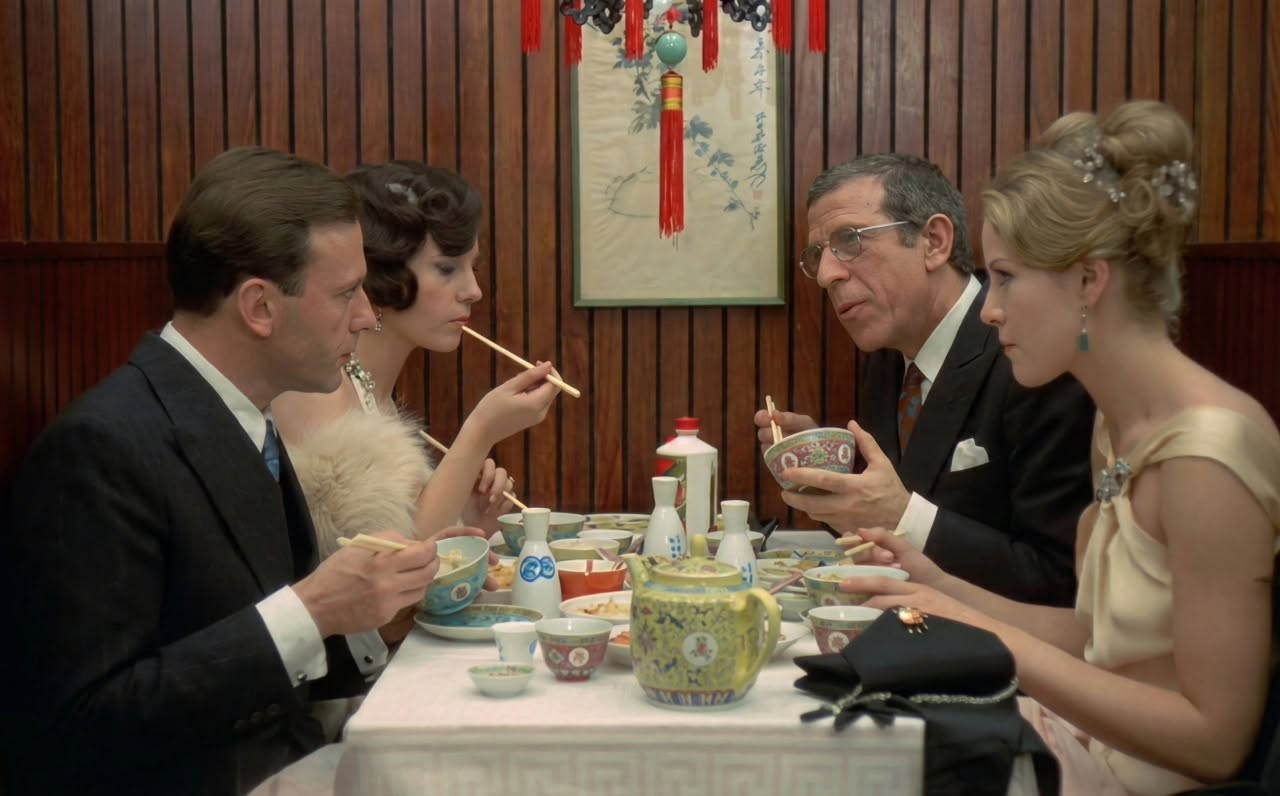
Four formally dressed people dine at a Chinese restaurant table with tea, bowls, and chopsticks.

The movie expertly evokes these emotions through its amazing and artful cinematography. We see strange diagonal camera angles when he is confused, soft red hues when he is aroused, or cold blue colors when he is distant towards women. The play with light is incredible. Already in the first scene with his fiancée, Giulia, the blinds are drawn such that the black-and-white shadows on the wall mimic her dress. We see it again when they discuss Plato’s shadow play with the professor, or in a particular scene in a very foggy forest, where the light tries to escape before shadowy figures start to darken it.

t does have the occasional arthouse trope, such as a non-linear timeline, which takes a while to get used to. There is also some unnatural posing that looks amazing but can occasionally take you out of the narrative. However, the meandering film comes together quite expertly at the end, and it really stayed with me for hours afterward. It wasn’t at all about the question of why he becomes a fascist. In the end, it reminded me somewhat of The Lives of Others, but in reverse. In that movie, the man serving the dictatorship becomes compassionate by observing the humanity in others. Here, they throw humanity at him in droves—so much so that you are drowned in it (in one scene, he literally spirals as hundreds of people dance happily around him)—and all he does is passively look away.