1957 – Paths of Glory

1957 – Paths of Glory

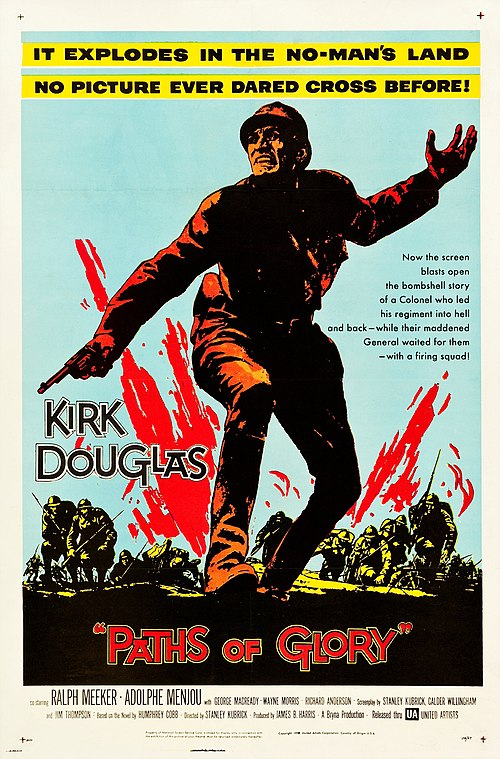
It’s an American anti-war film, directed by Stanley Kubrick when he was just 28 years old (wow). The screenplay he co-wrote with Calder Willingham and Jim Thompson is adapted from the 1935 novel of the same name, which in turn is based on the true Souain corporals affair that happened during WWI. The film mainly stars Kirk Douglas as Colonel Dax, the commanding officer of soldiers who refuse to continue to act out a suicide attack. I watched it on YouTube (free in Germany) here.
Is it even possible to make an anti-war film? That was the question media commentator Broey Deschanel asked herself in this video essay in a reaction to Alex Garland’s Warfare from last year. It’s supposed to be gritty, raw and show war exactly how it is, and in doing so critique its pointlessness. The essay goes on to cite many more examples, e.g. All Quiet on the Western Front or Platoon, but argues that war from the soldier’s point of view always comes with a caveat, with a point of view, there may be deceit on how these soldiers came to war, but never 100% innocence. Only movies like Grave of the Fireflies can truly be anti-war, since they depict the consequences of war on children.

Fair point, but this movie is pretty damning in its critique, especially for an almost 70-year-old movie. When I started watching it, with the typical trench warfare scenes we are accustomed to and which are marvelously depicted in 1917, for example, I thought it was going to be the typical “war is hell” type of story. I wondered why the prologue with the two generals was there in the beginning, it didn’t seem anti-war at all.

But then around a third of the movie in, it dawns on you that it’s not about the horrible trench fighting at all, but an indictment of the rulers at the top. They treat battles like pieces on a board, casualties are rattled off as percentages to be moved around – all before they go back to their civilized parties and gatherings. If some inconvenience is discovered it gets buried under legalese or the offended party gets bought off with a promotion. All the while the simple soldier is just fodder, where your fate is decided by the (un)luck of the draw quite literally.
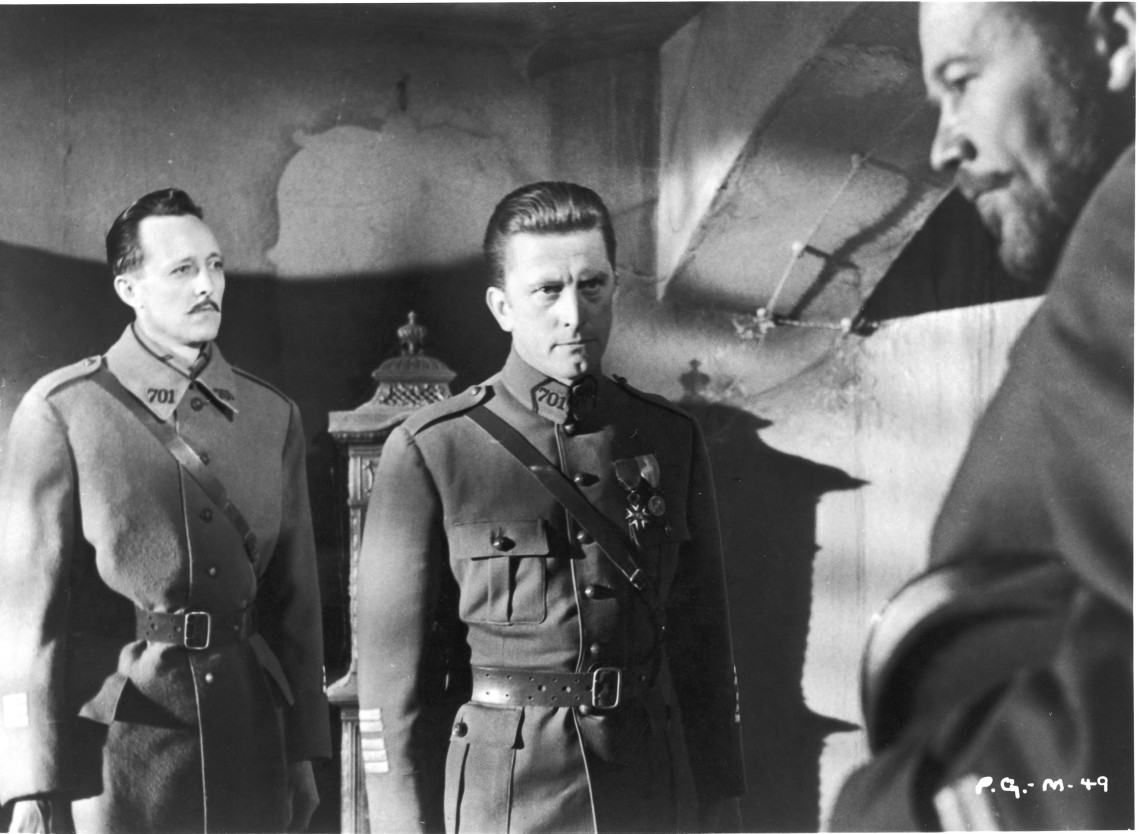
I liked this movie so much. So quiet in its portrayal of injustice, yet so adept at simply showing it. Add to that an amazing battle scene, where a part of a company is seen storming onto the barbed wire battlefield, most soldiers knowing it is a suicide mission, a mistake, with the chances of success slim at best. The desperation of the three soldiers, who are chosen for all the wrong reasons to take the fall for the blunder of the general is also shocking to see. That Kubrick guy has a bright future ahead of him, but even this, his first so-called masterpiece is really that!

Add to that the nagging discomfort that it is based on true events – a French general really did order his artillery to fire on his own trenches after demoralized soldiers refused to leave them and he ordered the execution of seemingly random soldiers of the company resulting in the death by firing squad of four of them (in the movie it’s three). Only 2 hours later would their sentences have been commuted and 19 years later they were fully exonerated. The whole ordeal changed the way military courts were held in France. And this movie was banned in Switzerland and France until the 70s. It shows you how even 40 years later, the establishment would rather get rid of uncomfortable situations than address the mistakes made by the senior commanders and upper class rulers.

So is it a truly 100% anti-war film as the thesis above proclaimed there aren’t any? No, it valorizes the soldier too much to be truly that, but it’s quite effective otherwise and in that I commend it!
1956 – The Searchers

1956 – The Searchers

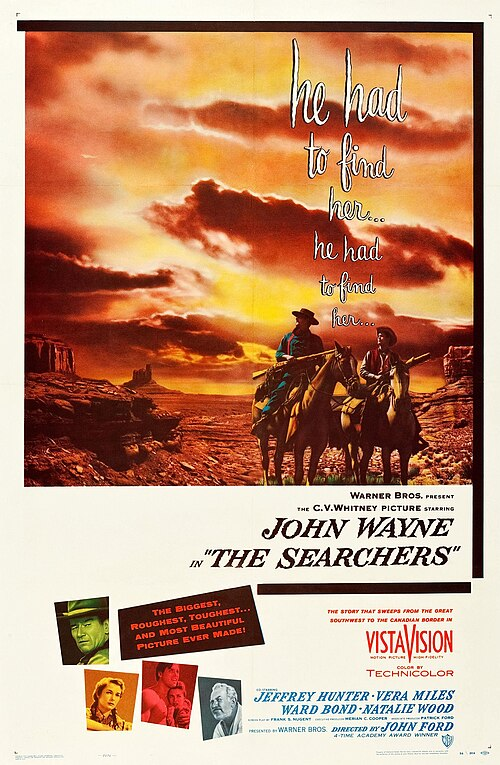
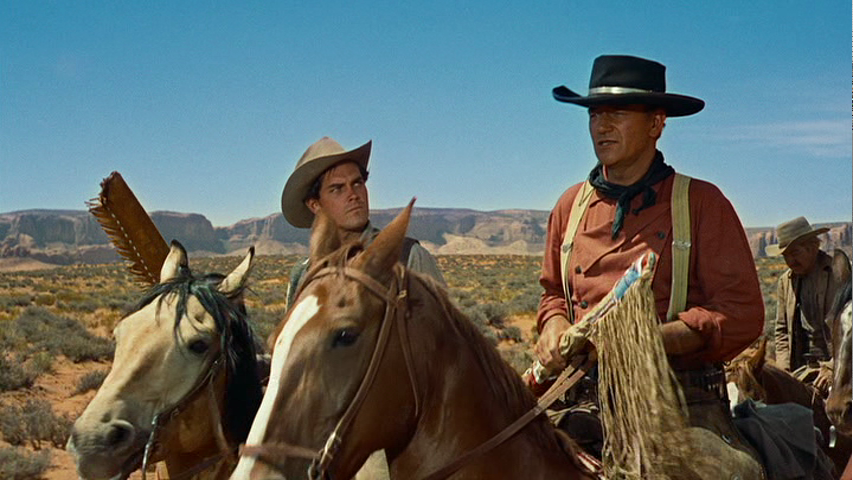
It’s an American epic Western directed by John Ford and written by Frank Nugent based on the 1954 novel by Alan Le May. It stars John Wayne as Ethan Edwards and Jeffrey Hunter as his adopted nephew Martin Pawley as they spend years searching for their abducted niece / sister. It was shot on VistaVision and processed by Technicolor making the landscape of Monument Valley really stand out for this movie. I rented it on Apple TV for 3.99 Eur.

Look, I have never been a fan of Westerns. It’s probably unfair to them, because I never gave them a chance, but already as a kid, I had no interest in playing “cowboys and indians”. By now, similar to Superhero / comic book movies, I have seen a few, but by far not many, especially none of the classics of Sergio Leone and/or Clint Eastwood. And often it is, because revered stuff, I just find boring: the stoic hero, spouting wisdoms like “that’s the way of life” or the hours of scenery on horseback. I recently came across this critique of Yellowstone by SkipIntro. Oh, my guy, I don’t even care about the conservative bend, I just found it boring, even though everybody was raving about it. The treatment of Beth was so problematic, it’s like that girl that says: “hey, I wasn’t groomed, I CHOSE to sleep this much older guy when I was 15”. I saw like 3-4 episodes and turned it off.

Anyway, perhaps I was wrong. Perhaps there is something I am missing in these Westerns. Perhaps, now that I am a bit older myself, I will understand “the old ways”, finally get what John Wayne was all about. I already missed Stagecoach (see my 1939 post on how I seem to have missed most iconic movies of that year), but perhaps this movie, that some say is the greatest Western of all time, will do?

So what are the themes here? A confederate soldier Ethan Edwards comes to his brother and big family in Texas. The going is tough and many have given up making a living out in the land there. There are some other families, like some Swedish immigrants (the Jorgensens), who are good friends with the Edwards family. They have also adopted an orphan, half white, half comanche named Martin Pawley. Already in this introduction, you are made to think that these families are more righteous, because they are out here living the hard life. Add to that the threat of the Indians, who are mad that the white man is taking their land away and murdering their people. And that is exactly what happens; while the men are out on a distraction, the Indians raid the Edwards farm, burn it, kill the parents and son and kidnap their two daughters. The elder is raped and killed quickly, but the younger Debbie is taken by the chief ‘Scar’.

So begins a 7 year search by Ethan and the adopted son Martin to find Debbie. By the time they finally find a 15-year old Debbie, she has assimilated and doesn’t want to go home at first. Here is where the other theme of the movie comes in – the deep-seated hatred of Ethan of the Indians. His racism is so big that he considers murdering his own niece, because she is tainted in his head. But it’s a constant struggle. For example, in the beginning he is barely capable of talking to “half-breed” Martin, but by the end he leaves him everything he owns in his will.

You are not supposed to root for the jerk that is Ethan. He is a wanderer and self-righteous asshole. First, he remains unapologetic Confederate, even wearing the coat 3 years after the war has ended (who goes to their family only 3 years after?). Also, even in the very beginning, you see there is something going on between him and his sister-in-law. And that is before he goes on his 7-year search. But Martin isn’t without blame either – he leaves the girl he is supposedly in love with and only writes her one letter in 5 years. In that sense, it makes it super hard to be on the side of the two: a bigoted prick and a sexist idiot. Apparently that is wanted by the director and it is what gets the conversation going.

And I get that, people are complicated and you can’t go through life with a 2020s lens and I can also do nuance. But the treatment the movie makes of Look (an Indian woman Martin betroths by mistake) is not one bit funny, but super tragic. In that sense, it seems that Ford went out of his way to explain the racism and circumstances of violence between the Whites and the Indians, that he conveniently forgot about the whole sexism thing, which doesn’t get a nuanced take.

Unfortunately that means that I am still not enamoured with Westerns. Very entertaining watch, but not easy and it left me mostly angry (maybe if movies are supposed to elicit emotions out of you, perhaps it was successful). The scenery is great, especially for 1956, the cinematography and action scenes are amazing. But I have to mention my favorite movie of all time Thelma and Louise again and how they drive through Monument Valley, which is most of the scenery here. I’d rather have the modern setting, than the brooding cowboy.