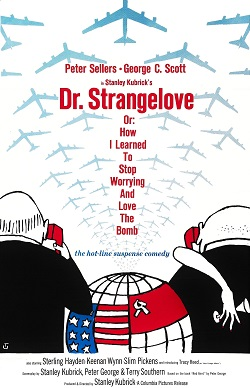
1964 – Dr. Strangelove or: How I Learned to Stop Worrying and Love the Bomb
It’s a political black comedy satire co-written, produced and directed by Stanley Kubrick. It is loosely based on the novel Red Alert by Peter George. It stars mainly Peter Sellers in three roles: Group Capt. Lionel Mandrake, President Merkin Muffley and the titular Dr. Strangelove. Its story deals with trying to contain the damage by an US general going rogue and ordering a preemtive nuclear attack on the Soviets without knowing that this will set off a doomsday device killing all life on Earth. I rented it on Apple TV for 3.99 Eur.
During my PhD studies, I completed them mostly in the Lawrence Livermore National Lab. While our little unsecured corner of the lab dealing with astronomy had little to do with atomic bombs, it was nevertheless a daily surreal experience. Together with my bright red foreigner badge, I had to carry around a little Geiger counter to make sure I wasn’t contaminated by nuclear waste. Similarly, we were constantly monitored on our online activity, our cars were randomly searched, we had to carry out bi-annual security trainings and right until I left in 2008, it was forbidden to have a phone with a camera on site. The site was also weirder than our sister Lawrence Berkeley National Lab, since our founding director was mainly the “crazy” and ostracized Edward Teller (the father of the hydrogen bomb) rather than the more nuanced Ernest Lawrence, even though both laboratories are named after the latter.
Everybody in the lab knew that Dr. Strangelove was a mixture of Wernher von Braun, but especially Edward Teller. His extreme stance in support of ever bigger and more powerful nuclear weapons and later of Star Wars was legend around the lab. When I was applying to work at the lab and was being background checked, one of his last speeches basically boiled down to: “Let’s bomb the islamists out of existence after September 11th!”. The town of Livermore embodied this strange discord – cowboys, nerds, military and hippies all living next to each other. By the time I finally began working at the lab (right around Teller’s death, hehe), I justified my joining with the fact that actual nuclear testing was banned (only simulations) and that the National Ignition Facility run by the lab could one day solve the energy crisis. Still, the movie and its message were always present at the lab, its satirical message serving as a reminder that maybe we were the baddies. I had to chuckle when my summer student named her research summary: “Quasar searches or: how I learned to stop worrying and love the Bob!” (Bob was my advisor’s name).
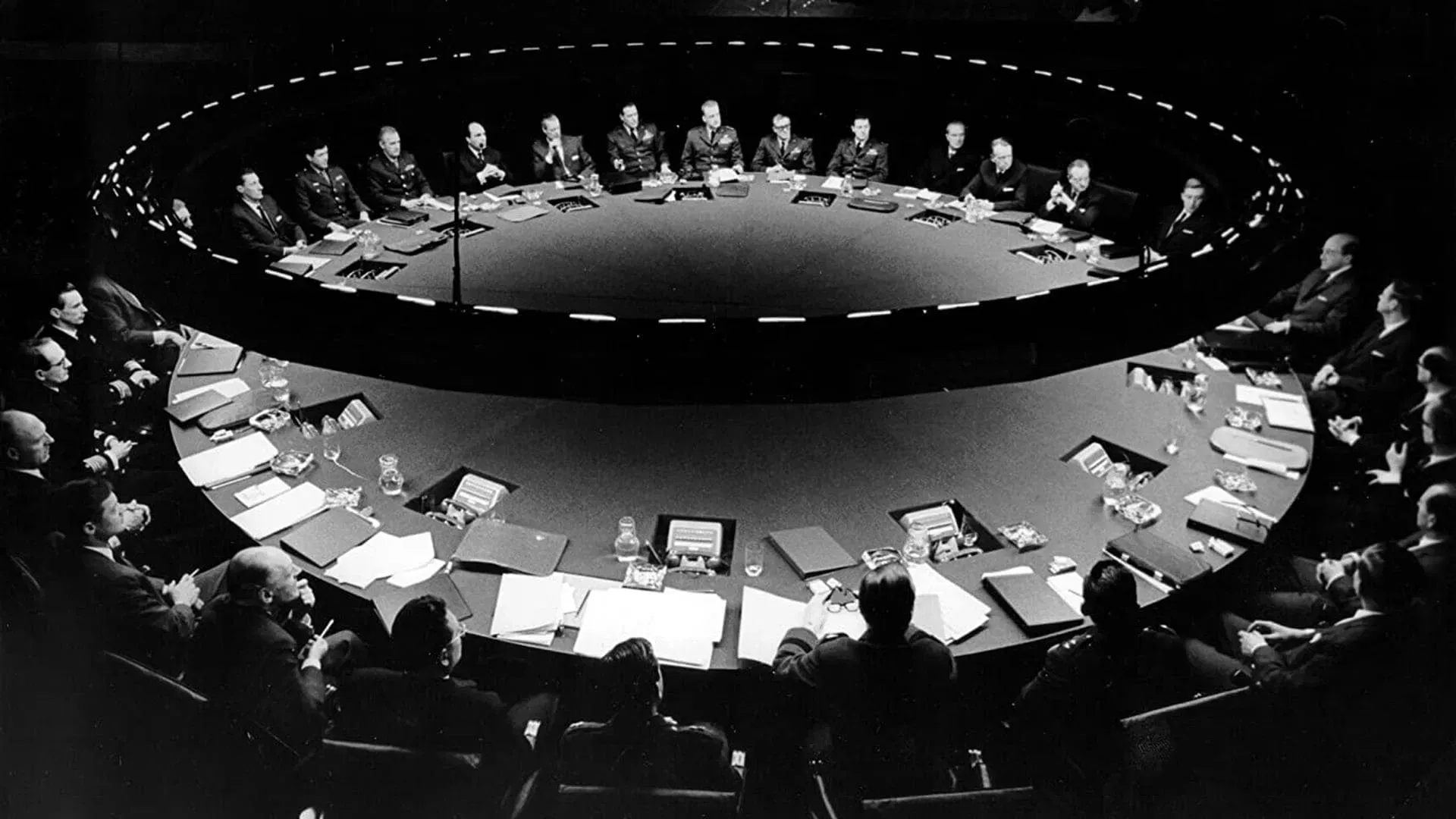
It is then ironic when I tell you that I had not seen the movie before. I knew so many of the jokes (“no fighting in the war room!”), so many of the images and yet I had never seen the whole thing. So now I finally sat down and watched the whole thing, rather quickly since it’s only 95 minutes long. Already the opening credits, which I didn’t know had me laughing, since the fuelling of a plane mid-air was presented so phallically.
So, what can I say? Brilliant! The phone calls between the American president Muffley and his Russian counterpart, Dimitri are the sweetest and funniest: “I’m sorry too, Dimitri. I’m very sorry. All right, you’re sorrier than I am! But I am sorry as well. I am as sorry as you are Dimitri, don’t say that you’re more sorry than I am because I’m capable of being just as sorry as you are! So we’re both sorry, alright?”. The motivation of the general (Jack Ripper, haha) to start the attack because he’s convinced that the Russians are contaminating the water via fluoridation sounds very similar to arguments you hear today against vaccinations, so the movie is as prescient as ever – we often have some truly crazy people at the top. And yet, I can’t give it full marks, but only because I knew so much of it. It’s as if you listen to a story about the Holocaust; the first time you learn of it, it’s shocking. But by the 7th Holocaust Oscar Bait movie, you might roll your eyes just a tiny bit. So nothing against this satire, I have heard all and even better jokes criticizing the nuclear arms race at the lab already.