1970 – The Comformist (Il conformista)
It’s a political drama written and directed by Bernardo Bertolucci (before Last Tango in Paris infamy and The Last Emperor‘s huge Oscar run). It’s an Italian, French, West-German co-production and is based on a based on the 1951 novel by Alberto Moravia. It stars Jean-Louis Trintignant as Marcello Clerici, a weak-willed closeted homosexual who seeks some sort of salvation from his perceived differences by embracing fascism. I saw it on YouTube here.
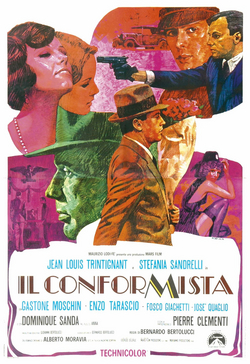
Boy, picking a movie from 1970 was a chore. Often, there is a year where I have five or six movies I really want to see and it is difficult to pick just one, but this year? Not really. So, I went a bit by popularity and reviews, and this arthouse movie’s themes seemed interesting. It’s been a few days since the midterms in the USA, and the blue tsunami just overran MAGA-world. In addition, elections in Hungary, Serbia, and Brazil have been rejecting the narrative that the world is descending into fascism. Still, the question remains: why is it so alluring? Its siren song is looming over next year’s elections in France, and who knows how long our government in Germany will hold before new elections are sparked. So, looking over the life of somebody who willingly participates in that ideology seemed interesting to me.
Already in the first few minutes of the movie, he gets asked why he is joining Mussolini’s movement. Some join because of fear, most join because of money, and just a very few join because they truly buy into the ideology. But this guy remains a mystery to the Italian government. He comes from money; we see his mother languishing her days away in a lavish mansion. He definitely doesn’t believe in anything, neither the church nor the ideology. He’s not afraid—we later see what a coward he is, but he’s not afraid of the other side. No, for him, it’s the allure of being “normal.” He wishes to have a normal life, a normal wife, and a normal government job—no sticking out! We slowly find out all he is repressing: his homosexuality (or bisexuality?) for one, his obvious intellect (which we see when he’s debating his leftist professor), and his friendship with misfits, such as a group of blind people throwing him a bachelor party. Repress, repress, repress; he becomes a walking contradiction.
He is supposed to kill his former leftist professor, now based in Paris, but he enjoys his company—and especially the company of his wife, Anna—too much. He plays his part well, even fooling his handler for a while, but we see what a small, petty man he is inside. It’s here where the movie becomes hard to watch; he’s not a hero, he’s outright despicable. At the climax of the movie, there is such a heartbreaking scene where he simply turns away, leaving the viewer entirely disgusted and filled with contempt toward the weakling.
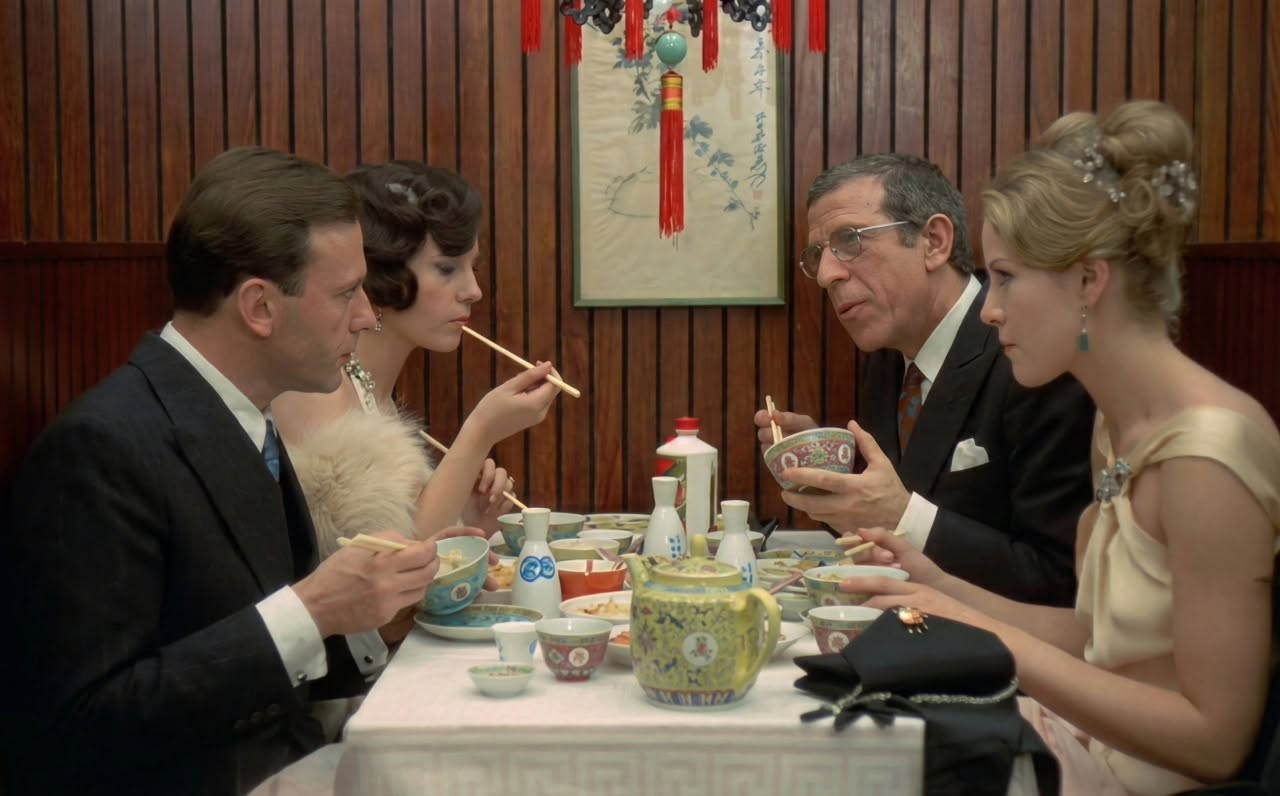
The movie expertly evokes these emotions through its amazing and artful cinematography. We see strange diagonal camera angles when he is confused, soft red hues when he is aroused, or cold blue colors when he is distant towards women. The play with light is incredible. Already in the first scene with his fiancée, Giulia, the blinds are drawn such that the black-and-white shadows on the wall mimic her dress. We see it again when they discuss Plato’s shadow play with the professor, or in a particular scene in a very foggy forest, where the light tries to escape before shadowy figures start to darken it.
t does have the occasional arthouse trope, such as a non-linear timeline, which takes a while to get used to. There is also some unnatural posing that looks amazing but can occasionally take you out of the narrative. However, the meandering film comes together quite expertly at the end, and it really stayed with me for hours afterward. It wasn’t at all about the question of why he becomes a fascist. In the end, it reminded me somewhat of The Lives of Others, but in reverse. In that movie, the man serving the dictatorship becomes compassionate by observing the humanity in others. Here, they throw humanity at him in droves—so much so that you are drowned in it (in one scene, he literally spirals as hundreds of people dance happily around him)—and all he does is passively look away.

