1938 – The Adventures of Robin Hood

1938 – The Adventures of Robin Hood

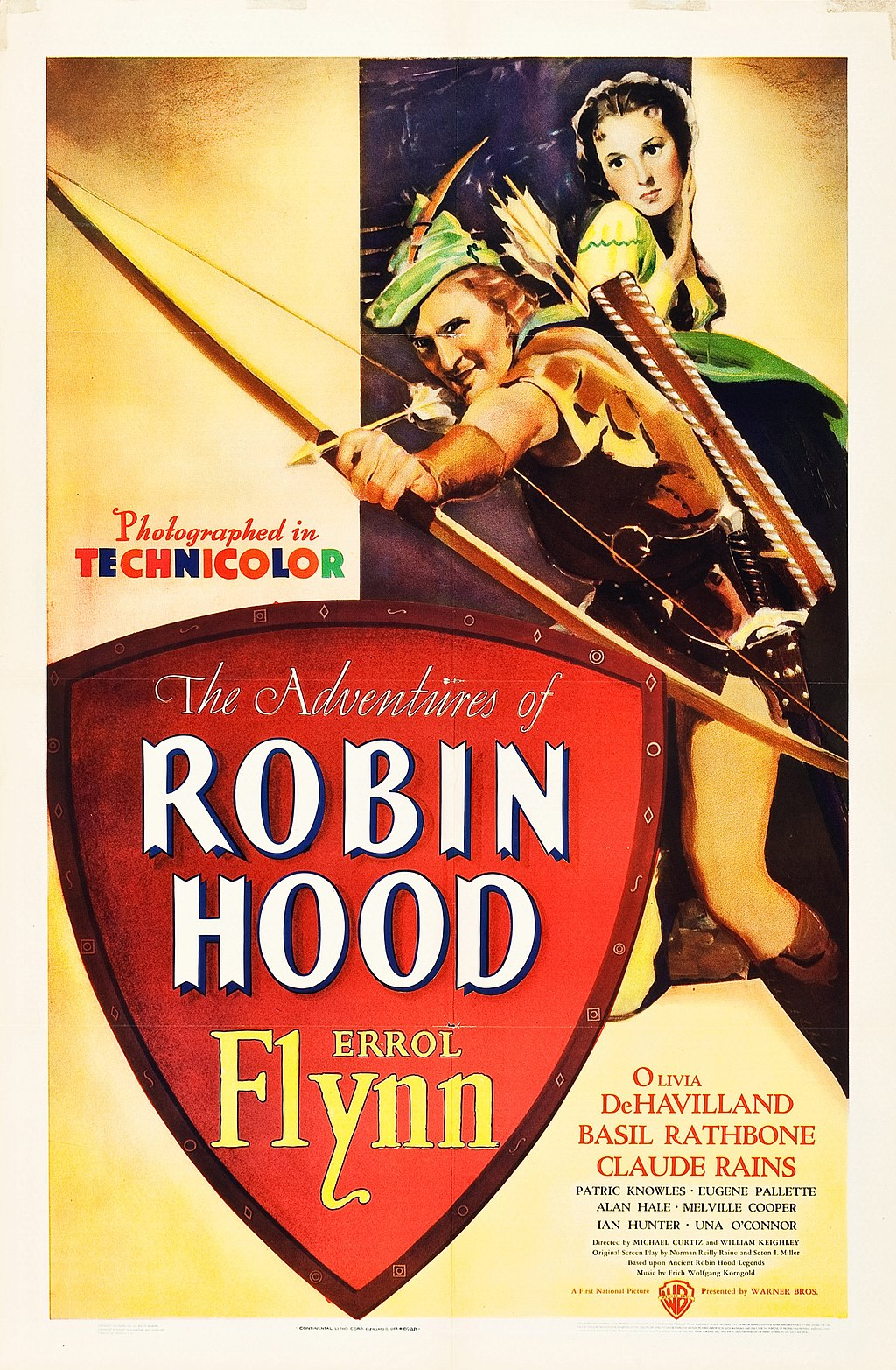
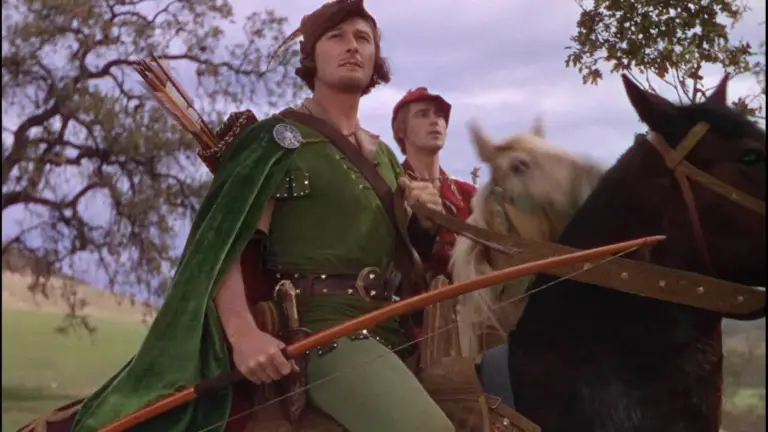
An American swashbuckling epic directed by Michael Curtiz and Willian Keighley. It stars Errol Flynn in the titular Robin Hood role and Olivia de Havilland as Maid Marian. It’s the first Technicolor picture on my movie list. This, plus the extensive settings, fight scenes, costumes, etc. made for a budget well over $2 million; it was Warner Brother’s most expensive picture made at that time, but made it back comfortably as one of the highest grossing movies of that year. I rented it at Apple+ for $3.99 Eur.

Adventure movies are quite difficult to describe, discuss and rate; especially the old ones. For one, it’s the exact reason you go to the movies for: have a good time, watch the good guys win, with a little excitement, some fighting, some escaping dangerous situations. For me growing up, it was the Indiana Jones movies, with The Last Crusade being my favorite one. But come on, when you think about it, some of it is a bit dumb (like the X in the library – haha), it is only the genius that is Steven Spielberg that lets you turn off your brain, enjoy the movie and even get your heart rate going. Today’s adventure movies are Comic Book movies, something I never got into, but there were probably a lot of people that didn’t get the 80s adventure craze either.

Another adventure movie that was quite big when I was growing up was Kevin Costner’s Robin Hood: Prince of Thieves. Nowadays, it’s widely panned, perhaps even being the worst ones of the bunch, but then little 12 year old me was smitten by everything the Hollywood machinery conjured: the cheesy soundtrack (fun trivia fact, the original 1991 music video seems to have disappeared), the constant bombardment of merchandising (I distinctly remember how I prized my Christian Slater – Will Scarlet sticker), the perfect villain (long before Snape, Alan Rickman was an amazing Sheriff of Nottingham). But yes, I see now how flawed that movie was, even though I loved it as a tween.

And so with a 1938 hat on, the Adventures of Robin Hood has got to be amazing. Well choreographed stunts and battles, a heartthrob leading man with his real-life “on again off again” partner, an epic incorporation of the score, a story that captured the spirit of the times and a studio that was willing to put a lot of money behind this adventure. That one single man could get away from so many enemies and do it with a smile on his face was totally new. And the final boss battle with Sir Guy of Gisbourne packed some real stakes and even worry that Robin wasn’t going to be able to overcome him. It’s a perfect encapsulation of what made the ballads of the medieval times great, the legend being larger than what probably happened.

But when you look at it from a 2025 lens on, then the movie suffers. it starts at the ridiculous costumes, so aptly made fun of in Robin Hood: Men in Tights – I now understand even more references of that parody movie, heh! It goes on with clunky dialogue and fights (yes, great for 1938, but it looks wooden and so staged for 2025). Even the scenery trying to get every drop of color to showcase the marvel that was Technicolor back in 1938, just underscores the fakeness of it all. It’s probably good for the Disney version (super underrated, highly recommend to watch it with your kids!), but not for the real life one. And don’t get me started on that ridiculous laugh and hairdo that Robin Hood sports, I laughed at it myself.

In short – adventure movies are amazing – but see them in the period that were made. Spend some amazing hours forgetting the world around you. Revisit them for nostalgia, if you are revisiting your childhood. But don’t expect them to hold up to modern scrutiny. It’s nice that I saw this as a piece of lore in Hollywood, but there are way better adventure movies nowadays.

1936 – Modern Times

1936 – Modern Times

Part silent, part talkie movie written, directed and starred in by Charlie Chaplin in his last performance as The Tramp. It also starts Paulette Goddard as Gamin, his potential love interest. I saw it for free on YouTube. It is a largely a scathing critique of modern technology in the name of capitalism during the Great Depression, apparently spurred by a conversation he had with Mahatma Ghandi.

Critique of capitalism is “in” these last few years in film – from The Menu, Triangle of Sadness, Glass Onion, Saltburn to the masterpiece that is Parasite, even the recent Mickey 17. And yet, none of these “eat the rich” dramedies did it with so much heart and and had me laughing in stitches like this Charlie Chaplin movie. The Tramp’s character tries and tries to catch a break to start to make a living in a house with his love Gamin among the height of the Great Depression in America. From demeaning work in a factory, literally being reduced to a cog in a machine that needs to function ever faster, to a security guard in a fancy department department store needing to keep his old friends and colleagues out of simply getting a meal. It does says a lot about society, when the main character is happier in prison than out in the workforce.

The Great Depression was no laughing matter. I already alluded to the poverty being ever present in American movies of that time in “It happened one night” and here the desperation is everywhere. Workers showing up in masses when there is a hint of work at a new or re-opened factory, people resorting to stealing food in their desperation, even some clinging to communists ideals and starting marches, strikes and other rebellions to fight back at the capitalists. Within that, the ever optimist figure of The Tramp works perfectly.

It is in this movie that the song Smile, later popularized by Nat King Cole or even bastardized in Joker (Todd Phillips would probably say it was a homage, but I hated that movie) first appears and it is to give us optimism that it will work out somehow – the true essence of The Tramp. Even though he always finds himself in desperate situations, he approaches them with an optimism that somehow it will get better for him. It is this optimism that I always admire in Americans, somehow ingrained in their culture and it shows this culture trait plenty in this movie. And yes, I did turn off the TV at the end of the movie with a smile on my face – it would somehow, someday resolve well for The Tramp, he would be ok!

I do have one point that sat badly with me throughout the whole movie and that is Gamin’s relationship with The Tramp. How old is she supposed to be, anyways? At one point, she runs away from family services that supposedly were shipping her off to an orphanage and in the next few scenes The Tramp services himself as her literal sugar daddy (giving her cake and sweets and later a fancy coat). It’s all played quite fanciful and the music always swells to make you feel ok, but it still gave me the creeps that this young girl attached her future to a much older vagrant, just because he gave her some food and money once. There is an alternative ending in which Gamin takes on vows and The Tramp leaves alone, but Chaplin changed his mind after wanting to make his real life lover and third wife Paulette Goddard famous and give the real her hope that she could succeed.

Ah, well, nonetheless, I do recommend this movie, finally a Charlie Chaplin one in these 100 Movies, the comedy is really strong here and the social critique is also well done. It even has a coherent plot from start to finish, even though you can always show the individual vignettes separately and have a good time (and I even see them some of the now on TikTok).

1932 – Scarface

1932 – Scarface (The Shame of a Nation)

It is a 1932 pre Hays code movie directed by Howard Hawks and co-produced by Howard Hughes. Its screenplay by Ben Hecht is loosely based on the novel of the same name by Armitage Trail (a pseudonym) and by the real life Al Capone and re-imagines some real events. It stars Paul Muni as Antonio “Tony” Camonte and some supporting cast includes George Raft and Boris Karloff. I rented it for 3,99 Eur on Apple TV.

I’ve been watching with horror on how in the last few weeks the office of president Trump has wilfully ignored court orders left and right and has deported or is in the process of deporting people that did not deserve to be deported (from expressing their opinion, to mistakes, to inconveniences, and so on…); not for nothing it’s being called a constitutional crisis. The office of the president, most notable led by Stephen Miller is employing draconian measures and cramming out weird laws to justify their actions. One is reminded of the Japanese internment camps during WWII in which American citizens of Japanese heritage were simply stripped of their rights via presidential Executive Order and Roosevelt was widely celebrated for it. Surely that could not happen today? Of course it can, our timeline is nothing special. People are easily persuaded to strip people of their rights in the name of security!

I did not expect to encounter those conundrums in this movie. It was supposed to be a gangster movie. I like those, escape into a world you know nothing about, where the ruthless rules of organized crime are as suspenseful as any relationship drama (“who’s going to betray who? is the oath of loyalty sworn going to hold?”). And hey, the gangster movie has a long tradition in America, so I wanted to know how it got its start.

With some jarring effect, Scarface doesn’t simply start after the opening credits; there are some title cards quite moralistically preaching the following: “This picture is an indictment of gang rule in America and of the callous indifference of the government to this constantly increasing menace to our safety and liberty. Every incident in this picture is a reproduction of an actual occurrence, and the purpose of this picture is to demand of the government: ‘What are you going to do about it?’. The government is your government. What are YOU going to do about it?”. At first I thought that they had to do this for a pre-Hays code film, sort of preemtive message saying “no, don’t glorify this guy!”. And sure, the movie is quite alluring showing all the riches Toni has at the height of his power, but I never saw it as glorifications, especially because you know he’s going to fall at some point. It still was banned in many states and cities.

But in the middle of the movie, it repeats that message and much clearer and much scarier. The newspaper editor and a politician argue that ordinary citizens are powerless against these gangsters unless the government does something. They keep on arguing that most of these thugs aren’t even citizens and that all of them should be rounded up and fast-tracked deported! And who if not us, the proper citizens to ask for laws to be changed in the name of security and liberty. Chilling how this could’ve been said in 2025!

As for the rest of the movie… I felt it was quite entertaining, it’s a crisp 93 minutes and a fun watch, often unintentionally funny. The car chases were cool and the movie’s depiction of the St. Valentine’s Day Massacre was quite ingenious play with shadows. But then… it was only that – entertaining. The acting is quite stiff in some places, the flow of one scene to the next somewhat abrupt.

It is probably a product of its time, Toni must have been much cooler in 1932, perhaps like Michael Corleone in 1972 or Jordan Belfort in 2013 – we all know those men are deeply flawed and criminal, but for a second you ask yourself, what would it be like to live in those shoes for a few days? Interestingly, I found the tragic character of Rinaldo, the quiet, loyal, but deadly associate much more alluring than the loudmouth Toni. So the end did not grip me as much, I was not invested in Toni’s faith, how they finally got him, how he went out, misled by a blinking advertisement that kept telling him “the world was his”! Ah well, predictable, even pre-code!

1931 – M

1931 – M (Eine Stadt sucht einen Mörder)

A german Nero Film Production written and directed by Fritz Lang. Also here, Lang’s wife Thea von Harbou had a hand in co-writing this production. It stars Peter Lorre in the title role as the murderer. I saw it on Amazon Prime, where it is available for Prime members, but you can also watch it for free on YouTube.

Are there crimes so heinous, that even “normal” criminals are disgusted by them? That a series of them can paralyze an entire city of 4.5 million people? Yes, after 8 disgusting murders on little girls (it is only hinted what the murderer did to them), the whole city of Berlin is on edge. People are accusing random men on the street of being pedophiles for talking to children and parents don’t let their kids out of their sight, escorting them everywhere. And for good reason, the first scenes where we accompany the anguish of little Elsie’s mother waiting for her, hoping, asking and in the end just screaming her name, set me off as a viewing mother.

The whole city becomes so paranoid, that the police presence gets ramped up, raids on petty criminal hotspots have everybody agitated, cops are working overtime shifts to catch the killer. This increased police ubiquity in turn spooks the organized crime element in Berlin, that can’t handle such increased police presence on a day to day business. In a nice juxtaposition you see the heads of the organized crime and the chiefs of police debating on how to catch the killer, each with their own methods. This juxtaposition continues then, on one side with the grunt of detective work, the tediousness of hundreds of clues, interviews, etc. compared to the underground network of beggars and vagrants coordinating informal information networks.

And then there is the killer, clearly hunted by demonic inner drive. In one scene he tries to drown that drive in alcohol, yet it comes up again and again in the haunted, distorted whistled melody of Grieg’s In the Hall of the Mountain King. At one point in the movie in an amazing monologue, he screams in agony: “I don’t want to, I HAVE to”.

Much can be said about the movie, the modern montages (really, I thought the procedural element has been unsung in the reviews that I have read so far), the genius use of sound for this very early sound movie, the introduction of noir elements (low angles, play on shadows, etc.) that influenced so many later films. And then the dilemma that is presented to the viewer almost breaking the fourth wall: “Showing pity and understanding to a clearly deranged person, is that a commensurate judgement for the most despicable crimes on children?” But one thing that touched me, that is probably very personal and many cinephiles watching this movie won’t catch is the Berlin element of it all.

It starts with the accents. Everybody, but the murderer speaks “berlinish”, sometimes even exaggerated, but it immediately made me feel at home. Yes that is us, sometimes a bit petty criminal, yes we have the “Berliner Schnauze” (a plump, even unfriendly way of speaking), but deep down, Berliners stick together. I love that Fritz Lang, an Austrian, understood that dynamic. Erich Kästner (a Berliner) had just in 1929 released his children’s book “Emil and the Detectives” and at so many points in the movie, I thought of that book and the atmosphere of late 20s, early 30s Berlin and their people: seedy, anything goes, poor, but also clever, fair and funny. It also reminded me of the song “Das ist Berlin” my husband worked on during his time at Funke. “When you spice yourself up, even though you’re ugly. When Stefan becomes Steffi. That is Berlin”. That spirit is still in the city: we will be very open to any of your ideas, you live you life man, you may see us as a bit lazy, a bit dumb, a bit unfriendly, a bit ugly, but when it really matters, we will band together, you can’t break this city’s spirit. And at the same time… we know; there is that haunting spectre hovering over the city in 1931… what is to come!

Ok, so I am a week late, but so happy this is the movie I got to see for this year, it had been on my list for far too long. I will probably post 2 weeks from now, fortunately I had set myself some cheat weeks.

1930 – Murder!

1930 – Murder!

A British mystery movie, directed by a young Alfred Hitchcock. It was written by him and his wife Alma Reville and Walter Mycroft. It stats Herbert Marshall as Sir John Menier, Norah Baring as Diana Baring and Edward Chapman as Ted Markham. It’s based on the 1928 novel Enter Sir John by Clemence Dane and Helen de Guerry Simpson. A watched it with ads for free on Plex.

Finding a movie for 1930 turned out to be difficult. I had already seen All Quiet on the Western Front and The Blue Angel, so those easy pickings were gone. I tried very hard to find Morocco, but couldn’t lest I shelled out 16 Euros for a DVD (nah!). I had no desire for yet another F.W. Murnau movie in City Girl about living on the farm in Minnesota. Sigh…

And then I saw the BKR video about Alfred Hitchcock’s Hair Obsession, which I really liked. But what I liked most, is the accompanying podcast No Noise podcast which was about Alma Reville, Hitchcock’s wife and a tremendous influence on him and especially his early movies when he was still in Britain. Highly recommend it, and this one is free for everybody, though supporting Izzy is always a good idea! In the podcast Dr. Josephine Botting, Curator at the BFI National Archive goes into the history how Alma started as a cutter (editor basically), meeting Hitchcock and then sort of becoming the person that would tidy up his films, mostly through writing. This went on for a long time right up until and including Rebecca, after which she focussed mostly on the children. So I got curious, how do British Hitchcock movies look like, how did this woman influence the weird genius that this man would become? So many successes and fortunes of men in the 20th century were heavily carried and influenced by their wives (often willingly in the shadows), I wanted to honor that.

The plot of “Murder!” is about an theater actress Diana Baring being accused of the murder of a fellow actress with a poker. In the jury there is Sir John (who happens to have hired Diana into his theater company – uh, conflict of interest?), who has doubts about Diana’s guilt, but is persuaded by the rest of the jury to convict. Later, haunted by his conscience, he goes on to investigate whether Diana was really guilty – playing detective with help of his stage manager Ted Markham.

This is my first talkie movie and ooooh boy, it is bad in that sense. It was supposedly first filmed as a silent film and later half talked over, half filmed again. And then there are scenes where nothing of this sort is done – it’s just… silent, no ambient sound, nothing. Similarly, the cuts are jarring, the film quality is horrendous at times. And don’t get me started on the editing, a 2 second close up on a clock, then 2 seconds on some meal, then the scene starts. One notices how filmmakers still had to learn to not use the cue cards to narrate a story. Sometimes it’s that janky shots quickly one to the other, sometimes a huge exposition dump. Add in to that the unevenness of the sound editing; there’s a radio programme at full blast when Sir John is talking to his butler about his motives for investigating this murder, or a baby screaming at full volume when he immerses himself into the lives of the actors.

But worst of all, is that it drags. Pity, because there are some real hidden gems in there, like the shadow play or a trapezium scene that is at the core of suspense. Or even some forced things, which are typical Hitchcock style over story, but which work so well — like the improbable, but very funny interrogation scene during a theater play. It could’ve been so great, had it had a competent editor. And so this week I was left disappointed, both that greats do really need to grow into greatness sometimes, but also that even if there was any of Alma’s influence in this movie, it sadly probably wasn’t very good. Still, I am glad I saw this movie, yet another style from the Russian, German, American and French that I have reviewed so far and one that I recognize in British films even many years later.