1935 – The 39 steps

1935 – The 39 steps

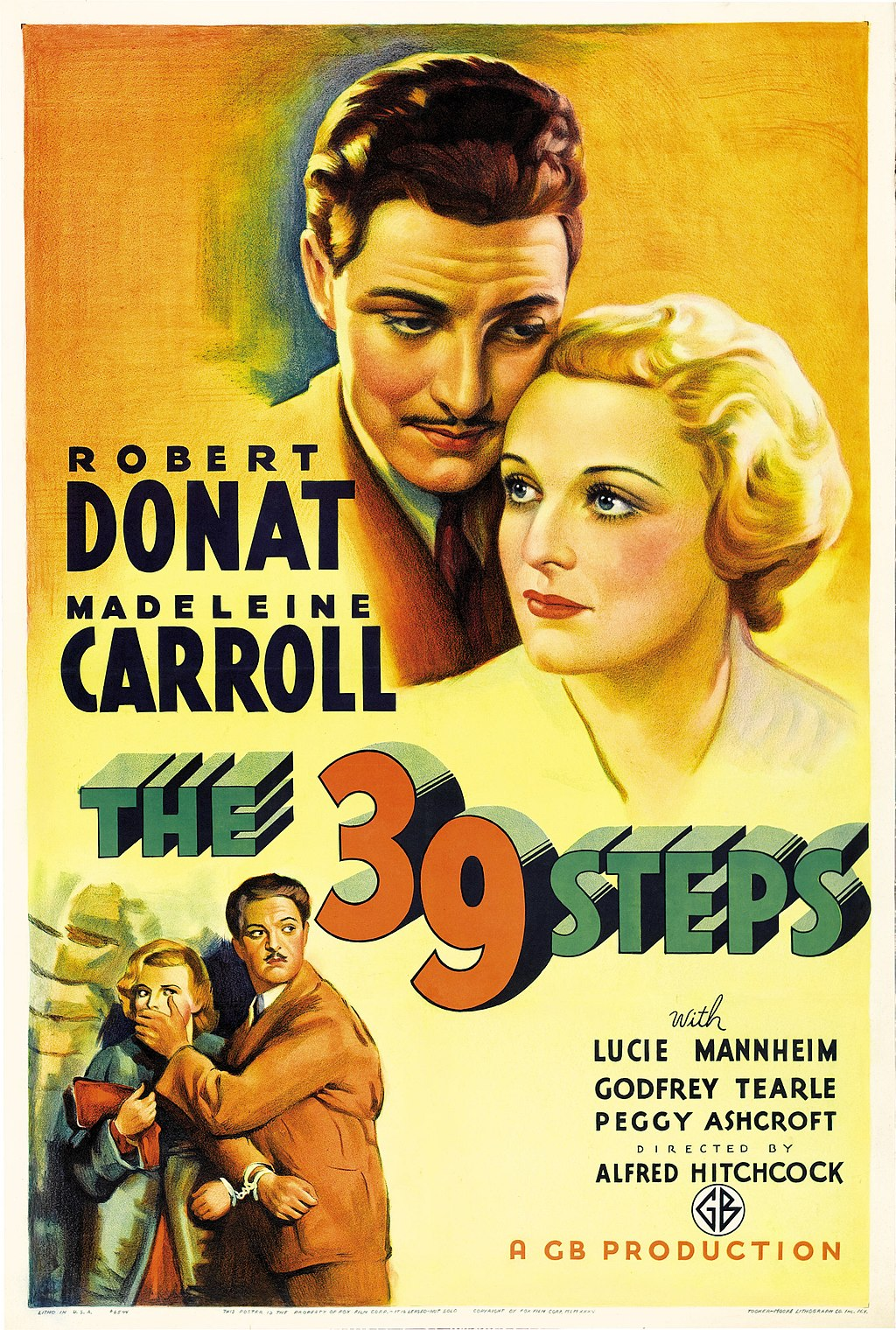
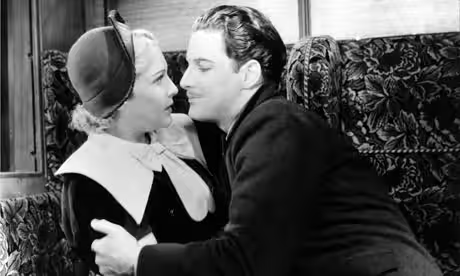
It is a British thriller spy film directed by Alfred Hitchcock. It stars Robert Donat as Richard Hannay and Madeleine Carroll as Pamela, the antagonist he ends up being handcuffed to in the middle of the movie. It is loosely based on the novel The Thirty-Nine Steps by John Buchan. I saw it on Amazon Prime where it is free to watch in the US. It was probably a lazy choice, because I had both seen an Alfred Hitchcock movie (1930) and a “enemies to lovers” (1934) movies in this blog before.

I love “premise movies”, these sort of movies in which the premise can be explained in a sentence or in an elevator pitch, but you still want to see the theme play out. This one is pretty well known. Just like last movie, in which sort of antagonists have to work together, here the main character ends up being handcuffed to the woman trying to turn him in for a murder he didn’t commit. Surrounding that is a pretty intriguing spy plot in Scotland with apparently some famous scenery along the way.

This handcuffing has been repeated many times along the way, most of the movies I only remember vaguely from The Defiant Ones (social commentary) to Midnight Run (much funnier). Even my favorite series as a teenager, My So-Called Life had a “Handcuff” Episode. But as far as I know, this is the prototype, so I wanted to check it out.

I was not disappointed, it was pretty great and the ways Hannay has to escape throughout the film is quite ingenious. I was thoroughly entertained and the movie even had some laugh out loud moments, for example when the woman owner of an inn winks at them when they “confess” that they’re runaway lovers. Even unwanted hilariousness, like the way people die in these movies, had me laughing.

One thing to prepare for, however, is that the movie moves at a breakneck speed. There are also some scenes or sequences, which defy credibility – just go with it and let yourself be entertained. Unfortunately that will also be probably be the reason why I won’t remember this movie much in a few years. Yeah, something about handcuffs and spies, totally fine for the Sunday morning I spent in my PJs, still on travel for work, watching this, but not to always remember.

N.B.: I forgot to add, that I read that Benedict Cumberbatch is to revive “The 39 Steps” in a modern Netflix 6 episode adaptation, though all the news have been from 2021 / 2022. Would be interesting to see him play Richard Hannay.

1934 – It happened one night

1934 – It happened one night

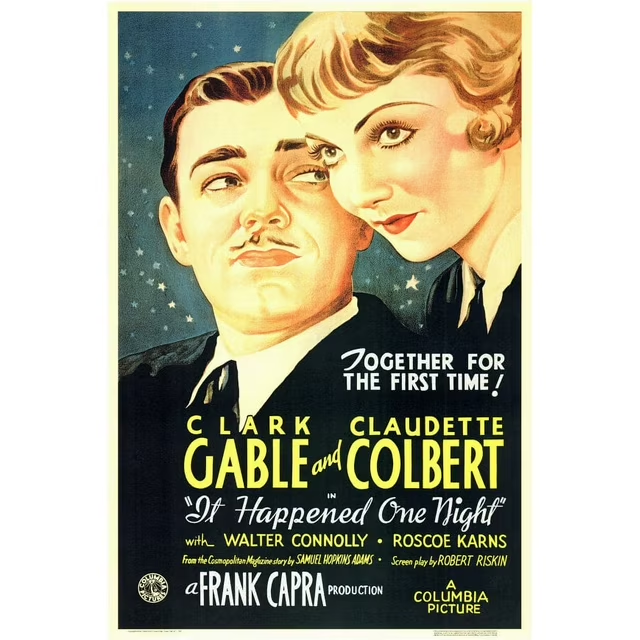
The movie is the prototypical screwball, romantic comedy, directed and co-produced by Frank Capra. It stars Claudette Colbert as Ellie Andrews and Clark Cable as Peter Warne. It is based on the August 1933 short story “Night Bus” by Samuel Hopkins Adams. I rented it for 3,99 Eur on Apple TV.

I love road trips. In fact, I am on a road trip right now and absolutely enjoying crossing the Rockies by train. In 2009 we took as a 3 week road trip across the US with our 3-year old daughter and had an absolute blast, for a long time we had a blog out there which was quite popular in Germany. But one thing I also keep in a very special place in my mind was the 3.5 day trip I took back – the changing scenery, the different food, the evolving character in people and all sorts of other observation you see on roadtrips. My absolute favorite movie of all time is Thelma and Louise and it is also a road movie. Besides the obvious feminist tones, the whole Americana element in it what makes me nostalgic, the greasy diners next to motels on the road, the radio stations that either play country or religious rock, the stretching of the road into the horizon, as far as the eye can see. You want road trip comedy? I’ll watch Planes, Trains and Automobiles every time it comes on the TV and still laugh at all the predictable parts.

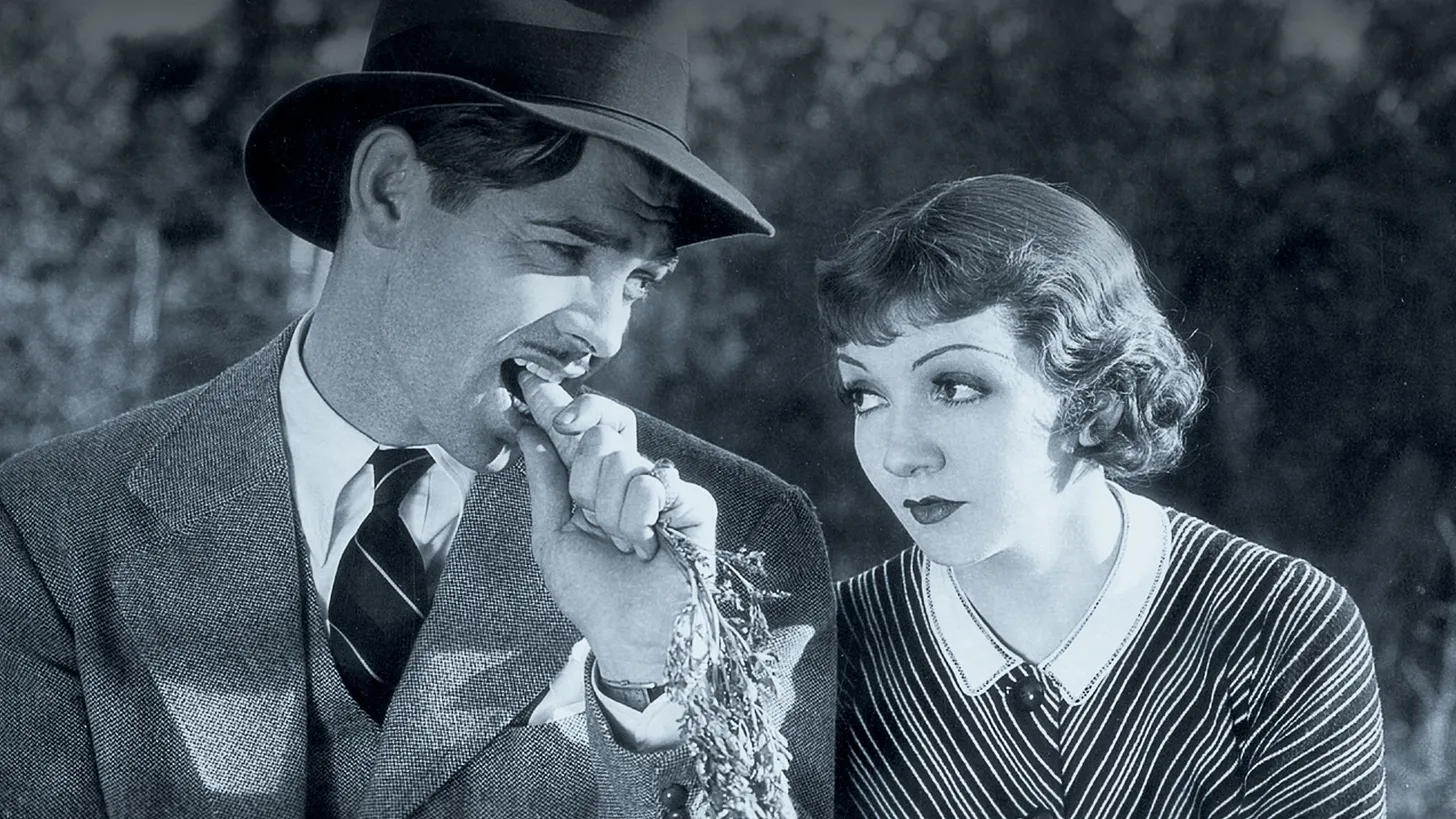
So I was super excited to see this movie, it has been on my watchlist forever, hailed as the prototypical romantic comedy with screwball elements. Yes, many of those elements, especially “foes to lovers” seem cliched, but one has to realize that it was often this very movie that started them. Even the way Peter ate his carrot is supposed to be an inspiration for Bugs Bunny (see image below). Add to that the fact that the movie was shot at the height of the Great Depression and the distortion between the extremely rich heiress and the bulk of the people not knowing where their next meal would come from.

But then it had that whole road trip element in there. People making conversation and even entertaining on the bus, the constant search for shelter and food on the road (especially when you run out of money halfway), even the bickering, because something will go wrong (car trouble, crooks wanting to take your money, etc). Some reviews I saw said that the movie dragged, how long can it take to go from Miami to New York? I didn’t feel it, it needed its time! And it had fun along the way.

And the romance? I bought it! First of all, Clark Cable does have a “je ne sais quoi” that makes him unbelievably attractive and when Ellie confesses her love to him, I got heart pangs, such was the rapport she had built up to him. And the hurt felt by both when they thought the other was indifferent to them, I felt it l too. I saw Before Sunrise yesterday and the way Céline and Jesse are at first guarded, but obviously so attracted to each other, it reminded me of this movie so clearly.

So remember, often the journey itself is the destination. And often the people you live those experiences with, will be in your mind forever, having shared an experience that was away from the day to day. So cherish those trips and don’t see them as a drag!

1933 – Duck Soup

1933 – Duck Soup

It is a musical comedy starring four of the Marx Brothers (Groucho, Harpo, Chico and Zeppo) in their final movie for Paramount and the final movie for Zeppo. It also features Marx Brothers’ regular Margaret Dumont as Mrs. Teasdale and Louis Calhern as ambassador Trentino and the antagonist. Since I was traveling this week, I downloaded it from the Internet Archive Marx Brothers Collection, which lists their 15 feature length films.

Growing up, like my earliest memories until we got cable when I was 6, I watched a lot of 20s-40s comedy. I think, Guatemalan TV got those shows on the cheap, so lots of Harold Lloyd, The Three Stooges, even some Chaplin. I think they also dubbed them on the super cheap if at all, so that must have been the reason why the Marx Brothers didn’t make it, since their comedy is quite filled with word play also. I look back fondly at those evening watching those shows, so I thought, hey, let’s fill a cultural hole, in that I have never watched a Marx Brothers movie ever. 1933’s Duck Soup is probably their most famous one – that mirror scene being one of the most transcendental situational comedy scene in movie history.

I was also traveling this week and quite busy the week before, so I didn’t have much time, so watching this on the train back from my trip was perfect – a comedy that barely spans 66 minutes, that’s about all I could take this week.

Perhaps, I was not in the right mood… because I didn’t like it. Yes, I can see it’s a clear attempt at making fun at what was happening in Europe in 1933. Benito Mussolini outright banned the film, it is not that complicated why – Freedonia vs. Sylvania, haha. The Americans lending money only on the condition of installing a dumb beloved doofus as the head of state and it leading straight into war after countless of opportunities of avoiding that war. Yes, the political satire is strong, but for me it was just outdated. And I don’t know if it was the style or the time or both.

Probably the style, because for all the wistfulness I had at watching “The Three Stooges” as a kid, it is quite horrible programming, I saw maybe 2 minutes of an episode somewhere and immediately switched away – “how did I ever like this?”. The same here, I still don’t get the thing with Harpo; he just cuts things and honks away and people found this hilarious? Was that like a known thing? And the first time you hear as a kid Groucho yelling “tanks!” when in war and them answering “you’re welcome!”, it is probably funny, but it got an eyeroll from me, sigh. I am doubly saddened, because I am a fan of Eyebrow Cinema, he just put out his 100 favorite movies, because he passed 100k on YouTube (yay!) and he had it at 83, so I was really looking forward to it.

1932 – Scarface

1932 – Scarface (The Shame of a Nation)

It is a 1932 pre Hays code movie directed by Howard Hawks and co-produced by Howard Hughes. Its screenplay by Ben Hecht is loosely based on the novel of the same name by Armitage Trail (a pseudonym) and by the real life Al Capone and re-imagines some real events. It stars Paul Muni as Antonio “Tony” Camonte and some supporting cast includes George Raft and Boris Karloff. I rented it for 3,99 Eur on Apple TV.

I’ve been watching with horror on how in the last few weeks the office of president Trump has wilfully ignored court orders left and right and has deported or is in the process of deporting people that did not deserve to be deported (from expressing their opinion, to mistakes, to inconveniences, and so on…); not for nothing it’s being called a constitutional crisis. The office of the president, most notable led by Stephen Miller is employing draconian measures and cramming out weird laws to justify their actions. One is reminded of the Japanese internment camps during WWII in which American citizens of Japanese heritage were simply stripped of their rights via presidential Executive Order and Roosevelt was widely celebrated for it. Surely that could not happen today? Of course it can, our timeline is nothing special. People are easily persuaded to strip people of their rights in the name of security!

I did not expect to encounter those conundrums in this movie. It was supposed to be a gangster movie. I like those, escape into a world you know nothing about, where the ruthless rules of organized crime are as suspenseful as any relationship drama (“who’s going to betray who? is the oath of loyalty sworn going to hold?”). And hey, the gangster movie has a long tradition in America, so I wanted to know how it got its start.

With some jarring effect, Scarface doesn’t simply start after the opening credits; there are some title cards quite moralistically preaching the following: “This picture is an indictment of gang rule in America and of the callous indifference of the government to this constantly increasing menace to our safety and liberty. Every incident in this picture is a reproduction of an actual occurrence, and the purpose of this picture is to demand of the government: ‘What are you going to do about it?’. The government is your government. What are YOU going to do about it?”. At first I thought that they had to do this for a pre-Hays code film, sort of preemtive message saying “no, don’t glorify this guy!”. And sure, the movie is quite alluring showing all the riches Toni has at the height of his power, but I never saw it as glorifications, especially because you know he’s going to fall at some point. It still was banned in many states and cities.

But in the middle of the movie, it repeats that message and much clearer and much scarier. The newspaper editor and a politician argue that ordinary citizens are powerless against these gangsters unless the government does something. They keep on arguing that most of these thugs aren’t even citizens and that all of them should be rounded up and fast-tracked deported! And who if not us, the proper citizens to ask for laws to be changed in the name of security and liberty. Chilling how this could’ve been said in 2025!

As for the rest of the movie… I felt it was quite entertaining, it’s a crisp 93 minutes and a fun watch, often unintentionally funny. The car chases were cool and the movie’s depiction of the St. Valentine’s Day Massacre was quite ingenious play with shadows. But then… it was only that – entertaining. The acting is quite stiff in some places, the flow of one scene to the next somewhat abrupt.

It is probably a product of its time, Toni must have been much cooler in 1932, perhaps like Michael Corleone in 1972 or Jordan Belfort in 2013 – we all know those men are deeply flawed and criminal, but for a second you ask yourself, what would it be like to live in those shoes for a few days? Interestingly, I found the tragic character of Rinaldo, the quiet, loyal, but deadly associate much more alluring than the loudmouth Toni. So the end did not grip me as much, I was not invested in Toni’s faith, how they finally got him, how he went out, misled by a blinking advertisement that kept telling him “the world was his”! Ah well, predictable, even pre-code!

1931 – M

1931 – M (Eine Stadt sucht einen Mörder)

A german Nero Film Production written and directed by Fritz Lang. Also here, Lang’s wife Thea von Harbou had a hand in co-writing this production. It stars Peter Lorre in the title role as the murderer. I saw it on Amazon Prime, where it is available for Prime members, but you can also watch it for free on YouTube.

Are there crimes so heinous, that even “normal” criminals are disgusted by them? That a series of them can paralyze an entire city of 4.5 million people? Yes, after 8 disgusting murders on little girls (it is only hinted what the murderer did to them), the whole city of Berlin is on edge. People are accusing random men on the street of being pedophiles for talking to children and parents don’t let their kids out of their sight, escorting them everywhere. And for good reason, the first scenes where we accompany the anguish of little Elsie’s mother waiting for her, hoping, asking and in the end just screaming her name, set me off as a viewing mother.

The whole city becomes so paranoid, that the police presence gets ramped up, raids on petty criminal hotspots have everybody agitated, cops are working overtime shifts to catch the killer. This increased police ubiquity in turn spooks the organized crime element in Berlin, that can’t handle such increased police presence on a day to day business. In a nice juxtaposition you see the heads of the organized crime and the chiefs of police debating on how to catch the killer, each with their own methods. This juxtaposition continues then, on one side with the grunt of detective work, the tediousness of hundreds of clues, interviews, etc. compared to the underground network of beggars and vagrants coordinating informal information networks.

And then there is the killer, clearly hunted by demonic inner drive. In one scene he tries to drown that drive in alcohol, yet it comes up again and again in the haunted, distorted whistled melody of Grieg’s In the Hall of the Mountain King. At one point in the movie in an amazing monologue, he screams in agony: “I don’t want to, I HAVE to”.

Much can be said about the movie, the modern montages (really, I thought the procedural element has been unsung in the reviews that I have read so far), the genius use of sound for this very early sound movie, the introduction of noir elements (low angles, play on shadows, etc.) that influenced so many later films. And then the dilemma that is presented to the viewer almost breaking the fourth wall: “Showing pity and understanding to a clearly deranged person, is that a commensurate judgement for the most despicable crimes on children?” But one thing that touched me, that is probably very personal and many cinephiles watching this movie won’t catch is the Berlin element of it all.

It starts with the accents. Everybody, but the murderer speaks “berlinish”, sometimes even exaggerated, but it immediately made me feel at home. Yes that is us, sometimes a bit petty criminal, yes we have the “Berliner Schnauze” (a plump, even unfriendly way of speaking), but deep down, Berliners stick together. I love that Fritz Lang, an Austrian, understood that dynamic. Erich Kästner (a Berliner) had just in 1929 released his children’s book “Emil and the Detectives” and at so many points in the movie, I thought of that book and the atmosphere of late 20s, early 30s Berlin and their people: seedy, anything goes, poor, but also clever, fair and funny. It also reminded me of the song “Das ist Berlin” my husband worked on during his time at Funke. “When you spice yourself up, even though you’re ugly. When Stefan becomes Steffi. That is Berlin”. That spirit is still in the city: we will be very open to any of your ideas, you live you life man, you may see us as a bit lazy, a bit dumb, a bit unfriendly, a bit ugly, but when it really matters, we will band together, you can’t break this city’s spirit. And at the same time… we know; there is that haunting spectre hovering over the city in 1931… what is to come!

Ok, so I am a week late, but so happy this is the movie I got to see for this year, it had been on my list for far too long. I will probably post 2 weeks from now, fortunately I had set myself some cheat weeks.