1932 – Scarface

1932 – Scarface (The Shame of a Nation)

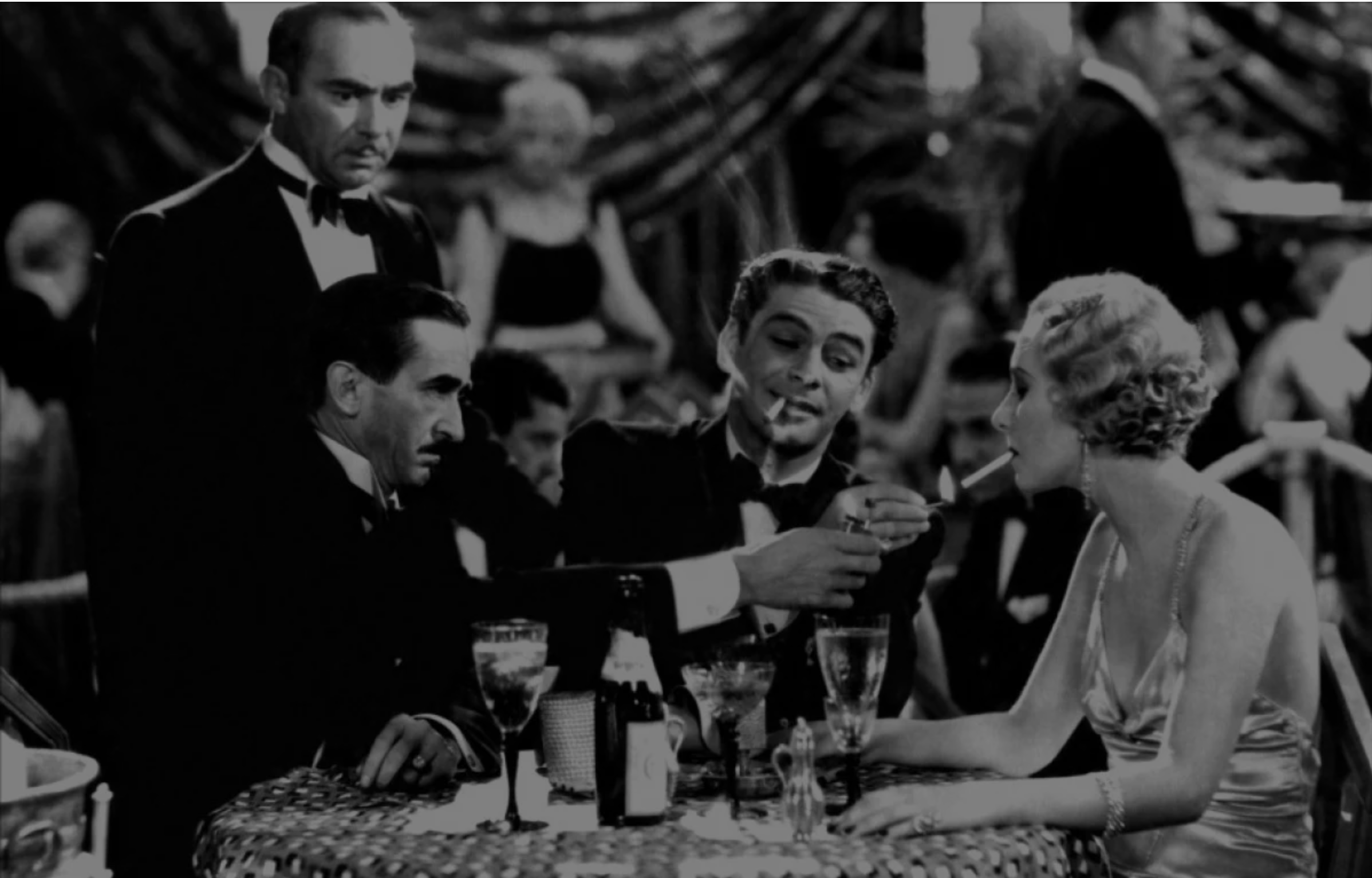
It is a 1932 pre Hays code movie directed by Howard Hawks and co-produced by Howard Hughes. Its screenplay by Ben Hecht is loosely based on the novel of the same name by Armitage Trail (a pseudonym) and by the real life Al Capone and re-imagines some real events. It stars Paul Muni as Antonio “Tony” Camonte and some supporting cast includes George Raft and Boris Karloff. I rented it for 3,99 Eur on Apple TV.

I’ve been watching with horror on how in the last few weeks the office of president Trump has wilfully ignored court orders left and right and has deported or is in the process of deporting people that did not deserve to be deported (from expressing their opinion, to mistakes, to inconveniences, and so on…); not for nothing it’s being called a constitutional crisis. The office of the president, most notable led by Stephen Miller is employing draconian measures and cramming out weird laws to justify their actions. One is reminded of the Japanese internment camps during WWII in which American citizens of Japanese heritage were simply stripped of their rights via presidential Executive Order and Roosevelt was widely celebrated for it. Surely that could not happen today? Of course it can, our timeline is nothing special. People are easily persuaded to strip people of their rights in the name of security!

I did not expect to encounter those conundrums in this movie. It was supposed to be a gangster movie. I like those, escape into a world you know nothing about, where the ruthless rules of organized crime are as suspenseful as any relationship drama (“who’s going to betray who? is the oath of loyalty sworn going to hold?”). And hey, the gangster movie has a long tradition in America, so I wanted to know how it got its start.

With some jarring effect, Scarface doesn’t simply start after the opening credits; there are some title cards quite moralistically preaching the following: “This picture is an indictment of gang rule in America and of the callous indifference of the government to this constantly increasing menace to our safety and liberty. Every incident in this picture is a reproduction of an actual occurrence, and the purpose of this picture is to demand of the government: ‘What are you going to do about it?’. The government is your government. What are YOU going to do about it?”. At first I thought that they had to do this for a pre-Hays code film, sort of preemtive message saying “no, don’t glorify this guy!”. And sure, the movie is quite alluring showing all the riches Toni has at the height of his power, but I never saw it as glorifications, especially because you know he’s going to fall at some point. It still was banned in many states and cities.

But in the middle of the movie, it repeats that message and much clearer and much scarier. The newspaper editor and a politician argue that ordinary citizens are powerless against these gangsters unless the government does something. They keep on arguing that most of these thugs aren’t even citizens and that all of them should be rounded up and fast-tracked deported! And who if not us, the proper citizens to ask for laws to be changed in the name of security and liberty. Chilling how this could’ve been said in 2025!

As for the rest of the movie… I felt it was quite entertaining, it’s a crisp 93 minutes and a fun watch, often unintentionally funny. The car chases were cool and the movie’s depiction of the St. Valentine’s Day Massacre was quite ingenious play with shadows. But then… it was only that – entertaining. The acting is quite stiff in some places, the flow of one scene to the next somewhat abrupt.

It is probably a product of its time, Toni must have been much cooler in 1932, perhaps like Michael Corleone in 1972 or Jordan Belfort in 2013 – we all know those men are deeply flawed and criminal, but for a second you ask yourself, what would it be like to live in those shoes for a few days? Interestingly, I found the tragic character of Rinaldo, the quiet, loyal, but deadly associate much more alluring than the loudmouth Toni. So the end did not grip me as much, I was not invested in Toni’s faith, how they finally got him, how he went out, misled by a blinking advertisement that kept telling him “the world was his”! Ah well, predictable, even pre-code!

1931 – M

1931 – M (Eine Stadt sucht einen Mörder)

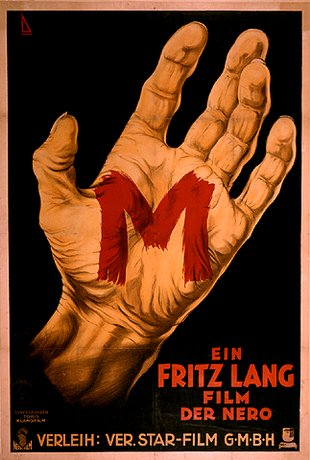
A german Nero Film Production written and directed by Fritz Lang. Also here, Lang’s wife Thea von Harbou had a hand in co-writing this production. It stars Peter Lorre in the title role as the murderer. I saw it on Amazon Prime, where it is available for Prime members, but you can also watch it for free on YouTube.

Are there crimes so heinous, that even “normal” criminals are disgusted by them? That a series of them can paralyze an entire city of 4.5 million people? Yes, after 8 disgusting murders on little girls (it is only hinted what the murderer did to them), the whole city of Berlin is on edge. People are accusing random men on the street of being pedophiles for talking to children and parents don’t let their kids out of their sight, escorting them everywhere. And for good reason, the first scenes where we accompany the anguish of little Elsie’s mother waiting for her, hoping, asking and in the end just screaming her name, set me off as a viewing mother.

The whole city becomes so paranoid, that the police presence gets ramped up, raids on petty criminal hotspots have everybody agitated, cops are working overtime shifts to catch the killer. This increased police ubiquity in turn spooks the organized crime element in Berlin, that can’t handle such increased police presence on a day to day business. In a nice juxtaposition you see the heads of the organized crime and the chiefs of police debating on how to catch the killer, each with their own methods. This juxtaposition continues then, on one side with the grunt of detective work, the tediousness of hundreds of clues, interviews, etc. compared to the underground network of beggars and vagrants coordinating informal information networks.

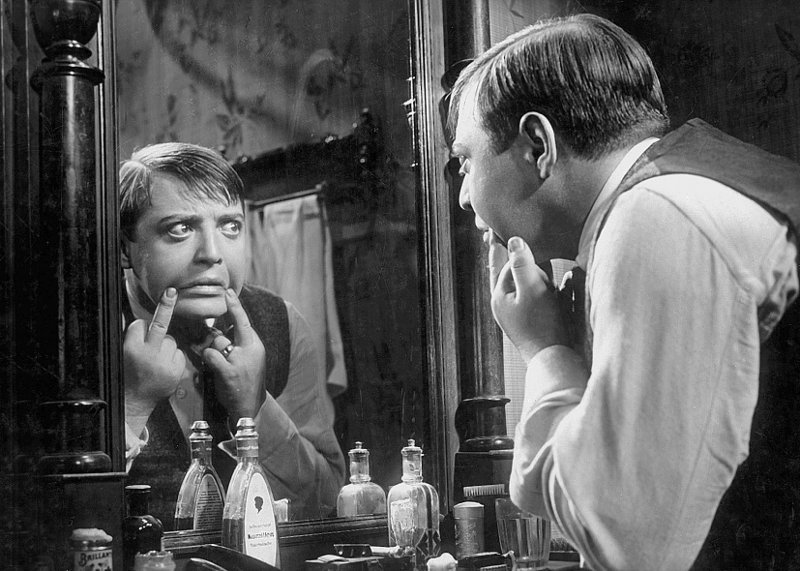
And then there is the killer, clearly hunted by demonic inner drive. In one scene he tries to drown that drive in alcohol, yet it comes up again and again in the haunted, distorted whistled melody of Grieg’s In the Hall of the Mountain King. At one point in the movie in an amazing monologue, he screams in agony: “I don’t want to, I HAVE to”.

Much can be said about the movie, the modern montages (really, I thought the procedural element has been unsung in the reviews that I have read so far), the genius use of sound for this very early sound movie, the introduction of noir elements (low angles, play on shadows, etc.) that influenced so many later films. And then the dilemma that is presented to the viewer almost breaking the fourth wall: “Showing pity and understanding to a clearly deranged person, is that a commensurate judgement for the most despicable crimes on children?” But one thing that touched me, that is probably very personal and many cinephiles watching this movie won’t catch is the Berlin element of it all.

It starts with the accents. Everybody, but the murderer speaks “berlinish”, sometimes even exaggerated, but it immediately made me feel at home. Yes that is us, sometimes a bit petty criminal, yes we have the “Berliner Schnauze” (a plump, even unfriendly way of speaking), but deep down, Berliners stick together. I love that Fritz Lang, an Austrian, understood that dynamic. Erich Kästner (a Berliner) had just in 1929 released his children’s book “Emil and the Detectives” and at so many points in the movie, I thought of that book and the atmosphere of late 20s, early 30s Berlin and their people: seedy, anything goes, poor, but also clever, fair and funny. It also reminded me of the song “Das ist Berlin” my husband worked on during his time at Funke. “When you spice yourself up, even though you’re ugly. When Stefan becomes Steffi. That is Berlin”. That spirit is still in the city: we will be very open to any of your ideas, you live you life man, you may see us as a bit lazy, a bit dumb, a bit unfriendly, a bit ugly, but when it really matters, we will band together, you can’t break this city’s spirit. And at the same time… we know; there is that haunting spectre hovering over the city in 1931… what is to come!

Ok, so I am a week late, but so happy this is the movie I got to see for this year, it had been on my list for far too long. I will probably post 2 weeks from now, fortunately I had set myself some cheat weeks.

1930 – Murder!

1930 – Murder!

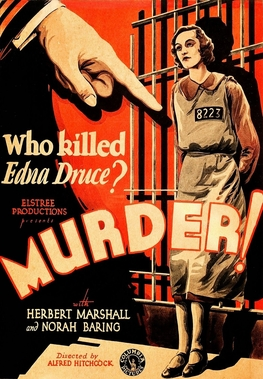
A British mystery movie, directed by a young Alfred Hitchcock. It was written by him and his wife Alma Reville and Walter Mycroft. It stats Herbert Marshall as Sir John Menier, Norah Baring as Diana Baring and Edward Chapman as Ted Markham. It’s based on the 1928 novel Enter Sir John by Clemence Dane and Helen de Guerry Simpson. A watched it with ads for free on Plex.

Finding a movie for 1930 turned out to be difficult. I had already seen All Quiet on the Western Front and The Blue Angel, so those easy pickings were gone. I tried very hard to find Morocco, but couldn’t lest I shelled out 16 Euros for a DVD (nah!). I had no desire for yet another F.W. Murnau movie in City Girl about living on the farm in Minnesota. Sigh…

And then I saw the BKR video about Alfred Hitchcock’s Hair Obsession, which I really liked. But what I liked most, is the accompanying podcast No Noise podcast which was about Alma Reville, Hitchcock’s wife and a tremendous influence on him and especially his early movies when he was still in Britain. Highly recommend it, and this one is free for everybody, though supporting Izzy is always a good idea! In the podcast Dr. Josephine Botting, Curator at the BFI National Archive goes into the history how Alma started as a cutter (editor basically), meeting Hitchcock and then sort of becoming the person that would tidy up his films, mostly through writing. This went on for a long time right up until and including Rebecca, after which she focussed mostly on the children. So I got curious, how do British Hitchcock movies look like, how did this woman influence the weird genius that this man would become? So many successes and fortunes of men in the 20th century were heavily carried and influenced by their wives (often willingly in the shadows), I wanted to honor that.

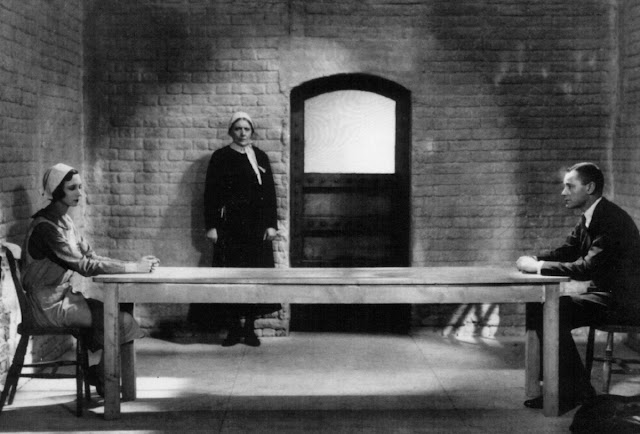
The plot of “Murder!” is about an theater actress Diana Baring being accused of the murder of a fellow actress with a poker. In the jury there is Sir John (who happens to have hired Diana into his theater company – uh, conflict of interest?), who has doubts about Diana’s guilt, but is persuaded by the rest of the jury to convict. Later, haunted by his conscience, he goes on to investigate whether Diana was really guilty – playing detective with help of his stage manager Ted Markham.

This is my first talkie movie and ooooh boy, it is bad in that sense. It was supposedly first filmed as a silent film and later half talked over, half filmed again. And then there are scenes where nothing of this sort is done – it’s just… silent, no ambient sound, nothing. Similarly, the cuts are jarring, the film quality is horrendous at times. And don’t get me started on the editing, a 2 second close up on a clock, then 2 seconds on some meal, then the scene starts. One notices how filmmakers still had to learn to not use the cue cards to narrate a story. Sometimes it’s that janky shots quickly one to the other, sometimes a huge exposition dump. Add in to that the unevenness of the sound editing; there’s a radio programme at full blast when Sir John is talking to his butler about his motives for investigating this murder, or a baby screaming at full volume when he immerses himself into the lives of the actors.

But worst of all, is that it drags. Pity, because there are some real hidden gems in there, like the shadow play or a trapezium scene that is at the core of suspense. Or even some forced things, which are typical Hitchcock style over story, but which work so well — like the improbable, but very funny interrogation scene during a theater play. It could’ve been so great, had it had a competent editor. And so this week I was left disappointed, both that greats do really need to grow into greatness sometimes, but also that even if there was any of Alma’s influence in this movie, it sadly probably wasn’t very good. Still, I am glad I saw this movie, yet another style from the Russian, German, American and French that I have reviewed so far and one that I recognize in British films even many years later.

1929 – Pandora’s Box

1929 – Die Büchse der Pandora (Pandora’s Box)

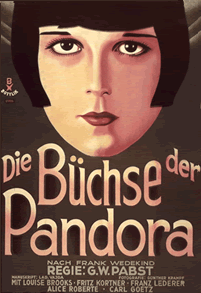
A classic Weimar era silent movie, directed by G.W Pabst. It stars Louise Brooks in its titular role as Lulu , Fritz Kortner as Dr. Schön and Francis Lederer as Alwa Schön. It is based on Frank Wedekin’s plays “Erdgeist” (1895) and the follow-up “Die Büchse der Pandora” (1904). The film explores the tragic that the natural seductiveness of Lulu brings to herself and everybody to succumbs to her allures. I saw it at filmfriend, the German library service for free (you have to enter your local library card).

Last Sunday Anora won the Academy Award for Best Picture for 2024. Well deserved, in my opinion, though I haven’t seen many of the other movies that were favored to win. What I liked was the realistic depiction of the crashing down of the “fairy tale”. Ani is firmly grounded in reality, but even then for just a second the lure of the possibility to obtaining respectability is so great… maybe, just maybe. It was all masterfully done by Mickey Madison, who wholeheartedly deserved that Oscar – the constant battle in her head of “am I gonna get mine?” and “it’s gonna work out, Vanya loves me!” and in the end “that dipshit… really hurt me”. Yes, sex workers know how society sees them, but it still hurts to be shown that with such contempt.

Also in this movie Lulu – a masterful Louise Brooks – is constantly reminded that all she is ever good for, is to seduce. Men and women alike, by the way, the movie has a whole lesbian subplot. The movie starts with a visit by her former pimp Schigolch (sorry, later it gets revealed that in may be her dad, but the way he acts throughout the movie, I’m going with pimp). She doesn’t need him anymore, she already has found her sponsor, ahem boyfriend Dr. Schön, an older man and a rich publisher. But Dr. Schön actually wants to shed her, gain some respectability, marry the daughter of the minister of the interior. And that constant push and pull between the entrancement that Lulu has on other people and the way that she brings them sorrow is the main plot of the movie. It is a tragedy throughout the movie. Nobody that crosses paths with Lulu is made whole, many end up dead or living in complete poverty. But nobody is completely innocent either, they act out of self-interest going over dead bodies to get money, love or escape the police.

The story is quite convoluted, the settings very varied – a theater production company, a wedding party, a courtroom, a confined train escaping the law, a gambling ship, a squalid room under the roof in London. It wouldn’t have worked without its main protagonist, who wholeheartedly encapsulates the myth of Greek mythology Pandora’s Box: opening the box brings misfortune, but the box also holds hope! Is the hope of love that Lulu offers along with evils that her status and her non-moralistic candor bring, a benefit or a curse? How ironic then that the movie star herself ended up in poverty, noting that “the only people who wanted to see me were men who wanted to sleep with me.”

In modern culture, the box has become “a can of worms” or a “slippery slope”. It’s often a warning against unbridled optimism, that while the hope that comes with the act is understandable, there is often a hidden evil or tragedy when you go in blind. This week’s Pandora’s Box for me has been AI in science. I heard two presentations on it, one was even on the ethics of the use of AI in science, yet at the end there were a lot of shrugs and “well, if we’re careful…”. Working on a white paper this week, I was amazed that a woman spoke up and declared that if even a sentence of the paper was written with an LLM, we should take her name off the paper. I am distancing myself from that box even more after this week, some of the things may bring hope, but its allure may damn me into a sequence of evils and tragedies I’d rather not go through.

1928 – The Passion of Joan of Arc

1928 – The Passion of Joan of Arc

Produced by Société Générale des Films, directed by Carl Theodor Dreyer, is a 1928. It stars Renée Jeanne Falconetti as Joan. It is a French film based on the trial record fro Joan of Arc. I watched it on JustWatch here kindly remastered and made public by the Open Archive.

Because of David Lynch’s recent passing, I saw Mulholland Drive for the first time a few weeks ago. I had always been scared to watch it, that I would probably not understand it. So glad I did, because I absolutely loved it, especially the performance by Naomi Watts. However, I don’t know, if I liked it so much, because I understood a lot of callbacks, e.g. the “Kim Novak, Vertigo” dress that Betty wears at some point in the movie. I kept asking myself, if I would’ve understood it as much 24 years ago, when it came out, me not being mature enough or would the chills that I had throughout the movie been enough? I think the same applies for this movie, The Passion of Joan of Arc. I’ve always archived it to “probably need to see this at some point in my life, but I am still too scared that I won’t get it”. I have been disappointed before – unimpressed by Citizen Kane, bored by Lawrence of Arabia, confused by The Last Picture Show, so it’s not a given that my fears will be for nothing.

Well, I am glad to say that “I got it” for this movie. The main theme being the feeling of dread, discomfort and desperation from the oppressing close-ups in this movie. It is quite experimental, but simple at the same time. The mantra in movies usually is “show, don’t tell” – that’s what the moving pictures are for! But then you get something that turns it on its head – think 12 Angry Men, which plays out only in the juror’s room – it’s such a fine line, because a lot of the showing is only in the desperation of the faces, while the telling is often the classic expository dialogue. And the same happens in this movie – it basically has no plot, it’s the final days of Joan of Arc and her trial before her burning at the stake. It’s all the oppression she felt, but her quiet defiance in the face of torture and death.

Just like Joan of Arc itself, I also liked the quiet defiance it took to get this film made. She had just been canonized as a saint 8 years before, so fervors in France were strong to honor one of their heroes. It was quite controversial that (a) the plot was just about her final 10 days, not the amazing battles that inspired France’s last push in the 100 years war against the English (b) the movie was directed by a Dane and not a Frenchman and (c) they tried to make it as original as possible, largely reproducing word for word the original transcripts from the 15th century – condensing them into one trial, which did not sit well with the Archishop of Paris at the time and we final restoration only coming to us in 2015 after the final cut was found in a mental institution in 1981.

And then of course, there is the feminism, quite remarkable also for 1928. How the subtleties in the faces doing the horror belong to men and the faces distorting in horror at what its happening, belong to the women (with a few unhelpful exceptions such as the priest sprinkled in). Quiet, defiant competence gets women so far and Joan of Arc, but also here Maria Falconetti’s performance underscored that! Very strange to juxtapose it to the so-called feminism depicted in Lessons in Chemistry that I just finished a few days ago (blergh!). The brilliance in so many women role models for me was how they could inspire anybody to fight, work, protest, vote with them, not simply preach! This movie, while simple, also does that!