1944 – Arsenic and Old Lace

1944 – Arsenic and Old Lace

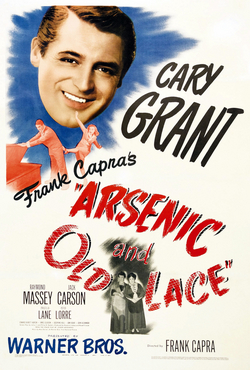
It’s a dark screwball comedy directed by Frank Capra and starring mainly Cary Grant as Mortimer Brewster. It’s based on a play with the same name by Joseph Kesselring, which was very successful, so it was stipulated that the film would not be released until its Broadway run ended. I rented in on YouTube, since both Apple and Amazon only had the German version here for sale.

The leaves have been falling like crazy these last few days here in Berlin. Fall is here and with it pumpkins (soups, pies, lattes, jack-o-lanterns, …), corn mazes (though there aren’t as many as in the past…) and Halloween stuff! Also movies; from marathons the streaming services releasing a bunch of horror movies to the over the air TV channels issuing their Halloween night schedule (apparently it’s actual Halloween marathon this year). So this movie fit right into the season, its whole plot unfolding over Halloween night. Plus, it’s not scary, but a macabre, black comedy.

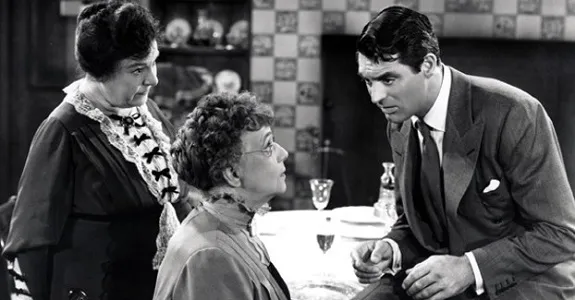
As to what makes it dark – well it’s two extremely sweet, old ladies murdering lonely older gentlemen (they just bagged their 12th victim in the windowsill) out of pity. It’s wrong, but when you look at them, how they prance around the hall with their arsenic infused wine, you can’t help but laugh. They’re pleasant, give toys to the poor, are in good standing with the police and clergy, how can you not love them? And in their sweetness, they don’t feel remorse either. In fact, there’s quite some commentary over how some people do some truly horrible things in the name of pity, going over the heads of the victims, but present themselves as honorable citizens.

But the movie doesn’t linger on this too long. It’s more on the desperation of their nephew to save his aunts from the police by trying to pin it on his delusional younger brother “Teddy”, who things he’s the actual Teddy Roosevelt. Teddy has buried the bodies in the basement (no, that’s not a metaphor) thinking it’s Panama and they were victims of yellow fever. Getting him interned in an insane asylum is a way to bury… ahem… to keep the skeletons in the closet.

But then hilarity ensues when Mortimer’s other estranged brother Jonathan shows up with his sidekick Dr. Einstein (Peter Lorre is really becoming my favorite actor in this blog, he again is a reason why the whole plot doesn’t fall apart). He’s become quite a killer, I mean criminal on his own also claiming a dozen murders on his side of the ledger. Can Mortimer remain sane with all things crashing upon his once very simple world? The murderous aunts, the crazy brothers, one evil, one naive, his new wive, the police, the director of the asylum, the taxi driver in front of his house, etc., etc., Yes, at a certain point it becomes slapstick and the conclusion is also quite rushed, but in the middle it is quite funny, being punctuated by Cary Grant’s excellent over-the-top acting. His “deer in the headlights” look is especially great and we feel for him when he mumbles to himself trying to hatch a scheme to get out of the newest comeuppance driving a dent into the old plan.

It is quite clear that the movie was born out of a play. The whole thing takes place in the main room of the aunts’ house, with some elements on the outside or the stairs, but which can fit the stage quite comfortably. It’s a plus and minus an some points. Plus, because it keeps everything contained and there are no long excursions into a distraction to the main plot, but minus, because it retains too much of the play character. It’s not like filming the play of Hamilton and calling it a movie and there are some cinematic elements (close-ups, the shot from the stairs, the music, …), but overall the movie made me even curiouser about the play. There was even a line where the brother Jonathan grows incensed because the plastic surgery has made him look like Frankenstein’s monster. Everybody says: “He looks like Boris Karloff!”, which makes him angry. Well, in the Broadway play, he was played by the actual Boris Karloff.

So, final verdict. I laughed in quite a few places, so yes, very successful in that, but don’t go around looking for the heart we see just 2 years later in Frank Capra’s It’s a Wonderful Life. It never leaves its screwball roots and as such is a good time and some very good, funny lines, but not much more behind it. Hey, it’s Halloween in 1944, sometimes you just want amusement!

1943 – The life and death of Colonel Blimp

1943 – The life and death of Colonel Blimp

It’s an english epic biography of an english soldier, with elements of war, romance and friendship. It was produced by Michael Powell and Emeric Pressburger. It stars Roger Livesey as Clive Candy, Anton Walbrook as Theo Kretschmar-Schuldorff and a very young Deborah Kerr in 3 pivotal roles in Candy’s life. This movie also, thankfully was on YouTube.

We have now reached 1943 and while on the outside World War II is raging, also the number of movies being produced are certainly going down; there were only a third of many movies being made that year than in 1939. Also the themes are changing to include the raging war, but just as last year’s movie, one has to be careful not to fall into outright propaganda movies.

So, this one fit the bill, which was a quite critical of the English mindset of the beginning of the 20th century, with its colonialism, its supposed noblesse oblige, but all through the eyes of a quite naive English soldier stuck in the 19th century with allusions to honor and a carefully smoothed over history (for example, making light of the Boer concentration camps). One aspect I liked, is that that the movie didn’t tell you about it, you’re like two thirds of the way in and it dawns on you, “oh, that’s why it doesn’t sit right, it’s a critique of the old chap, not a celebration!”.

The way his obsession for a woman is manifested in him falling for the same type over and over again – heh, Deborah Kerr playing three roles in three important phases of Clive’s life. Creepy, but sweet at the same time. Thankfully, they’re all three quite independent women, the one in the middle marrying him to go off to see the world.

Another eye-rolling aspect is the “wall of trophies” he has in his own and which serves as a plot device to mark the passage of time. It is quite ridiculous how he accumulates these taxidermy mounts, the most cringe worthy being a whole elephant head. He even puts up a picture of his dead wife prominently in that room. We feel the uncomfortableness that Theo displays when he is shown the room.

But the most poignant point of the movie comes in the form of a speech comes right at the end. Clive is still steeped in his old ways of fighting right until the start of the Second World War. It reminded me of some aspects of Hillary Clinton’s campaign: Michelle Obama’s “When they go low, we go high” or her bringing up the dead Syrian toddler on the beach breaking he heart. It was a dirty fight and to a dirty fight you don’t bring appeals to honor or dignity. The movie explicitly has a speech about it from Theo:

“i don’t think you won it. we lost it — but you lost something, too. you forgot to learn the moral. because victory was yours, you failed to learn your lesson twenty years ago: this is not a gentleman’s war. this time you’re fighting for your very existence against the most devilish idea ever created by a human brain: nazism. and if you lose, there won’t be a return match next year… perhaps not even for a hundred years.”

And he’s like that the whole movie, surprised that the Germans would torture the English to get the location of a bridge, while his own soldiers do the same as soon as he leaves. When he greets Theo in a sea of Germans in the English POW camp like he was running into a friend at the movie theater and is surprised that his counterpart is quiet and reserved.

It’s Theo that ends up being the most fascinating protagonist of the movie. Even when he doesn’t appear through large parts of the movie, his presence is there on Clive throughout. And when he does come back to plead to be accepted by the English we learn how his whole world (view) has been slowly, but surely been destroyed. The sadness of eyes, when he says he lost his two sons… they’re now good Nazis.

I saw “One Battle After Another” last weekend, excellent movie, highly recommend it! And it told the themes of fighting for justice, how sometimes you have to fight dirty or perhaps to go against “the rules” to do right, precisely because the rules are often done by evil people. Also here, in the end, the Colonel sees the need to fight for what’s right, not for the ceremonial rules.

Lastly, some more technical aspects that need to be mentioned, but I’d rather let Scorsese introduce them for me. For a movie about someone’s life, the movie is actually very sparse in telling the most traditional aspects of it – battles won, marriages, deaths – they all get hinted at in newspaper clippings, but never shown. Rather, it is more a collections of meetings which at first don’t seem to mean much, but will define him for the rest of his life. Even the significant duel between Theo and Clive has a ceremonial and ritualistic preparation aspect that goes on for many, many minutes, but when the duel starts, the camera cuts away to the snow. It isn’t important, the build-up is, because it tells us about the type of battle and consequences that it will have.

The other aspect, is the behind the scenes stuff. Clive was supposed to be played by Laurence Olivier, but this was opposed to by Winston Churchill. Roger Livesey brings an amazing performance – this typical english speech, where they don’t even unclench their jaw – so authentic, but so jarring it made me like the movie less. The movie in general was opposed by the war department for the sympathetic depiction of a German soldier and its English critiques detailed above. In a recollection from Powell, he says that he had an interview with the war minister and he had to bluntly ask him if they were going to forbid them outright to make the film. He said something like: “Oh my dear fellow, we can’t possibly forbid you. That wouldn’t do at all. But don’t make it or you’ll never get a knighthood.” So they made it and Powell never got his supposed knighthood. Very on the nose, that one. Ha!

1942 – To Be or Not to Be

1942 – To Be or Not to Be

It’s an american black comedy directed by Ernst Lubitsch. It stars Carole Lombard and Jack Benny as Maria and Joseph Tura in a biting satire of the Nazi invasion of Poland and a theater troupe’s rebellion against them. I am happy, I found it on YouTube. Incidentally it was Carol Lombard’s last film, her crashing on an airplane during the movie’s post-production. There is even a rumor that some dialogue of the movie was edited to remove the line “”What can happen on a plane?” out of respect for the circumstances surrounding her death, but that has never been confirmed. Clark Gable never recovered from her death, all quite tragic. I recommend this episode of Star Wars season from the “You Must Remember This” podcast for the whole story.

Jimmy Kimmel was summarily fired this week after saying that the “MAGA gang” was “desperately trying to characterise this kid who murdered Charlie Kirk as anything other than one of them” and of trying to “score political points from it”. I don’t know how this is going to play out (Disney’s stock seems to be in free fall as of September 18th), but I was so reminded of this movie, which I saw a few days back when it happened. In the beginning of this movie a polish theater group is putting on a production about Hitler, but they later decide to go with the tamer “Hamlet” to appease the looming threat of the Nazis. Eventually it dawns too late on most Poles that there is no appealing to fascists, no matter how flattering they were to Hitler. In the end, the actors rise to the occasion and are quite successful in their operation, mainly using their weapons of acting and improvisation to get out of iffy situations.

I really loved this movie. Around me, I have always heard how great the alternate history of Inglorious Basterds is; nah, while Landa is indeed an amazing villain, I found this movie much funnier, but subversive at the same time. Add to that that the war was still going on during that time and the US entered it while this movie was being filmed. The full atrocities hadn’t been committed yet, yet this movie already knew exactly how to strike a nerve. And then it’s really laugh out funny – “so they call me concentration camp ehrhardt?” or “Schulz!”, I suddenly get a smirk on my face.

But most of all, I believe it is a movie of our time! Naturally, it is always easy with today’s lenses on to root against the Nazis, but it applies to many resistance fights there exist in the world today if one thinks about it a bit more. And I don’t mean some nebulous fascism concept, I mean standing up for our values. In one scene, Maria Tura is enticed to betray her country with all sorts of material goods and comforts; she immediately retorts with her conscience (in an absolute amazing diva mode throughout the whole runtime). Would we do the same today or do we often take the easy route of material comfort?

Casablanca tends to be remembered as *the* movie of 1942 that dealt with Nazi themes and a great love story. And it is good, but I honestly responded to the satire of this movie much more than the schmaltzy romance of the former. It is comedians and laughter that will save us in the end!

1941 – The Maltese Falcon

1941 – The Maltese Falcon

It’s an American film noir movie written and directed by John Huston in his directorial debut. It stars Humphrey Bogart as private investigator Sam Spade, Mary Astor as his femme fatale client and the great Peter Lorre as one of the villains. It is based on a 1930 novel by Dashiell Hammett and is actually a remake of a 1931 movie. I rented it on AppleTV for 3.99 Eur.

Tell me if you’ve heard this one: a bombshell of a woman walks into a private eye agency. In there, she meets a drizzled, cynical detective. He is sceptical of the woman’s story, but agrees to take on the case. In it ensues a fantastical, intriguing story, along with a romantic subplot with the knockout femme fatale of a woman. The weary and sardonic hero escapes all sort of tight situations with his cool, almost aloof demeanor, but in the end he must choose between a life with the tragic woman or righteousness. Of course he chooses the latter leading to the demise of the doomed woman. Yes, that is the plot of many hard-boiled film noirs and it is for this one, too. The actual Maltese Falcon is just a plot device to get the story going.

What makes this one special then? For one, it launched both Humphrey Bogart as a leading man and a blue-ribbon John Huston as a director into the stratosphere of greatness. It would be just the next year that Bogart would play the lead it Casablanca, I don’t think this would’ve happened without this movie. I am not a big fan of Bogey – he sure does have a big head on a small body and his weary face just signifies that, not wisdom.

“The Maltese Falcon” also is one of the pioneers of this style of hard-boiled story. There were detective stories before, but this look that I described in the first paragraph, is premiered by this one, especially the weird fast-talking way of the protagonist. I swear, like half an hour after seeing this movie, I kept describing things in my head in the same manner that Sam Spade did. A sort of “look, honey, we all know what’s going on here, but let’s call this dinner sandwich for what it is, nothing more, nothing less. some ham in the middle, little bit of butter, i’ve always liked it this way, perhaps today with a pickle on the side…” when having dinner.

It also features the decisive film noir low angles and lightning that make the genre so distinctive – just pay attention to that lamp in Sam’s apartment, it’s like an additional protagonist. Several movies after that emulated that style – some I have seen are Double Indemnity and The Third Man, the last one being my favorite with a plot of someone making a fortune by selling fake penicillin.

And yes, that’s just the crux – it was more style over story. It was all well and good, but the story of this black bird is way less interesting than the question that drives someone to doom hundreds of people by selling them fake medicine. Or the water politics of Los Angeles in another hard-boiled, femme fatale story in Chinatown with its devastating reveal. Here, the assured Spade just calmly solves everything, avoiding not just three antagonists, but also the police. The only thing that saves the movie and the characters as a whole is Peter Lorre as Joel Cairo. His weird elegant, but somehow false style is so funny and intriguing at the same time. That little man already made left me with his mouth open as the villain in M and here he was also the spice that made this movie bearable.

I am glad I watched this movie for this “100 movies” project of mine. At one point, before I became a mother and Netflix was still sending DVDs, I was going through AFI’s Top 100 movies and this had been on the back burner and I am happy to cross it off so many lists. But I don’t think I will visit this one any time soon – it may have kicked of the genre, but since then, there have been many more and better examples of the genre generated.

1940 – Ahí está el detalle

1940 – Ahí está el detalle (You’re missing the point)

The movie is a mexican comedy, directed by Juan Bustillo Oro. It stars the great “mexican Charlie Chaplin” Cantinflas (Mario Moreno) as himself with a great supporting staff. It is his breakout role, even though he had portrayed this character in many skits and even films before. I saw it on YouTube for free thanks to the restoration of Cineteca of the UNAM from material of Televisa A.C.

The week between Christmas and New Year’s is a black hole for productivity. It’s often a period of lounging from food coma to food coma and boring family visits; kids running around, adults getting out some whiskey with a snicker, everybody trying out their new Christmas presents, whether it is clothes, toys, perfumes, etc. In the background there is some movie playing that always plays during that time and you take it in, sometimes non-consciously, sometimes jumping into the middle or not finishing it.

Even last year, that’s how I spent my week, with my mother in law on her last Christmas (she passed away in April) – watching the original Sissi marveling at the beauty of Romy Schneider or Little Lord Fauntleroy with Alec Guiness, a staple of movies shown that week. I guess in the US, they probably watch It’s a Wonderful Life on Christmas and The Sound of Music over that week.

Well, growing up in Guatemala, back when we didn’t have cable or were visiting relatives that didn’t have cable, it was Cantinflas time. I don’t remember details of what I saw, it’s more like feelings, like watching the one where he gets to become a pilot at my aunt’s place with my dad, while my cousin had fallen asleep next to me. The shtick of Cantinflas movies is always the same – he gets in a situation way above his vagrant status (e.g. becoming an ambassador, a musqueteer, a congressman, an anthlete, a prince, a movie star, a priest, etc.) and hilariousness ensues. Yes, in Guatemala Cantinflas is cult, even if it is a Mexican figure! And growing up even as kids, you copied the mannerisms of him, his affected way of speaking hilariously mocked in the kids program Chiquilladas, which I also saw as a kid by Carlos Espejel’s Carlinflas. I personally like Chespirito much more and he is (sort of) more of my time, but you have got to acknowledge the tremendous influence he had over Mexican cinema and Latin-America as a whole.

So for 1940, I was almost ready to watch The Philadelphia Story (ah, yes, yet another screwball comedy with Cary Grant…), when I saw the Cantinflas movie way down. Hey, I hadn’t seen that one, and it’s the one that made him famous, so off I go into nostalgia territory.

I had a blast! I do understand that this movie is probably not for everybody, especially non-native spanish speakers as so much of the comedy is wordplay (very simple wordplay, but nonetheless). One thing I like, is that Cantinflas is not perfect, in fact, he becomes a quite despicable character when he’s drunk. He takes advantage of people, he’s lazy, always looks out for himself. But in the end, you can’t help to love the doofus. There’s a reason he became so famous and it’s different from the US-American brand, very Latin-American coded, yet he truly makes it his own (even if he apparently became quite insufferable in his opinions in old age, which thankfully I didn’t consciously experience).

But can I recommend this to anybody? Like, if you want to get to know this “Cantinflas” phenomenon? There are probably better, more visual stories from him that don’t rely on the word play comedy as much, so no, not anybody. But this one goes right up among the best old movies I have seen this year and it’s just the combination of situation comedy, wordplay, but good old nostalgia playing a role. For a little while, I was a kid in Guatemala again, just enjoying the simple life of watching an old movie on the basic local channels.