1944 – Arsenic and Old Lace

1944 – Arsenic and Old Lace

It’s a dark screwball comedy directed by Frank Capra and starring mainly Cary Grant as Mortimer Brewster. It’s based on a play with the same name by Joseph Kesselring, which was very successful, so it was stipulated that the film would not be released until its Broadway run ended. I rented in on YouTube, since both Apple and Amazon only had the German version here for sale.
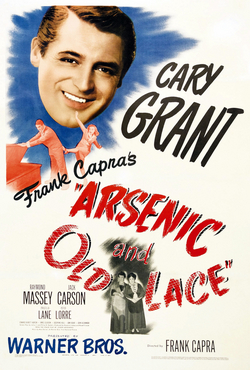
The leaves have been falling like crazy these last few days here in Berlin. Fall is here and with it pumpkins (soups, pies, lattes, jack-o-lanterns, …), corn mazes (though there aren’t as many as in the past…) and Halloween stuff! Also movies; from marathons the streaming services releasing a bunch of horror movies to the over the air TV channels issuing their Halloween night schedule (apparently it’s actual Halloween marathon this year). So this movie fit right into the season, its whole plot unfolding over Halloween night. Plus, it’s not scary, but a macabre, black comedy.

As to what makes it dark – well it’s two extremely sweet, old ladies murdering lonely older gentlemen (they just bagged their 12th victim in the windowsill) out of pity. It’s wrong, but when you look at them, how they prance around the hall with their arsenic infused wine, you can’t help but laugh. They’re pleasant, give toys to the poor, are in good standing with the police and clergy, how can you not love them? And in their sweetness, they don’t feel remorse either. In fact, there’s quite some commentary over how some people do some truly horrible things in the name of pity, going over the heads of the victims, but present themselves as honorable citizens.

But the movie doesn’t linger on this too long. It’s more on the desperation of their nephew to save his aunts from the police by trying to pin it on his delusional younger brother “Teddy”, who things he’s the actual Teddy Roosevelt. Teddy has buried the bodies in the basement (no, that’s not a metaphor) thinking it’s Panama and they were victims of yellow fever. Getting him interned in an insane asylum is a way to bury… ahem… to keep the skeletons in the closet.

But then hilarity ensues when Mortimer’s other estranged brother Jonathan shows up with his sidekick Dr. Einstein (Peter Lorre is really becoming my favorite actor in this blog, he again is a reason why the whole plot doesn’t fall apart). He’s become quite a killer, I mean criminal on his own also claiming a dozen murders on his side of the ledger. Can Mortimer remain sane with all things crashing upon his once very simple world? The murderous aunts, the crazy brothers, one evil, one naive, his new wive, the police, the director of the asylum, the taxi driver in front of his house, etc., etc., Yes, at a certain point it becomes slapstick and the conclusion is also quite rushed, but in the middle it is quite funny, being punctuated by Cary Grant’s excellent over-the-top acting. His “deer in the headlights” look is especially great and we feel for him when he mumbles to himself trying to hatch a scheme to get out of the newest comeuppance driving a dent into the old plan.
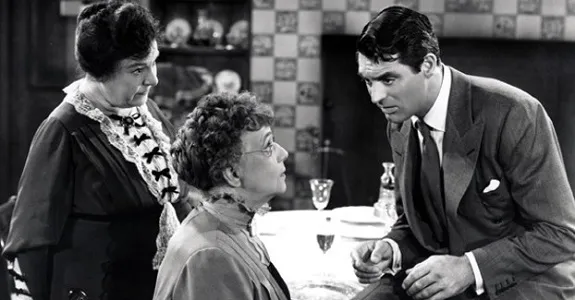
It is quite clear that the movie was born out of a play. The whole thing takes place in the main room of the aunts’ house, with some elements on the outside or the stairs, but which can fit the stage quite comfortably. It’s a plus and minus an some points. Plus, because it keeps everything contained and there are no long excursions into a distraction to the main plot, but minus, because it retains too much of the play character. It’s not like filming the play of Hamilton and calling it a movie and there are some cinematic elements (close-ups, the shot from the stairs, the music, …), but overall the movie made me even curiouser about the play. There was even a line where the brother Jonathan grows incensed because the plastic surgery has made him look like Frankenstein’s monster. Everybody says: “He looks like Boris Karloff!”, which makes him angry. Well, in the Broadway play, he was played by the actual Boris Karloff.

So, final verdict. I laughed in quite a few places, so yes, very successful in that, but don’t go around looking for the heart we see just 2 years later in Frank Capra’s It’s a Wonderful Life. It never leaves its screwball roots and as such is a good time and some very good, funny lines, but not much more behind it. Hey, it’s Halloween in 1944, sometimes you just want amusement!
1943 – The life and death of Colonel Blimp

1943 – The life and death of Colonel Blimp

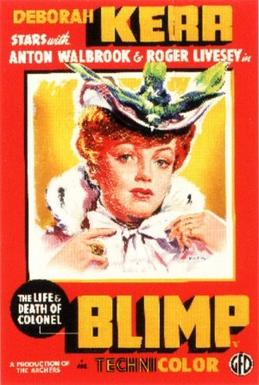
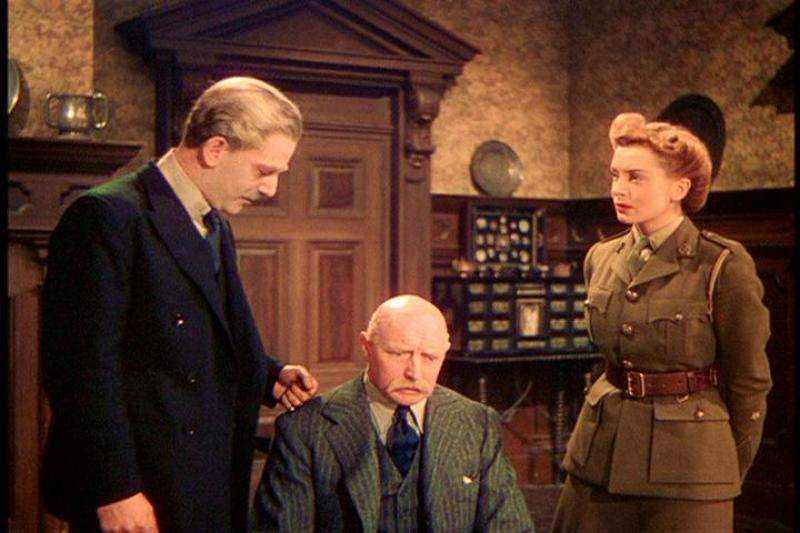
It’s an english epic biography of an english soldier, with elements of war, romance and friendship. It was produced by Michael Powell and Emeric Pressburger. It stars Roger Livesey as Clive Candy, Anton Walbrook as Theo Kretschmar-Schuldorff and a very young Deborah Kerr in 3 pivotal roles in Candy’s life. This movie also, thankfully was on YouTube.

We have now reached 1943 and while on the outside World War II is raging, also the number of movies being produced are certainly going down; there were only a third of many movies being made that year than in 1939. Also the themes are changing to include the raging war, but just as last year’s movie, one has to be careful not to fall into outright propaganda movies.

So, this one fit the bill, which was a quite critical of the English mindset of the beginning of the 20th century, with its colonialism, its supposed noblesse oblige, but all through the eyes of a quite naive English soldier stuck in the 19th century with allusions to honor and a carefully smoothed over history (for example, making light of the Boer concentration camps). One aspect I liked, is that that the movie didn’t tell you about it, you’re like two thirds of the way in and it dawns on you, “oh, that’s why it doesn’t sit right, it’s a critique of the old chap, not a celebration!”.

The way his obsession for a woman is manifested in him falling for the same type over and over again – heh, Deborah Kerr playing three roles in three important phases of Clive’s life. Creepy, but sweet at the same time. Thankfully, they’re all three quite independent women, the one in the middle marrying him to go off to see the world.

Another eye-rolling aspect is the “wall of trophies” he has in his own and which serves as a plot device to mark the passage of time. It is quite ridiculous how he accumulates these taxidermy mounts, the most cringe worthy being a whole elephant head. He even puts up a picture of his dead wife prominently in that room. We feel the uncomfortableness that Theo displays when he is shown the room.

But the most poignant point of the movie comes in the form of a speech comes right at the end. Clive is still steeped in his old ways of fighting right until the start of the Second World War. It reminded me of some aspects of Hillary Clinton’s campaign: Michelle Obama’s “When they go low, we go high” or her bringing up the dead Syrian toddler on the beach breaking he heart. It was a dirty fight and to a dirty fight you don’t bring appeals to honor or dignity. The movie explicitly has a speech about it from Theo:

“i don’t think you won it. we lost it — but you lost something, too. you forgot to learn the moral. because victory was yours, you failed to learn your lesson twenty years ago: this is not a gentleman’s war. this time you’re fighting for your very existence against the most devilish idea ever created by a human brain: nazism. and if you lose, there won’t be a return match next year… perhaps not even for a hundred years.”

And he’s like that the whole movie, surprised that the Germans would torture the English to get the location of a bridge, while his own soldiers do the same as soon as he leaves. When he greets Theo in a sea of Germans in the English POW camp like he was running into a friend at the movie theater and is surprised that his counterpart is quiet and reserved.

It’s Theo that ends up being the most fascinating protagonist of the movie. Even when he doesn’t appear through large parts of the movie, his presence is there on Clive throughout. And when he does come back to plead to be accepted by the English we learn how his whole world (view) has been slowly, but surely been destroyed. The sadness of eyes, when he says he lost his two sons… they’re now good Nazis.

I saw “One Battle After Another” last weekend, excellent movie, highly recommend it! And it told the themes of fighting for justice, how sometimes you have to fight dirty or perhaps to go against “the rules” to do right, precisely because the rules are often done by evil people. Also here, in the end, the Colonel sees the need to fight for what’s right, not for the ceremonial rules.

Lastly, some more technical aspects that need to be mentioned, but I’d rather let Scorsese introduce them for me. For a movie about someone’s life, the movie is actually very sparse in telling the most traditional aspects of it – battles won, marriages, deaths – they all get hinted at in newspaper clippings, but never shown. Rather, it is more a collections of meetings which at first don’t seem to mean much, but will define him for the rest of his life. Even the significant duel between Theo and Clive has a ceremonial and ritualistic preparation aspect that goes on for many, many minutes, but when the duel starts, the camera cuts away to the snow. It isn’t important, the build-up is, because it tells us about the type of battle and consequences that it will have.

The other aspect, is the behind the scenes stuff. Clive was supposed to be played by Laurence Olivier, but this was opposed to by Winston Churchill. Roger Livesey brings an amazing performance – this typical english speech, where they don’t even unclench their jaw – so authentic, but so jarring it made me like the movie less. The movie in general was opposed by the war department for the sympathetic depiction of a German soldier and its English critiques detailed above. In a recollection from Powell, he says that he had an interview with the war minister and he had to bluntly ask him if they were going to forbid them outright to make the film. He said something like: “Oh my dear fellow, we can’t possibly forbid you. That wouldn’t do at all. But don’t make it or you’ll never get a knighthood.” So they made it and Powell never got his supposed knighthood. Very on the nose, that one. Ha!