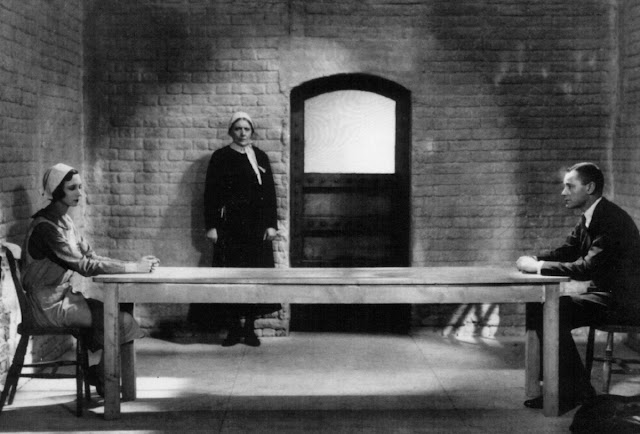
1928 – The Passion of Joan of Arc

1928 – The Passion of Joan of Arc

Produced by Société Générale des Films, directed by Carl Theodor Dreyer, is a 1928. It stars Renée Jeanne Falconetti as Joan. It is a French film based on the trial record fro Joan of Arc. I watched it on JustWatch here kindly remastered and made public by the Open Archive.

Because of David Lynch’s recent passing, I saw Mulholland Drive for the first time a few weeks ago. I had always been scared to watch it, that I would probably not understand it. So glad I did, because I absolutely loved it, especially the performance by Naomi Watts. However, I don’t know, if I liked it so much, because I understood a lot of callbacks, e.g. the “Kim Novak, Vertigo” dress that Betty wears at some point in the movie. I kept asking myself, if I would’ve understood it as much 24 years ago, when it came out, me not being mature enough or would the chills that I had throughout the movie been enough? I think the same applies for this movie, The Passion of Joan of Arc. I’ve always archived it to “probably need to see this at some point in my life, but I am still too scared that I won’t get it”. I have been disappointed before – unimpressed by Citizen Kane, bored by Lawrence of Arabia, confused by The Last Picture Show, so it’s not a given that my fears will be for nothing.

Well, I am glad to say that “I got it” for this movie. The main theme being the feeling of dread, discomfort and desperation from the oppressing close-ups in this movie. It is quite experimental, but simple at the same time. The mantra in movies usually is “show, don’t tell” – that’s what the moving pictures are for! But then you get something that turns it on its head – think 12 Angry Men, which plays out only in the juror’s room – it’s such a fine line, because a lot of the showing is only in the desperation of the faces, while the telling is often the classic expository dialogue. And the same happens in this movie – it basically has no plot, it’s the final days of Joan of Arc and her trial before her burning at the stake. It’s all the oppression she felt, but her quiet defiance in the face of torture and death.

Just like Joan of Arc itself, I also liked the quiet defiance it took to get this film made. She had just been canonized as a saint 8 years before, so fervors in France were strong to honor one of their heroes. It was quite controversial that (a) the plot was just about her final 10 days, not the amazing battles that inspired France’s last push in the 100 years war against the English (b) the movie was directed by a Dane and not a Frenchman and (c) they tried to make it as original as possible, largely reproducing word for word the original transcripts from the 15th century – condensing them into one trial, which did not sit well with the Archishop of Paris at the time and we final restoration only coming to us in 2015 after the final cut was found in a mental institution in 1981.

And then of course, there is the feminism, quite remarkable also for 1928. How the subtleties in the faces doing the horror belong to men and the faces distorting in horror at what its happening, belong to the women (with a few unhelpful exceptions such as the priest sprinkled in). Quiet, defiant competence gets women so far and Joan of Arc, but also here Maria Falconetti’s performance underscored that! Very strange to juxtapose it to the so-called feminism depicted in Lessons in Chemistry that I just finished a few days ago (blergh!). The brilliance in so many women role models for me was how they could inspire anybody to fight, work, protest, vote with them, not simply preach! This movie, while simple, also does that!

1927 – Wings

1927 – Wings

Produced by Paramount (Famous Lasky Corporation), directed by W. Wellman. It stars Clara Bow, Charles “Buddy” Rogers and Richard Arlen. It’s a story about the piloting and aerial dog fights in World War I. I watched it on YouTube here. It is the restored version that was finalized in 2012 for its 85th anniversary.


Some movies have an amazing effect on people. I was 5, almost 6 years old, when my dad took me to see War Games at the theater – anybody in their right mind would tell you that’s not a movie for a 5-year old. And yet, that movie sparked an everlasting love for computers in me, how he reversed engineered (hacked) his way into what he thought was a gaming company, the first time I heard about a modem, heard about a branch of mathematics called game theory… I begged and begged my dad for a computer and when he owed me a favor for a trip he flaked out on, I got it and have been hooked ever since. The first thing that Apple IIc taught me was perfect strategy in blackjack, heh!

Why do I tell that story? Well, it was only 2-3 years later that Top Gun came out. All the boys in my class started drawing jet fighters instead of houses, families, etc. when it was “drawing time” at school. Aviator glasses and jackets were suddenly cool. Apparently, enrolment in the air force went through the roof. It’s just like that, a movie can entice you, give you your calling… Well, judging by the technical aspects of the 1927 movie Wings, I am sure it would’ve been a siren call to many to become pilots or at least be fascinated by the aerial prowess possible with airplanes then. Last year, I read The Great Circle by Maggie Shipstead and was fascinated by the teenager girl bootlegging liquor from Canada during prohibition – she too, must have been fascinated by Wings. It was something different in the 1920s, aviators were like astronauts, something special, that barely anybody could do! I totally get the fascination with flying!

The plot of the movie is quite simple – it’s an epic of two pilots (Jack and Dave) during World War I, they pine over the same girl Sylvia at home. But just as Challengers this year, it’s also about the “friendship” these guys have with each other (and it’s still unclear whether this movie features the first gay kiss on screen or not); how they have each other’s back during the dog fights with the germans (Heinis). Sort of added, because Clara Bow’s complete star persona, was the character of Mary, who pines for Jack and joins the army as an ambulance driver.

Why did I choose the movie? For one, hey, it’s the first ever Best Picture Winner from the Academy Award. For the other, I love Buddy Rogers and Clara Bow and seeing them together should be good. I also must confess that I mixed it up with Hell’s Angels, the Howard Hughes produced movie, which fascinated me back when I saw The Aviator. Alas, it’s not that different, the filming is all original, done on the airplanes themselves, which made the movie crazy expensive (2 million dollars back then). Richard Arlen already could fly airplanes, Buddy Rogers learned for this movie.

Unfortunately, I have to say the movie is just fine. And it’s a shame, because

(a) the technical aspects are so amazing. The dogfights are a delight to see, the scenes in the air bristle with excitement and artistry. You really get the sense of airplanes being crucial to many roles in the war. As said above, I am certain, just like me with War Games and computers, this must have been an inspiration to many young people to get into aviation.

(b) Clara Bow is widely underused. She has such a magnetic personality, I would’ve much more been interested in how she came to be a uniformed mechanic and ambulance driver during WW1, than her infatuation with pretty boy Jack. Apparently even Clara Bow, didn’t see the point of her limited role in the movie, as she thought this movie was focussed on the two pilots.

As for the rest of the movie? Look, I can take the melodrama. The scene where Jack comes home from the war and meets with Dave’s parents or the “choice” Sylvia makes for Dave. But I can’t take the “aw shucks” approach this movie has to war. You tell me in a title card “The Horrors of War” and the next few scenes show them getting drunk in Paris and having a jolly good time – the bubbles gag just goes on and on and on. Or you show me the patriotism of Schwimpf with a wobbling tattoo of the Stars and Strips, jeez. And it can’t be a movie of it’s time or American sentiment during the silent film era, not when just 3 years later the masterpiece “All Quiet on the Western Front” produced in America will be released. So sure, watch this movie, because it is important for the history of movies, but sadly not because it’s a well told story.

1926 – Faust

1926Faust

Produced by Ufa, directed by F. W. Murnau. It stars Gösta Ekman as Faust, Emil Jannings as Mephisto and Camilla Horn as Gretchen. I watched it on YouTube here (did not like the horrible colorization there is on other places).

When I was an adolescent, it was typical that in the 13th year of school, you read the “Faust” by Goethe. I got out of it by reading 2 Thomas Mann books and I still regret it to this day. It may have been harder to interpret, but I am sure it would’ve given me more than that depressive German attitude that “Der Untertan” gave me, a good description, but so, so lost. In any case, reading the “Faust” is still on my backlist, but more like a project that “I’ll do someday” (yeah, right…). Everybody knows its main theme: Faust gets visited by Mephisto, an incarnation of the Devil which offers him youth, fame and fortune in exchange for his soul. Will he take that (Faustian) bargain?

So, with everybody discovering Murnau, because of the remake of Nosferatu, it was quite an easy decision to go with the Faust! It was his last German film at Ufa and is believed together with Nosferatu to be the height of German Expressionism in Film. Of course, having studied and having now worked in Potsdam for many years, the history of Ufa is present at all times. You see the imagery when visiting the Film Studios Babelsberg (the rides are horrible, but the studio and the history are great) or the Film Museum, so I went in to watch the movie knowing that.

The plot is as expected, though I did not know much about the Gretchen part of the story, which is Faust’s potential love story and the wringer she is put through in the last part of the movie. Things I liked in the movie were the artistic expression, like a ballet, almost like they were pausing the movie now and then to pose off, so that you could save the frame. The face contortions and mannerisms of Mephisto are purposively over the top, but I liked that very much. The film drags a bit in the middle, because they need to show the huge fall from grace that Gretchen has, so need to show her good, but boring life, but it distracts from the actual Faust story. Interestingly, the title cards in German were a bit hard to read, so sometimes I reverted to the English subtitles, whose translation was quite good.

In any case, the movie is as prescient today as it was in any time. In a week when during the Trump administration inauguration among the invited guests where the billionaires of tech companies, I was reminded of the quote by Lord Acton:

“Power corrupts, and absolute power corrupts absolutely.”

There is no bargain you make with the devil where you will do good in the end, even if that was your intention in the beginning. And that’s really what this techno super-elite has turned into, Faustian doppelgangers making deals with Trump, seeking eternal fountains of youth, telling themselves that they’re doing good in the world by inventing the next social media app. To assuage their guilt and looking for absolution, they donate a few millions, but are always baffled at why the people see them as evil. People, also in the movie, can sniff the wickedness in Faust a mile away. And so I can only recommend people watch the movie, the style may not be for everybody and the end message is cheesy. But just because it’s cheesy, doesn’t mean it isn’t true.

1925 – Battleship Potemkin

2025 I was looking for a New Year’s resolution. There’s always the typical ones – “I want to read more”, “I want to be healthier”, “I want to keep caught up on astro-ph”, the listserver we get our newest 60-70ish papers delivered to every day! Nah, I wanted a fun challenge. So movies, those are fun, but if chosen wisely, they can linger with you for a long time, teach you something and change your perspective on stuff. But rather than simply going after famous “100 / 250 lists” (AFI 100, IMDB Top 250, Letterboxd Top 250), many of which I have already seen, I decided to make my own list, that is 1 movie per year from 1925 – 2024! Of course, I couldn’t have seen the movie before, duh! Choosing a movie is as easy as me googling “movies from 19xx” and me going by name recognition on something I always wanted to see and look if I can stream or rent it somewhere (I still get my classics via DVD, we don’t have Criterion in Germany, grrr). But I do still have a life, I can’t watch 100 movies in a year. Last year, I watched like 85 and that included movies watched on planes and dumb Netflix movies, like “Carry On” (which was fine, but not what I’m looking for). So let’s make this a 4 year project. 25 movies per year, One every 2 weeks and I get a grace period somewhere in the year. By the way, if you like this movie blog, I do log my movies over at letterboxd, too. So…

1925 – “Battleship Potemkin
Produced by Mosfilm. Directed and co-written by Sergei Eisenstein. Main character Aleksandr Antonov portraying Vakulinchuk.You can watch it on YouTube

What does it take to start a revolution? Just like not every stone falling from a mountain will cause a landslide, likewise not every action against a represive regime will start a revolution. Just think of how difficult it was until finally the English gave up their colonial reign in India, how many failed attempts, horrifying in their brutalness. Similarly, before the Bolchevik revolution in 1917, there was the Revolution of 1905, which did NOT end the Tsarist regime, though it introduced the Duma. If you read about “The Bloody Sunday” (aka Red Sunday) it is quite clear that this is a catalyst of civil unrest.

This movie takes place during that time. It is based on true events, though the film has been changed for propaganda sakes and you need to take this into account at all times, when watching this movie. In any case, because of the Russo-Japanese war happening at that time, the Black Sea was controlled only by dingy warships, none of which were given much importance, let alone proper maintanenance. It is when the ship is given rotten meat (cinematically disgustingly exaggerated with maggots crawling all over it), that the mutiny starts. Vakulinchuk, a simple sailor, emboldened by hearing about the unrests happening in Russia decides with many other sailors to refuse to eat the rotten meat. In any case, things escalate quite quickly and I don’t want to give things away, but the sailors do take over the ship and go to Odessa to bury the ones they lost. In Odessa, the actions of the soldiers inspire the common folk in the city to join in on the fight against the higher powers.

It is then in the movie when the most dramatic and most well known scene of the movie happens: The Odessa steps. Cossacks from the top simply firing on fleeing civilians, children, women, even a dreadful sequence of a baby carriage barreling down the steps… It is a silent movie and yet I got anxious and even had to flinch away a few times. The battleship retaliates this inhuman attack by firing onto the opera house where the Tsarist leaders are meeting. Battleship Potemkin now has a big target on its back, all the rest of the Russian fleet in the Black Sea will go after them. Will they survive or go down in a flame of glory?

It is quite ironic that the actions take place in modern day Ukraine, that atrocious acts are done on Ukrainian citizens, in the name of a higher government.

In any case, the movie had a big influence on the next years. It is always weird to watch these old films and World War 2 hasn’t happened. Apparently Goebbels was impressed with it and the power of movies as propaganda. It is really quite simple, yet effective in its propaganda, you immediately know who to sympathize with, but they are easy to sympathize with. But just like this Salon article makes clear – the propaganda isn’t what is captivating about this movie. Otherwise it would’ve disappeared in the archives of the Soviet Union only to be studied by historians and not a movie enthusiast in 2025. It is the revolution in filmmaking that made this movie remarkable, the art of the montage, the capturing of emotion on the steps recreated in many movies even with the carriage as an homage. And that’s what will stay with me, a remarkable movie!