1931 – M

1931 – M (Eine Stadt sucht einen Mörder)

A german Nero Film Production written and directed by Fritz Lang. Also here, Lang’s wife Thea von Harbou had a hand in co-writing this production. It stars Peter Lorre in the title role as the murderer. I saw it on Amazon Prime, where it is available for Prime members, but you can also watch it for free on YouTube.
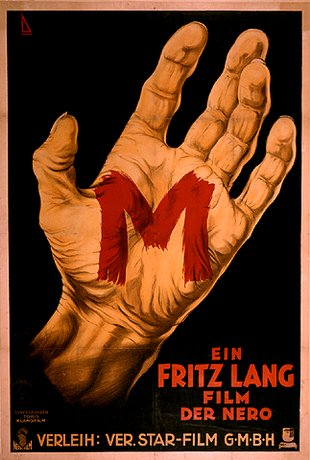
Are there crimes so heinous, that even “normal” criminals are disgusted by them? That a series of them can paralyze an entire city of 4.5 million people? Yes, after 8 disgusting murders on little girls (it is only hinted what the murderer did to them), the whole city of Berlin is on edge. People are accusing random men on the street of being pedophiles for talking to children and parents don’t let their kids out of their sight, escorting them everywhere. And for good reason, the first scenes where we accompany the anguish of little Elsie’s mother waiting for her, hoping, asking and in the end just screaming her name, set me off as a viewing mother.

The whole city becomes so paranoid, that the police presence gets ramped up, raids on petty criminal hotspots have everybody agitated, cops are working overtime shifts to catch the killer. This increased police ubiquity in turn spooks the organized crime element in Berlin, that can’t handle such increased police presence on a day to day business. In a nice juxtaposition you see the heads of the organized crime and the chiefs of police debating on how to catch the killer, each with their own methods. This juxtaposition continues then, on one side with the grunt of detective work, the tediousness of hundreds of clues, interviews, etc. compared to the underground network of beggars and vagrants coordinating informal information networks.

And then there is the killer, clearly hunted by demonic inner drive. In one scene he tries to drown that drive in alcohol, yet it comes up again and again in the haunted, distorted whistled melody of Grieg’s In the Hall of the Mountain King. At one point in the movie in an amazing monologue, he screams in agony: “I don’t want to, I HAVE to”.
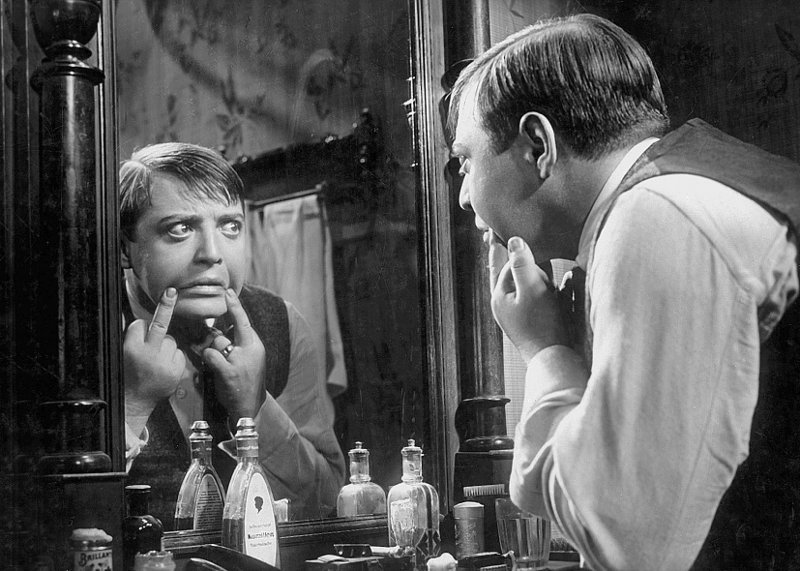
Much can be said about the movie, the modern montages (really, I thought the procedural element has been unsung in the reviews that I have read so far), the genius use of sound for this very early sound movie, the introduction of noir elements (low angles, play on shadows, etc.) that influenced so many later films. And then the dilemma that is presented to the viewer almost breaking the fourth wall: “Showing pity and understanding to a clearly deranged person, is that a commensurate judgement for the most despicable crimes on children?” But one thing that touched me, that is probably very personal and many cinephiles watching this movie won’t catch is the Berlin element of it all.

It starts with the accents. Everybody, but the murderer speaks “berlinish”, sometimes even exaggerated, but it immediately made me feel at home. Yes that is us, sometimes a bit petty criminal, yes we have the “Berliner Schnauze” (a plump, even unfriendly way of speaking), but deep down, Berliners stick together. I love that Fritz Lang, an Austrian, understood that dynamic. Erich Kästner (a Berliner) had just in 1929 released his children’s book “Emil and the Detectives” and at so many points in the movie, I thought of that book and the atmosphere of late 20s, early 30s Berlin and their people: seedy, anything goes, poor, but also clever, fair and funny. It also reminded me of the song “Das ist Berlin” my husband worked on during his time at Funke. “When you spice yourself up, even though you’re ugly. When Stefan becomes Steffi. That is Berlin”. That spirit is still in the city: we will be very open to any of your ideas, you live you life man, you may see us as a bit lazy, a bit dumb, a bit unfriendly, a bit ugly, but when it really matters, we will band together, you can’t break this city’s spirit. And at the same time… we know; there is that haunting spectre hovering over the city in 1931… what is to come!

Ok, so I am a week late, but so happy this is the movie I got to see for this year, it had been on my list for far too long. I will probably post 2 weeks from now, fortunately I had set myself some cheat weeks.
1929 – Pandora’s Box

1929 – Die Büchse der Pandora (Pandora’s Box)

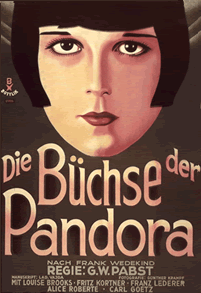
A classic Weimar era silent movie, directed by G.W Pabst. It stars Louise Brooks in its titular role as Lulu , Fritz Kortner as Dr. Schön and Francis Lederer as Alwa Schön. It is based on Frank Wedekin’s plays “Erdgeist” (1895) and the follow-up “Die Büchse der Pandora” (1904). The film explores the tragic that the natural seductiveness of Lulu brings to herself and everybody to succumbs to her allures. I saw it at filmfriend, the German library service for free (you have to enter your local library card).

Last Sunday Anora won the Academy Award for Best Picture for 2024. Well deserved, in my opinion, though I haven’t seen many of the other movies that were favored to win. What I liked was the realistic depiction of the crashing down of the “fairy tale”. Ani is firmly grounded in reality, but even then for just a second the lure of the possibility to obtaining respectability is so great… maybe, just maybe. It was all masterfully done by Mickey Madison, who wholeheartedly deserved that Oscar – the constant battle in her head of “am I gonna get mine?” and “it’s gonna work out, Vanya loves me!” and in the end “that dipshit… really hurt me”. Yes, sex workers know how society sees them, but it still hurts to be shown that with such contempt.

Also in this movie Lulu – a masterful Louise Brooks – is constantly reminded that all she is ever good for, is to seduce. Men and women alike, by the way, the movie has a whole lesbian subplot. The movie starts with a visit by her former pimp Schigolch (sorry, later it gets revealed that in may be her dad, but the way he acts throughout the movie, I’m going with pimp). She doesn’t need him anymore, she already has found her sponsor, ahem boyfriend Dr. Schön, an older man and a rich publisher. But Dr. Schön actually wants to shed her, gain some respectability, marry the daughter of the minister of the interior. And that constant push and pull between the entrancement that Lulu has on other people and the way that she brings them sorrow is the main plot of the movie. It is a tragedy throughout the movie. Nobody that crosses paths with Lulu is made whole, many end up dead or living in complete poverty. But nobody is completely innocent either, they act out of self-interest going over dead bodies to get money, love or escape the police.

The story is quite convoluted, the settings very varied – a theater production company, a wedding party, a courtroom, a confined train escaping the law, a gambling ship, a squalid room under the roof in London. It wouldn’t have worked without its main protagonist, who wholeheartedly encapsulates the myth of Greek mythology Pandora’s Box: opening the box brings misfortune, but the box also holds hope! Is the hope of love that Lulu offers along with evils that her status and her non-moralistic candor bring, a benefit or a curse? How ironic then that the movie star herself ended up in poverty, noting that “the only people who wanted to see me were men who wanted to sleep with me.”

In modern culture, the box has become “a can of worms” or a “slippery slope”. It’s often a warning against unbridled optimism, that while the hope that comes with the act is understandable, there is often a hidden evil or tragedy when you go in blind. This week’s Pandora’s Box for me has been AI in science. I heard two presentations on it, one was even on the ethics of the use of AI in science, yet at the end there were a lot of shrugs and “well, if we’re careful…”. Working on a white paper this week, I was amazed that a woman spoke up and declared that if even a sentence of the paper was written with an LLM, we should take her name off the paper. I am distancing myself from that box even more after this week, some of the things may bring hope, but its allure may damn me into a sequence of evils and tragedies I’d rather not go through.

1926 – Faust

1926Faust

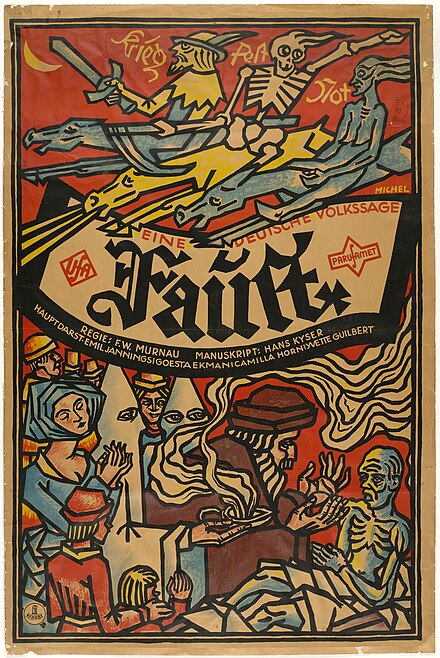
Produced by Ufa, directed by F. W. Murnau. It stars Gösta Ekman as Faust, Emil Jannings as Mephisto and Camilla Horn as Gretchen. I watched it on YouTube here (did not like the horrible colorization there is on other places).

When I was an adolescent, it was typical that in the 13th year of school, you read the “Faust” by Goethe. I got out of it by reading 2 Thomas Mann books and I still regret it to this day. It may have been harder to interpret, but I am sure it would’ve given me more than that depressive German attitude that “Der Untertan” gave me, a good description, but so, so lost. In any case, reading the “Faust” is still on my backlist, but more like a project that “I’ll do someday” (yeah, right…). Everybody knows its main theme: Faust gets visited by Mephisto, an incarnation of the Devil which offers him youth, fame and fortune in exchange for his soul. Will he take that (Faustian) bargain?

So, with everybody discovering Murnau, because of the remake of Nosferatu, it was quite an easy decision to go with the Faust! It was his last German film at Ufa and is believed together with Nosferatu to be the height of German Expressionism in Film. Of course, having studied and having now worked in Potsdam for many years, the history of Ufa is present at all times. You see the imagery when visiting the Film Studios Babelsberg (the rides are horrible, but the studio and the history are great) or the Film Museum, so I went in to watch the movie knowing that.

The plot is as expected, though I did not know much about the Gretchen part of the story, which is Faust’s potential love story and the wringer she is put through in the last part of the movie. Things I liked in the movie were the artistic expression, like a ballet, almost like they were pausing the movie now and then to pose off, so that you could save the frame. The face contortions and mannerisms of Mephisto are purposively over the top, but I liked that very much. The film drags a bit in the middle, because they need to show the huge fall from grace that Gretchen has, so need to show her good, but boring life, but it distracts from the actual Faust story. Interestingly, the title cards in German were a bit hard to read, so sometimes I reverted to the English subtitles, whose translation was quite good.

In any case, the movie is as prescient today as it was in any time. In a week when during the Trump administration inauguration among the invited guests where the billionaires of tech companies, I was reminded of the quote by Lord Acton:

“Power corrupts, and absolute power corrupts absolutely.”

There is no bargain you make with the devil where you will do good in the end, even if that was your intention in the beginning. And that’s really what this techno super-elite has turned into, Faustian doppelgangers making deals with Trump, seeking eternal fountains of youth, telling themselves that they’re doing good in the world by inventing the next social media app. To assuage their guilt and looking for absolution, they donate a few millions, but are always baffled at why the people see them as evil. People, also in the movie, can sniff the wickedness in Faust a mile away. And so I can only recommend people watch the movie, the style may not be for everybody and the end message is cheesy. But just because it’s cheesy, doesn’t mean it isn’t true.