1930 – Murder!
A British mystery movie, directed by a young Alfred Hitchcock. It was written by him and his wife Alma Reville and Walter Mycroft. It stats Herbert Marshall as Sir John Menier, Norah Baring as Diana Baring and Edward Chapman as Ted Markham. It’s based on the 1928 novel Enter Sir John by Clemence Dane and Helen de Guerry Simpson. A watched it with ads for free on Plex.
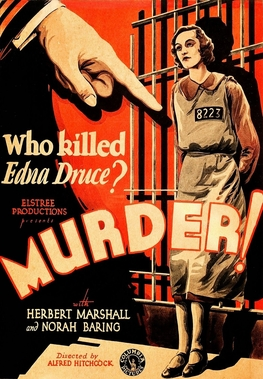
Finding a movie for 1930 turned out to be difficult. I had already seen All Quiet on the Western Front and The Blue Angel, so those easy pickings were gone. I tried very hard to find Morocco, but couldn’t lest I shelled out 16 Euros for a DVD (nah!). I had no desire for yet another F.W. Murnau movie in City Girl about living on the farm in Minnesota. Sigh…
And then I saw the BKR video about Alfred Hitchcock’s Hair Obsession, which I really liked. But what I liked most, is the accompanying podcast No Noise podcast which was about Alma Reville, Hitchcock’s wife and a tremendous influence on him and especially his early movies when he was still in Britain. Highly recommend it, and this one is free for everybody, though supporting Izzy is always a good idea! In the podcast Dr. Josephine Botting, Curator at the BFI National Archive goes into the history how Alma started as a cutter (editor basically), meeting Hitchcock and then sort of becoming the person that would tidy up his films, mostly through writing. This went on for a long time right up until and including Rebecca, after which she focussed mostly on the children. So I got curious, how do British Hitchcock movies look like, how did this woman influence the weird genius that this man would become? So many successes and fortunes of men in the 20th century were heavily carried and influenced by their wives (often willingly in the shadows), I wanted to honor that.
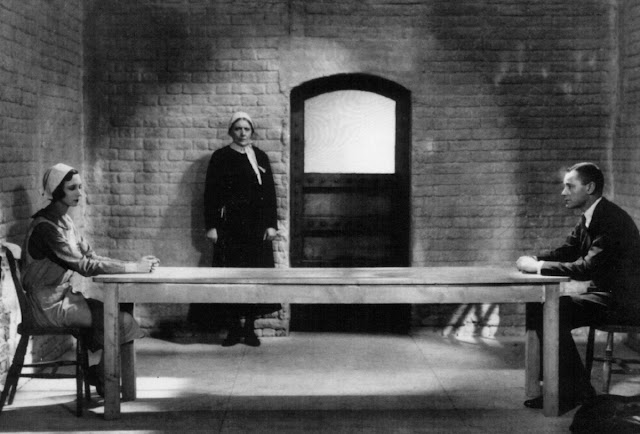
The plot of “Murder!” is about an theater actress Diana Baring being accused of the murder of a fellow actress with a poker. In the jury there is Sir John (who happens to have hired Diana into his theater company – uh, conflict of interest?), who has doubts about Diana’s guilt, but is persuaded by the rest of the jury to convict. Later, haunted by his conscience, he goes on to investigate whether Diana was really guilty – playing detective with help of his stage manager Ted Markham.
This is my first talkie movie and ooooh boy, it is bad in that sense. It was supposedly first filmed as a silent film and later half talked over, half filmed again. And then there are scenes where nothing of this sort is done – it’s just… silent, no ambient sound, nothing. Similarly, the cuts are jarring, the film quality is horrendous at times. And don’t get me started on the editing, a 2 second close up on a clock, then 2 seconds on some meal, then the scene starts. One notices how filmmakers still had to learn to not use the cue cards to narrate a story. Sometimes it’s that janky shots quickly one to the other, sometimes a huge exposition dump. Add in to that the unevenness of the sound editing; there’s a radio programme at full blast when Sir John is talking to his butler about his motives for investigating this murder, or a baby screaming at full volume when he immerses himself into the lives of the actors.
But worst of all, is that it drags. Pity, because there are some real hidden gems in there, like the shadow play or a trapezium scene that is at the core of suspense. Or even some forced things, which are typical Hitchcock style over story, but which work so well — like the improbable, but very funny interrogation scene during a theater play. It could’ve been so great, had it had a competent editor. And so this week I was left disappointed, both that greats do really need to grow into greatness sometimes, but also that even if there was any of Alma’s influence in this movie, it sadly probably wasn’t very good. Still, I am glad I saw this movie, yet another style from the Russian, German, American and French that I have reviewed so far and one that I recognize in British films even many years later.

 Tanya's Astro Blog