1926 – Faust
Produced by Ufa, directed by F. W. Murnau. It stars Gösta Ekman as Faust, Emil Jannings as Mephisto and Camilla Horn as Gretchen. I watched it on YouTube here (did not like the horrible colorization there is on other places).
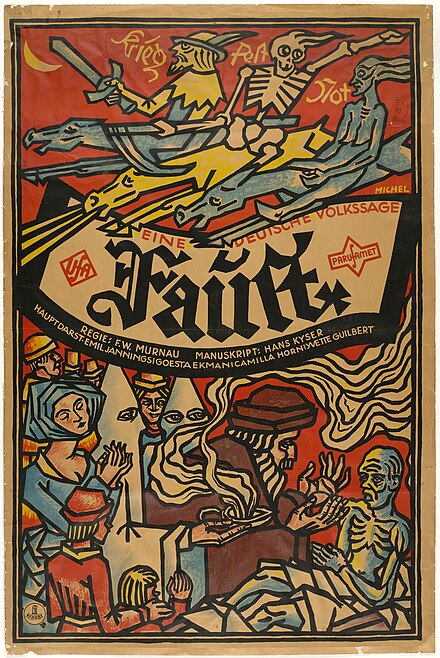
When I was an adolescent, it was typical that in the 13th year of school, you read the “Faust” by Goethe. I got out of it by reading 2 Thomas Mann books and I still regret it to this day. It may have been harder to interpret, but I am sure it would’ve given me more than that depressive German attitude that “Der Untertan” gave me, a good description, but so, so lost. In any case, reading the “Faust” is still on my backlist, but more like a project that “I’ll do someday” (yeah, right…). Everybody knows its main theme: Faust gets visited by Mephisto, an incarnation of the Devil which offers him youth, fame and fortune in exchange for his soul. Will he take that (Faustian) bargain?
So, with everybody discovering Murnau, because of the remake of Nosferatu, it was quite an easy decision to go with the Faust! It was his last German film at Ufa and is believed together with Nosferatu to be the height of German Expressionism in Film. Of course, having studied and having now worked in Potsdam for many years, the history of Ufa is present at all times. You see the imagery when visiting the Film Studios Babelsberg (the rides are horrible, but the studio and the history are great) or the Film Museum, so I went in to watch the movie knowing that.
The plot is as expected, though I did not know much about the Gretchen part of the story, which is Faust’s potential love story and the wringer she is put through in the last part of the movie. Things I liked in the movie were the artistic expression, like a ballet, almost like they were pausing the movie now and then to pose off, so that you could save the frame. The face contortions and mannerisms of Mephisto are purposively over the top, but I liked that very much. The film drags a bit in the middle, because they need to show the huge fall from grace that Gretchen has, so need to show her good, but boring life, but it distracts from the actual Faust story. Interestingly, the title cards in German were a bit hard to read, so sometimes I reverted to the English subtitles, whose translation was quite good.

In any case, the movie is as prescient today as it was in any time. In a week when during the Trump administration inauguration among the invited guests where the billionaires of tech companies, I was reminded of the quote by Lord Acton:
“Power corrupts, and absolute power corrupts absolutely.”
There is no bargain you make with the devil where you will do good in the end, even if that was your intention in the beginning. And that’s really what this techno super-elite has turned into, Faustian doppelgangers making deals with Trump, seeking eternal fountains of youth, telling themselves that they’re doing good in the world by inventing the next social media app. To assuage their guilt and looking for absolution, they donate a few millions, but are always baffled at why the people see them as evil. People, also in the movie, can sniff the wickedness in Faust a mile away. And so I can only recommend people watch the movie, the style may not be for everybody and the end message is cheesy. But just because it’s cheesy, doesn’t mean it isn’t true.
 Tanya's Astro Blog