1950 – Born Yesterday

1950 – Born Yesterday

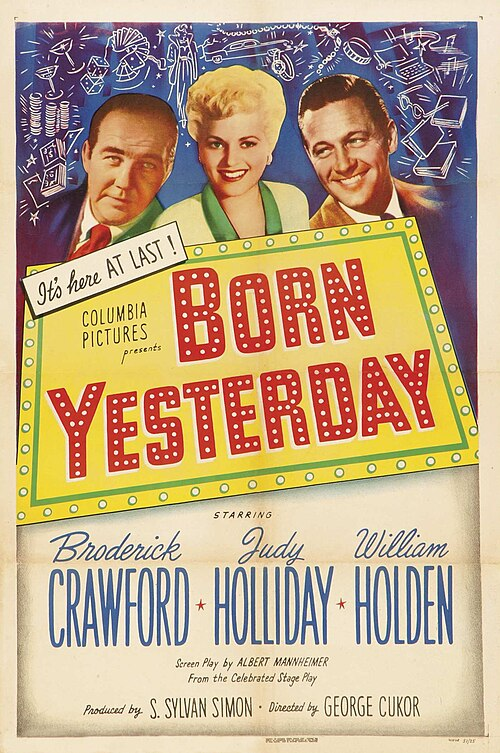
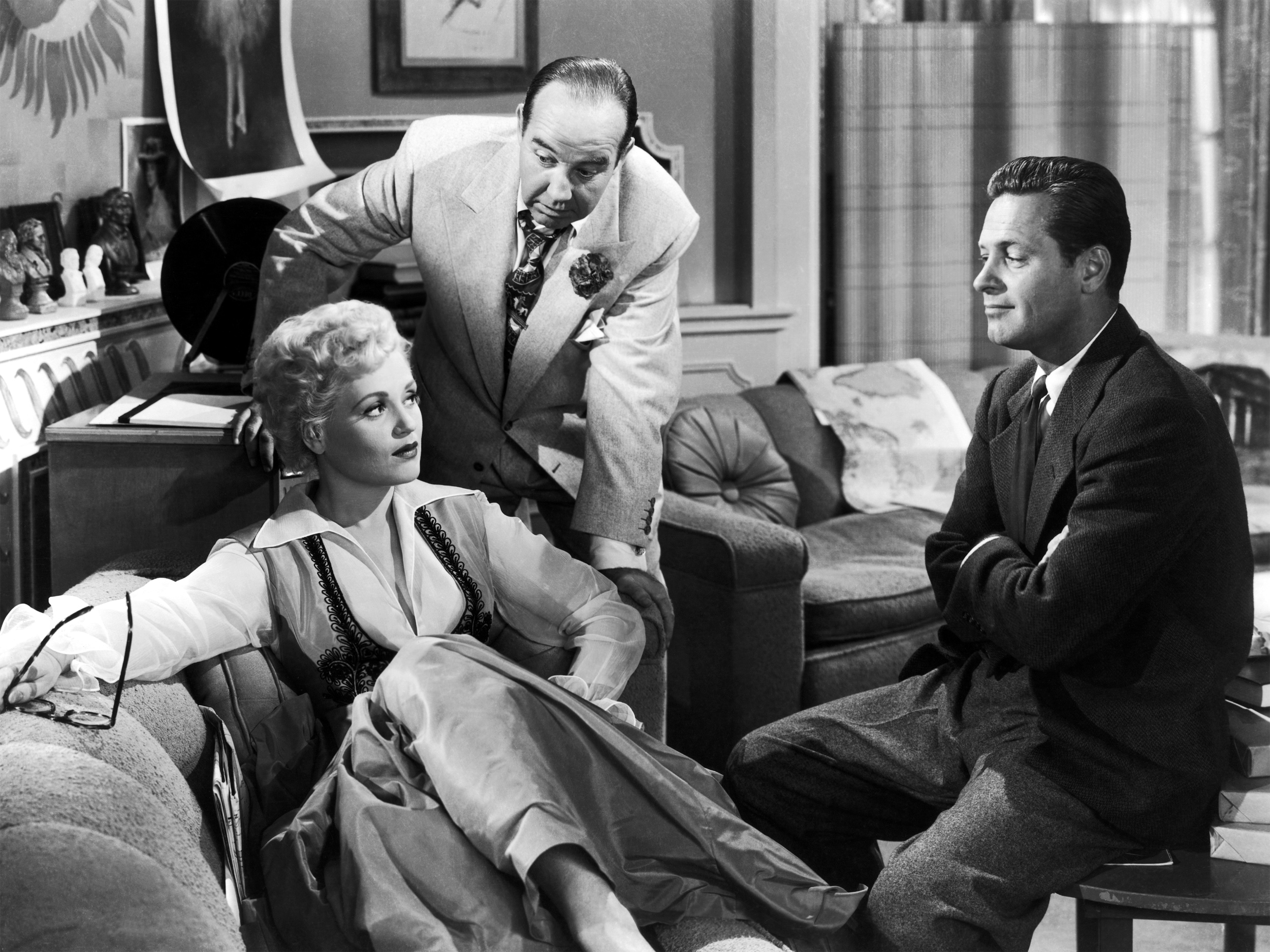
It’s a romantic comedy directed by George Cukor. It’s based on the 1946 play by Garson Kanin of the same name. Since Cukor apparently disliked Kanin, he did not share credit with him or the playwright Albert Mannheimer. It stars Judy Holliday as Billie Dawn (in her Oscar winning role), Broderick Crawford as Harry Brock and William Holden as Paul Verrall. I rented it on YouTube for 3.99 Eur.

Happy New Year, everybody. I never did write that summary of my first year of “100 years of movies”. Ah, never mind; it wasn’t going to be that interesting anyway. The theme is mainly that working on scratching out a list let’s you in on so many amazing movies (like “M” or “To Be or Not To Be”), but also some real clunkers (I am still stewing on how unlikable the protagonist of “Bicycle Thieves” is). You need the patience to go through it, so that the discovery of gems is even more rewarding. In summary, I am really happy, I undertook this project and I am really interested what I will discover in the 3rd year (movies from the 80s and 90s are my most-watched decades). Anyway, my essays in 2026 will cover the movie years 1950-1974, a period of significant change in cinema. It starts with Hollywood still being in a high, but very soon will be attacked by HUAC and people having TVs in their homes. But it will come out of the slump at the end of the 60s with a whole of individual auteurs, away from the rigid studio system into a more gritty, realistic cinema. I am really interested in the journey. Let’s begin.

One of my favorite TV shows is Better Call Saul. I could go wax poetic about it, especially now that Rhea Seehorn is finally getting awards recognition for Pluribus, but a major standout is the cinematography. Colors, shapes, angles and costumes all have meaning. The references within the show are also superb, from the books characters read and the songs they listen to, down to the food consumed. And, of course, the movies. In the climax of the final season, the midpoint of the season and the real breaking point of the whole series is Plan and Execution (just look at that IMDB score 9.9!). Before the shocking final act, Jimmy and Kim are just relaxing, celebrating, having some wine and watching a movie. Which movie? Well “Born Yesterday”, of course – the scene where Billie goes “the proper study of mankind is man (’cause that includes women, too)”. In the next episode the movie comically goes on playing, but I won’t give anything away. In any case, the choice of that movie and that quote made me curious about it.

I had seen the middling remake with Melanie Griffith before. Look, I do have a soft spot for Melanie Griffith, I don’t know why, but I can hardly recall anything about the movie, only that she wanders to the dictionary time and time again – so it’s forgettable, but not as bad as many people say. But what finally put this movie on my big watchlist was BKR’s 1950s Oscar race video essay. All About Eve is without a doubt the movie that turned me towards old movies, how good they could be. Bette Davis was just so fascinating to watch, so magnetic. It was unfathomable how anybody else could’ve won the race. But then, that 1950s race supposedly was legendary, because it also included Gloria Swanson for Sunset Boulevard, which was also amazing (though I am still on the Bette Davis train). What could’ve surpassed those performances?!?!? Judy Holiday’s performance apparently – so I had to watch it.

And yes, all three lead performances are amazing. Judy Holliday does have a natural charisma, and slips into the role very comfortably. At first I thought that voice would be grating on me, but she manages to change it ever so slightly over the course of starting to become a bit more educated that at the end you wanted to hear what she was going to say for herself, it had a touch of assuredness. Her “ditzy, dumb blond” performance is so iconic, she played it just a year later in front of the Pat McCarran’s Senate Internal Security Committee for apparently sympathizing with communists – no idea whether the Senate bought her performance or whether she didn’t really have any connections with communists, but she never suffered any consequences in her acting career from that subpoena. In any case, also also Broderick Crawford’s performance was amazing. I immediately bought his unlikable, but powerful dumb oaf performance. The scene where Harry and Billie are playing cards is mesmerizing: her for winning every hand and having a weird system in shuffling the cards; him, for wanting to assert power, but still yearning for those minutes with her, the way he slams the deck, but then looks at her. Fascinating! And William Holden? He is okay, but let’s face it, he is mainly eye candy. Haha.

Ok, so how about the themes of the movie? They are quite simplistic. The movie implies that Billie had her awakening through the study of politics in just a few weeks. That’s not how it works, of course, education takes time. In that sense, the process is presented almost childishly, packaged with sexism and derision and an odd Americana tinge (glorifying the architecture of Washington DC). But the lines the movie delivers are powerful. The way they equate selfishness to fascism immediately makes one think of the current president of the United States. The way Billie tells the senator that money shouldn’t put any person above his constituents immediately brings up images of Elon Musk. Her journey of self-discovery is fascinating to watch, even if it is not realistic.

In that sense, the delivery of the message is a little too plump. Harry is a convenient villain – loud and couth. The audience from the first scene knows he’s the bad guy, the way he treats the hotel staff and splashes around with his money. Of course, the breaking moment is when he hits Billie, of course he gets his comeuppance through his greed in the end (that is the mildest of spoilers, come on, you know the moral center will win).

So the theme of the movie seems to be that “knowledge is power,” yadda yadda, very liberal values, which is why the movie is often loved in liberal circles. Yet the movie conveniently forgets about the silent villain in the back, the knowledgeable lawyer Jim. He knows which politicians to buy and exactly how far to go with the law without getting into trouble. He could have been Assistant Attorney General, yet he willingly lets himself get lured to the dark, but very lucrative, side. Conveniently, the movie ties the main story up too neatly with a bow and just scratches the surface of the matter. If it is an invitation to further educate oneself, it is very superficially delivered; if it is a warning to stand for your principles no matter the lure of riches, it’s not very successful. I am probably being too harsh on the movie in this last paragraph, but that’s how I felt about the delivery of the message. But it is an entertaining romp, so I should not dissuade you to watch it from that viewpoint.

1948 – Bicycle Thieves

1948 – Bicycle Thieves – (Ladri di biciclette)

It’s an Italian neorealist drama film directed by Vittorio De Sica. It stars totally unknown actors Lamberto Maggiorani as the father (Antonio) and Enzo Staiola as the son (Bruno), who are looking for a stolen bike in poverty stricken post-WWII Italy. I saw it on YouTube, thanks to this amazing list I found on there. I chose it because it was at one time (1952) rated number 1 in Sight an Sound’s Greatest Movie of all time.

As a kid, I loved my bike. Rode it up and down our little neighborhood in the afternoons, down dirt paths, trying to get amazing jumps in. On the weekend my dad would take me to the BMX park and I would dive into the bowl with joy and try (and fail) some jumps on the half pipe. I even dreamt of my bike, that I could fly over the big cliff near our house, that I would win some bike race. I wasn’t even super good at it; I just loved the bike. Not for nothing, at one point I could recite you the lines of Pee-wee’s Big Adventure, by heart. Poor Peewee’s beautiful red bike (mine was red, too) gets stolen and he has to track it down all over America, what’s not to like?

I was also captivated by the two staples of Italian cinema when I was young: Cinema Paradiso and Life is Beautiful. Both are centered around the relationship between a boy and his father figure and both boys are so cute to look at. The pictures I had seen of Bruno in this movie seemed enough to convince me to watch this movie.

But then… I kinda hated this movie. First of all, the bleakness – yes, of course, post war Italy is bleak. People are fighting for survival, there aren’t any jobs around. But that’s just it, everybody is miserable, everybody is suffering, of course some people are going to resort to stealing. I could just simply no warm up to the main character. So self righteous, as if he deserved special treatment, as if he is the only one to be believed by the police. He gets all indignant and impatient when his wife goes to see a fortune-teller and nags at her, but then he goes to see her himself and whines that his wife nags at him. But the worst is his treatment of his son, he constantly yells at him when all he’s trying to do is to help his father. Poor kid falls and gets scraped in the rain, gets beaten by his old man and in the end is berated for having such a dead beat dad.

And the movie drags, too. It gets boring after a while to go from street to street of Antonio accusing yet another person of stealing his damn bike. There are some scenes, which are cute, for example Bruno eating his mozzarella sandwich (yum!), but I had to stop the movie at several points, because I was bored. Sorry, but I will just go back to Pee-Wee and let Antonio wallow in his misery.

This is my second-to-last entry for this year and I don’t want to end my last entry on a sour note, so before I leave, I want to wish you, some happy holidays and merry Christmas! Thanks for reading the blog!

1947 – The Lady from Shanghai

1947 – The Lady from Shanghai

It’s an american film noir produced and directed by Orson Welles and also stars him along Rita Hayworth as the two main characters. Welles’s screenplay is based on the novel “If I Die Before I Wake” by Sherwood King. It’s about a drifter sailor and how he gets caught up between a corrupt lawyer and his mysterious wife. I rented in on Apple TV for 3.99 Eur

You know what I like having grown up in a different country than I live now? Even though, I fully understand the culture and I can adapt fully, I know of different ways something can be looked at or done. It often leaves a smirk on my face when somebody is enraged that they’re being questioned about the way “they have always done it” or the unwillingness to adapt to new circumstances. I see that in other kids that grew up as citizens of the world and not married to one country, they have a sort of pragmatism about the world without succumbing to cynicism.

So it is here that I chose to have a second movie in a row with Rita Hayworth, because she plays this woman that grew up in China and calls herself a gambler of the world – it just seemed so interesting. Her way of talking, her familiarity about the Chinese culture in the far too few scenes in San Francisco, were fully intriguing. And it left me wondering, she was clearly a very knowledgable person of the world – what was her backstory?

Unfortunately, the film itself has many, many shortcomings. Allegedly, the film is about 60 minutes longer, but Welles was forced to cut a lot out by the studio. It shows. The story is quite abrupt in some places. In my review I had said, the movie needed a good editor, but perhaps when you have to cut that much, well then it doesn’t matter, it’s always going to be janky. As said above, I so would’ve loved to hear more about Elsa’s backstory. No, instead we get weird courtroom scenes, where Mr. Bannister plays the fool on purpose.

In my review, I had also said that the movie went style over substance, but perhaps too much of the substance was cut away in post. But boy, it is stylish; we’re in beautiful locations at sea and in Mexico, where everybody is sweaty and boozed up. The scenes in San Francisco are more muted, but much more elegant, even Chinatown looks enticing, like a whole other world. These scenes were both filmed on location and it ballooned the cost of the movie, but it does look amazing (like you can see the beach of Acapulco in the background and people walking on it, so it’s not a set). And the ending is what sells it to a lot of people, the hall of mirrors giving us a dizzying, disorientating feeling. Even that, was 20 minutes, cut down to just 3, a shame. Rita Hayworth, of course, steals the show as the femme fatale and even Orson Welles would’ve been charismatic and great if not for that very, very strange Irish accent he’s trying to sell (and sometimes forgets to enact).

And lastly, the melodrama. Nah, this time it was ratcheted up to 11 with the violin in the background trying to tug at your feelings. I just wasn’t sold on it. That’s the thing with melodramas, it’s very hard to argue when people get sold on them, sometimes they work and sometimes they just leave people cold. A lot of people like this B-movie noir (I did also seek it out for its quite good, but not excellent reviews), so it is a personal taste, it just didn’t appeal to me.

1946 – Gilda

1946 – Gilda

It’s an american noir directed by Charles Vidor. It stars Rita Hayworth as Gilda, Glenn Ford as Johnny Farrell and George Macready as Ballin Mundson in a deliciously elegant antagonist role. It’s the story about a gambler rediscovering his old girlfriend in Argentina, only she’s out for revenge and is married to his new boss. I rented it on Apple TV for 3.99 Eur.

One of the reasons movies are so special to us is they often transport us to a world that is far beyond our reach. Whether it’s a fantasy adventure like Lord of the Rings or a historic epic like Gladiator, heck, even a Western like The Searchers, you are wholly in an unfamiliar setting. What has become less and less prevalent, are movies about far away lands, the exoticism, coupled with opportunity of a clean slate. Even growing up, the movies of the 80s and 90s were often: “I did a crime, I’m going to Mexico!”. 80 years ago, every country outside our own seemed ripe and full of possibilities, because we didn’t know any better. The world of sophisticated and elegant actors, a dream to journey on for riches.

Today, nothing is exotic anymore, every little cafe in the middle of nowhere has a Google review and GPS makes sure you aren’t lost even in the deepest jungle or the most arid landscape. I’ve been fascinated this year reading about Point Nemo or the adventures of wandering to Bir Tawil, the last truly unknown places. It seems I am not alone with this feeling, one of my favorite YouTubers expressed as much for the way we travel, in that it somehow lost its magic.

So it was nice to travel back in time with this movie, to a place where you could Tabula Rasa your way in – Buenos Aires, Argentina (and also Montevideo later) seemed exotic enough. The war had just ended, the world full of possibilities for gamblers and sinners to start anew.

And boy does this movie look great. It’s not for nothing that Andy Dupree was stricken by Rita Hayworth and put her up on that wall in The Shawshank Redemption, that flick with the hair inmortailized. The hip action in her songs – what amazing rendition of Put the Blame on Mame dubbed in by Anita Ellis. And even old Johnny chap is very nice on the eyes. I only ever knew him for being Pa Kent in Superman, but that smirk and the way he leans… swoon. And the electricity between them is crackling, apparently it was real and they become “on again, off again” lovers during the filming of the movie.

But the plot is a convoluted mess, haha. As I said, go for the exotics, the elegance, the worldliness, but not for the story. Of course the villain is somehow involved with the Germans. Of course the elegant local policeman will be the one handing out sage advice. Of course our hero is a plucky american, a little rough on the edges, but with a little gamble in him, he’ll get what he want. At least the ending didn’t quite adhere to noir tropes. So an entertaining movie all around and a great escape to a time when you could just “escape” to Argentina – just don’t try looking for logic and please overlook the millions of plot holes.

1945 – Brief Encounter

1945 – Brief Encounter

It is a British romantic tragedy directed by David Lean from a screenplay by Noel Coward based on a 1936 one-act play Still Life. It stars Celia Johnson as Laura and Trevor Howard as Alec. I saw it on YouTube thanks to the wonderful restoration by the British Film Institute, the David Lean Foundation and Digital restoration by CineImage

I feel like my life has settled into a comfortable routine nowadays. It’s great, I get to travel the world and do amazing science and get to meet super interesting people. And then I get to go home to a kind and loving family. I have no money troubles, no illnesses, no major burdens. But one thing, I do try to do every so often, is to realize the uniqueness that lives in that routine, the small things you know. It occurred to me when I heard yet another person complaining about air travel, how we have forgotten how magical it is that we get into a metal flying tube and are at our destinations so quickly it was unimaginable just 120 years ago. It’s a bit like being in love sometimes, grateful for it, your senses are more tuned to the world around you and you see the good in everything.

I think that is what I take from this movie the most. It’s about a love story between two married people, that was so brief, it didn’t even fully get off the ground. It was so powerful for them, it makes it seem so powerful to us, too. Yet life around them goes on as normal, I like the little “will they, won’t they” routine the train conductor has with the refreshment room lady or how the kids are petulant, but nice. When they’re in love, suddenly everything, even a lady playing the base weirdly is wildly funny or an excursion to an old stone bridge meaningful.

Did I buy into the romance? Yes, I did. Celia Johnson plays the part marvelously, strikes just the correct balance (for that time acting, at least) to make us see and believe what she is going through. Her change in face when she is lying to her friend on the phone asking her to cover for her to when she hangs up, is well portrayed to us. And Trevor Howard makes it very easy for us, the audience, to fall for him, too. I also like the realism on how it won’t last – like what are they supposed to run away together? It takes me back to one of the final scenes in “The Bridges of Madison County“, how she is clinging to the door handle, but doesn’t act on it.

The movies this is most compared to, is the “Before-Trilogy” by Richard Linklater, the giddiness of the first encounter on the train, the played upon non-chalance in the second movie and the setting in of the realism in the third movie. It’s not just me, one of the top comments on Letterboxd is a misquote from Before Sunset (my favorite one of the three): “Baby, you’re going to miss your train!” (she says plane in the movie) and it’s all we can think of, that Laura (of Brief Encounter now) should give in to her feelings. Sadly, I do give the slight edge to the “Before Trilogy” in that sense, “Brief Encounter” is just a tad too melodramatic.

The final interesting aspect, which I didn’t know, was the music. In the background it kept playing the second movement of Sergei Rachmaninoff’s Piano Concerto No. 2, but we do now know it by the name “All by myself” made mostly famous by Celine Dion. If you don’t know the story of that note, how it gives you chills how she sang it after he husband died, I fully recommend this YouTube video David Neely made of the song. Anyway, I kept thinking about the sadness of the song as I watched the movie and it fit so perfectly. Well done, David Lean! I am now a bit more melancholic and romanic, but tuned to what is happening around me, thankful for what it has given me.