1950 – Born Yesterday
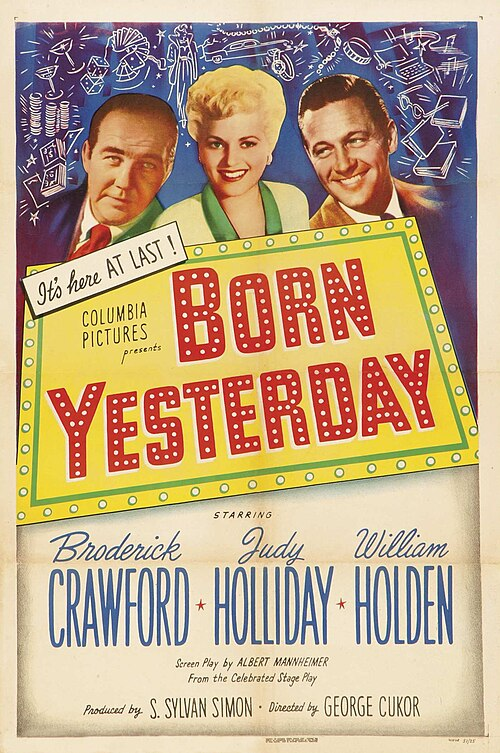
It’s a romantic comedy directed by George Cukor. It’s based on the 1946 play by Garson Kanin of the same name. Since Cukor apparently disliked Kanin, he did not share credit with him or the playwright Albert Mannheimer. It stars Judy Holliday as Billie Dawn (in her Oscar winning role), Broderick Crawford as Harry Brock and William Holden as Paul Verrall. I rented it on YouTube for 3.99 Eur.
Happy New Year, everybody. I never did write that summary of my first year of “100 years of movies”. Ah, never mind; it wasn’t going to be that interesting anyway. The theme is mainly that working on scratching out a list let’s you in on so many amazing movies (like “M” or “To Be or Not To Be”), but also some real clunkers (I am still stewing on how unlikable the protagonist of “Bicycle Thieves” is). You need the patience to go through it, so that the discovery of gems is even more rewarding. In summary, I am really happy, I undertook this project and I am really interested what I will discover in the 3rd year (movies from the 80s and 90s are my most-watched decades). Anyway, my essays in 2026 will cover the movie years 1950-1974, a period of significant change in cinema. It starts with Hollywood still being in a high, but very soon will be attacked by HUAC and people having TVs in their homes. But it will come out of the slump at the end of the 60s with a whole of individual auteurs, away from the rigid studio system into a more gritty, realistic cinema. I am really interested in the journey. Let’s begin.
One of my favorite TV shows is Better Call Saul. I could go wax poetic about it, especially now that Rhea Seehorn is finally getting awards recognition for Pluribus, but a major standout is the cinematography. Colors, shapes, angles and costumes all have meaning. The references within the show are also superb, from the books characters read and the songs they listen to, down to the food consumed. And, of course, the movies. In the climax of the final season, the midpoint of the season and the real breaking point of the whole series is Plan and Execution (just look at that IMDB score 9.9!). Before the shocking final act, Jimmy and Kim are just relaxing, celebrating, having some wine and watching a movie. Which movie? Well “Born Yesterday”, of course – the scene where Billie goes “the proper study of mankind is man (’cause that includes women, too)”. In the next episode the movie comically goes on playing, but I won’t give anything away. In any case, the choice of that movie and that quote made me curious about it.
I had seen the middling remake with Melanie Griffith before. Look, I do have a soft spot for Melanie Griffith, I don’t know why, but I can hardly recall anything about the movie, only that she wanders to the dictionary time and time again – so it’s forgettable, but not as bad as many people say. But what finally put this movie on my big watchlist was BKR’s 1950s Oscar race video essay. All About Eve is without a doubt the movie that turned me towards old movies, how good they could be. Bette Davis was just so fascinating to watch, so magnetic. It was unfathomable how anybody else could’ve won the race. But then, that 1950s race supposedly was legendary, because it also included Gloria Swanson for Sunset Boulevard, which was also amazing (though I am still on the Bette Davis train). What could’ve surpassed those performances?!?!? Judy Holiday’s performance apparently – so I had to watch it.
And yes, all three lead performances are amazing. Judy Holliday does have a natural charisma, and slips into the role very comfortably. At first I thought that voice would be grating on me, but she manages to change it ever so slightly over the course of starting to become a bit more educated that at the end you wanted to hear what she was going to say for herself, it had a touch of assuredness. Her “ditzy, dumb blond” performance is so iconic, she played it just a year later in front of the Pat McCarran’s Senate Internal Security Committee for apparently sympathizing with communists – no idea whether the Senate bought her performance or whether she didn’t really have any connections with communists, but she never suffered any consequences in her acting career from that subpoena. In any case, also also Broderick Crawford’s performance was amazing. I immediately bought his unlikable, but powerful dumb oaf performance. The scene where Harry and Billie are playing cards is mesmerizing: her for winning every hand and having a weird system in shuffling the cards; him, for wanting to assert power, but still yearning for those minutes with her, the way he slams the deck, but then looks at her. Fascinating! And William Holden? He is okay, but let’s face it, he is mainly eye candy. Haha.
Ok, so how about the themes of the movie? They are quite simplistic. The movie implies that Billie had her awakening through the study of politics in just a few weeks. That’s not how it works, of course, education takes time. In that sense, the process is presented almost childishly, packaged with sexism and derision and an odd Americana tinge (glorifying the architecture of Washington DC). But the lines the movie delivers are powerful. The way they equate selfishness to fascism immediately makes one think of the current president of the United States. The way Billie tells the senator that money shouldn’t put any person above his constituents immediately brings up images of Elon Musk. Her journey of self-discovery is fascinating to watch, even if it is not realistic.
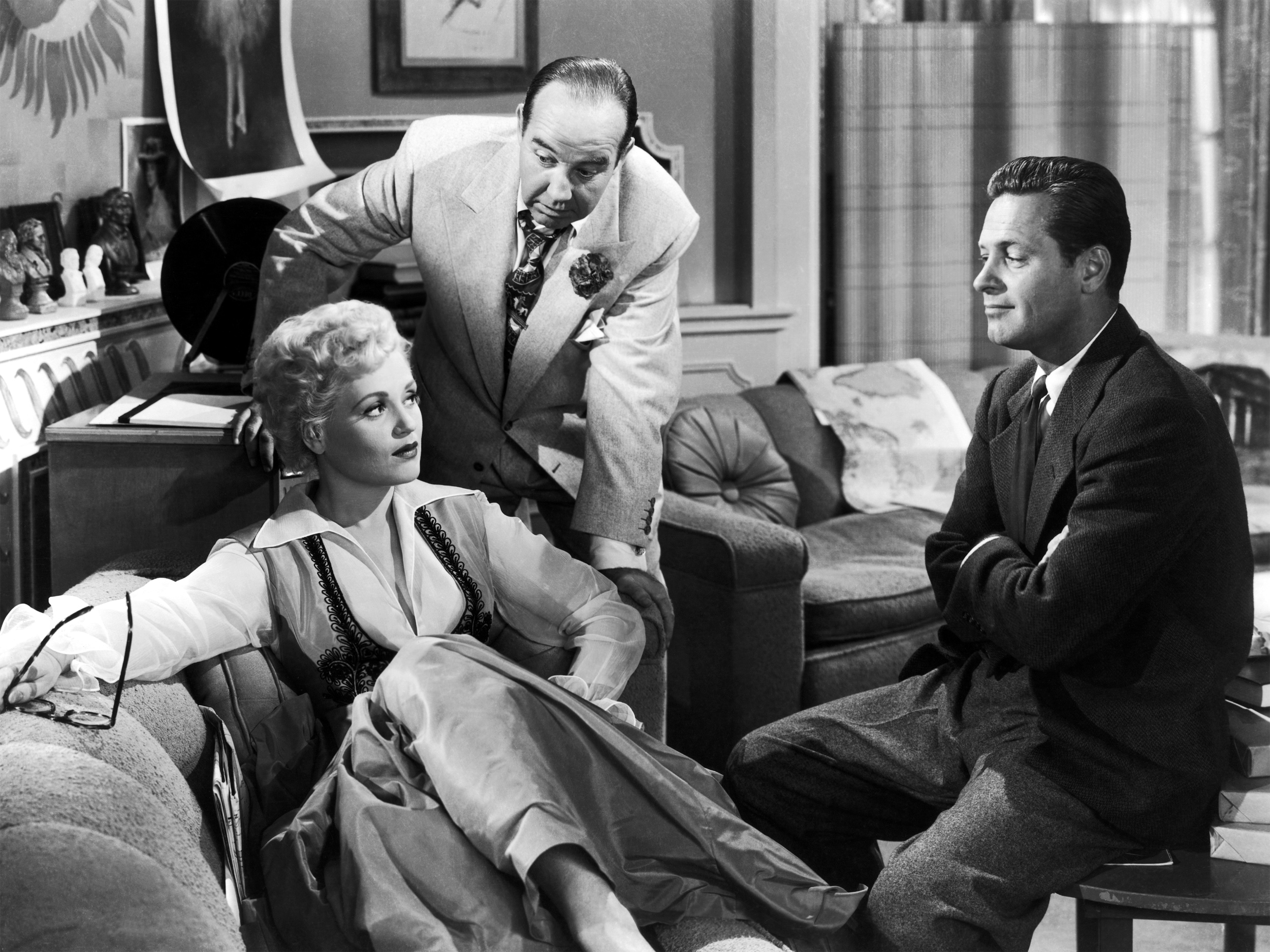
In that sense, the delivery of the message is a little too plump. Harry is a convenient villain – loud and couth. The audience from the first scene knows he’s the bad guy, the way he treats the hotel staff and splashes around with his money. Of course, the breaking moment is when he hits Billie, of course he gets his comeuppance through his greed in the end (that is the mildest of spoilers, come on, you know the moral center will win).
So the theme of the movie seems to be that “knowledge is power,” yadda yadda, very liberal values, which is why the movie is often loved in liberal circles. Yet the movie conveniently forgets about the silent villain in the back, the knowledgeable lawyer Jim. He knows which politicians to buy and exactly how far to go with the law without getting into trouble. He could have been Assistant Attorney General, yet he willingly lets himself get lured to the dark, but very lucrative, side. Conveniently, the movie ties the main story up too neatly with a bow and just scratches the surface of the matter. If it is an invitation to further educate oneself, it is very superficially delivered; if it is a warning to stand for your principles no matter the lure of riches, it’s not very successful. I am probably being too harsh on the movie in this last paragraph, but that’s how I felt about the delivery of the message. But it is an entertaining romp, so I should not dissuade you to watch it from that viewpoint.
 Tanya's Astro Blog