Personal comment on the infamous letter to astronomy grad students

If you are in the world of astronomy, you probably have heard or read about the infamous letter written by senior staff of an unnamed “famous” astronomy department sent out to their grad students (though it is not difficult to find out which department sent out the letter). If you don’t know what I’m talking about, please read the “inspirational” e-mail here.

The first reactions and comments were naturally ones of outrage (see e.g. astrobetter). There were tweets and facebook posts that were shocked and indignated, mostly on the fact that we, as astronomers, should be working on the subject all of our waking hours and expressing “Thank you, sir, may I have another“. I think that the main source of the scorn was the claim that you have to work 80-100 hours per week on astronomy as a grad student if you want to have a succesful path as a researcher.

First of all, I don’t think anybody can work that long over prolonged periods of time (there’s even evidence for that). As an exception, because there were so many deadlines, I worked 65 hours last week and feel tired today. I hardly saw my family last week and am pretty unhappy about that. Now add 15 hours to that and I would feel downright atrocious.

However, I feel like that putting a number to the hours you work in a week missed the point completely. I am especially sad that the letter put this point first without any nuance or diplomacy – a great way to discourage your students. I can smugly say that even though my advisor was trying to impart similar wisdom to me about working hard, his way of doing it had a much more positive effect on me. Let me veer a bit into personal anecdote time here:

I found out in 2005 I was pregnant. The timimg is never perfect. I had just gotten the Lawrence Fellowship for Graduate Students. Ironically, while that made my measly grad student salary multiply by about 1.5 times, it carried a pretty horrendous health insurance making me basically pay for a big part of the costs during pregnancy and birth, basically negating all the gains in salary (heh!). Anyway, there I was, freshly married and quite frankly scared of telling my advisor that I was about to devote a large part of my life to a new being growing inside of me.

He couldn’t have been any more supportive. First questions were of the lines of “Are you ok?”, but then he did the smart thing, appealing to my ego: “You’re not thinking of leaving astronomy, are you? That would be a big loss! You can make a great scientist. You can make it happen”. Anyway, I left that meeting with a big sense of confidence, that yes, I could make it happen! He didn’t sugarcoat anything, he never said I could succeed by just being half as productive, but he saw the potential that it was doable.

Fast forward about 14 months. I was on my first trip since having my daughter. We were observing at Keck. Funnily, many people complain that they feel tired all the time while observing, but let me tell you, with an 8-month old at home, I felt refreshed and slept like I hadn’t in months, i.e. contiguous 6 hours. heh! Anyway, it was September of 2006 and I was supposed to be graduating less than a year from that date. I had produced just one paper (my deal with my advisor had been three) and I was hitting a roadblock with the analysis of the two big papers. For the Hubble paper, I feel like I wasn’t getting the fitting program, how to tweak the parameters, etc. I just wanted to scream at the world: “Look at the pictures! They tell all the story, what do I need to analyze here!?!?!”.

So we were driving back from a pretty unsuccessful run. We had just gotten a few hours of data out of 2 or 3 nights, I forget. I was feeling down, it was just too hard, the baby, the roadblocks, the stupid clouds. So somewhere on the road between Waimea and Kona my advisor asked me if I really wanted it, that the time and commitment I was putting in wasn’t gonna cut it. Especially not when I was doing other things than the analysis needed for the papers. “It’s all about decisions, Tanya. The person observing after you tonight went diving today. It is a nice thing to do, especially if you’re in Hawai’i. But to really want that job in astronomy, you will need to give up some nice things sometimes.”

All about decisions. That point really resounded with me. I can’t tell you that suddenly everything worked out fine. But I worked hard and by November, close to Thanksgiving I had *the* analysis, *the* main point of the Hubble paper done. There’s even a funny story about my excitement over that result. I had gotten the correlation with which my most disturbed objects were also the most reddened ones on the Thursday before Thanksgiving. I know because the next morning was a “Baby and me” class that I attended every Friday (those who know me will cringe, since they already know this story). We were asked around the circle to say what we were thankful for. I was to go first and happily blurted out that I had just found out the last piece of the puzzle of the paper and that I would be one step closer to graduating. Oh man, that was the wrong answer in that group and I only realized it slowly after every. single. mom. was thankful for having a healthy baby. Ooops!

I did not get a job for the 2007 job season (but only half a year later), that would’ve been too convenient of a story, wouldn’t it have been?. But I can tell you that 2007 was a year which I did focus on work, very much. I shooed colleagues away wanting to come in and gossip, the hours at work were too precious. It was about decisions. The fact that I did not even know what was playing on the TV during those years (I know my friends were obsessed with Lost!, heh), what was going on in the news. I may not have been the best paper reader, may not have had the best code written, it was sometimes hard going at it a bit alone (not completely alone, of course, thank you, Mark!). But the focus was there, the motivation was sparked that kept me going, I was gonna to whatever it took to get that PhD and hopefully that postdoc job!

Mind you, I didn’t suddenly work some magical fixed number of hours a week or spent my time at home with my baby on one arm and the laptop in the other. Rather, and it sounds weird to say it like that, I became more efficient. I most definitely missed some things. I couldn’t have done it without the enormous help and encouragement of my husband. But I can’t explain it better than I was really into everything astronomy during that time (as I feel like I have been this year, too). And it’s like an avalanche, it just multiplies and gets bigger.

Anyway, boy did I veer off the point. It was about this fixation on the number of hours worked, when in reality you should get away from this thinking. It’s about the focus, the flow and the results which you should measure. And thankfully the posts and blogs that have come out since have been a bit more nuanced and addressed much more eloquently what I was wanting to say. The two articles I liked I liked the most were:

a) The post by Elizabeth Lovegrove over at astrobites. Its main point is that there is no clear line where work ends and when fun begins and that we should step away from the computer once in a while. That doesn’t mean that you suddenly should seek out weird ways of doing science in the cafeteria, but rather that we are not in a factory where some fixed amount of product needs to be produced in a certain amount of time. It is science, insights don’t come at the n-th hour worked on the subject.

b) Another amazing blog on the subject was written by Lucianne Walkowicz. http://tangledfields.com/2012/10/26/free-advice/ It’s downright inspirational for any field you work in. Right in the beginning she tackles the issue about the number of hours worked with this simple sentence: “If you are counting how many hours a week you are working, you probably don’t like your job very much.” Exactly! I couldn’t have conveyed it better. I would suggest you just sit down and read the whole article, it deals with health, goals and a whole bunch of other things that I was just nodding along to.

Lastly, I do want to say that I hope if anything good comes out of this discussion is: yes, it’s about decisions, but there are a few things that you should not decide away – it is your health, be it physical or mental and your family and close friends! Now go on, keep on truckin’!
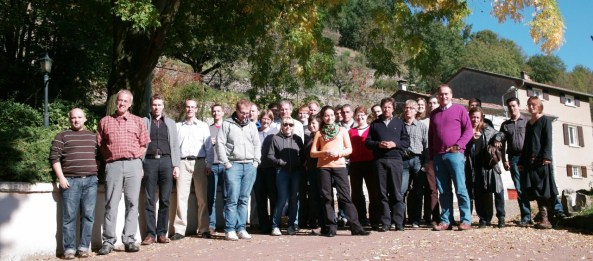
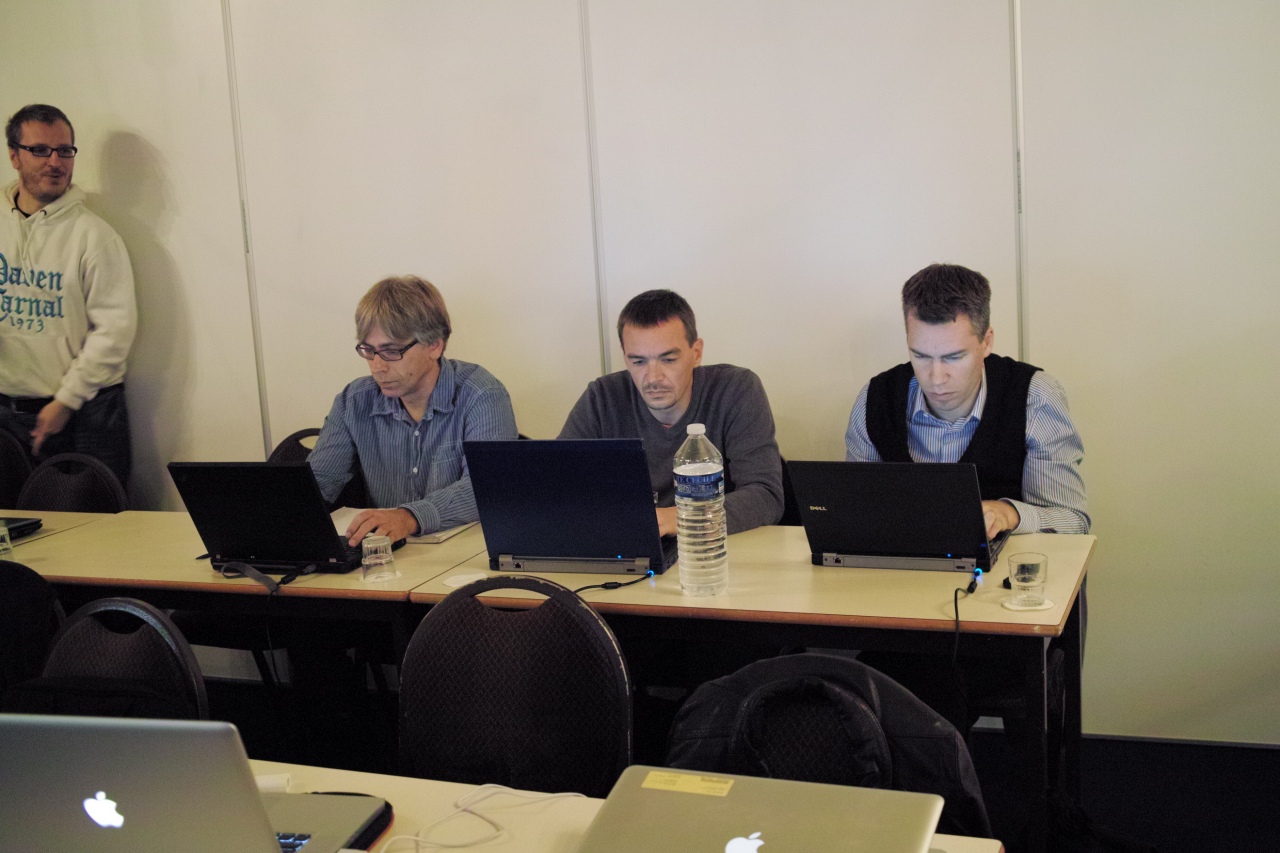
MUSE Science Busy Week in Satilleu near Lyon


The MUSE instrument is a giant 3D spectrograph consisting of 24 IFUs. It will be put on the VLT next year and be operated by ESO. But it is not built by ESO, it is actually built by a consortium of 7 institutes across Europe. Each institute has its own duties and contributions to the telescope, which is being assembled at CRAL. The AIP has already delivered the Calibration Unit (lamps, masks and other optical elements) and handles the Data Reduction Pipeline, which will also be delivered to ESO next year. This also is the part I am currently mostly working on and why I often talk about the MUSE instrument and data reduction.

As part of building the instrument, the institutes that are part of this consortium that is building MUSE get a significant fraction of guaranteed time observing (GTO) with it. It is about 40 nights per year, with some options to shuffle the nights around in the semester to aleviate pressures on certain RA range. That is a lot of time! And a lot of data! And considering the complexity of the instrument, its 24 IFUs and the variety of lightpaths a large computational challenge. So the consortium wants to make sure that they not only get the best science, but that they are prepared to handle the challenges that come with such a huge and complex dataset.

For that reason every 9 months or so we have scientific busy weeks. These are designed to bring to the table the best science cases possible for the GTO proposals. MUSE is an instrument that will go very deep, covering large fractions of sky at high redshift. One of the main scientific drivers is the unbiased detection of Lyman Alpha Emitters (LAEs) at all redshifts without being constrained by narrow band filters. But there is so much more science to be done with those deep observations (fluorescence, accretion flows, absorption systems, mid-z low luminosity systems, etc.). The same goes for the case in nearby galaxies. The MUSE science busy weeks make sure we are up to date with the newest results that could impact these observations, to prepare the best targets and to double-check that we have all the ancilliary observations and analysis tools to produce the best GTO science possible.

Since my main task is concerned with the data reduction side, for the scientific team that means that people working with the data understand the reduction pipeline and its outputs according to their needs. In the past it was to give them an overview of the recipes and tell them about the process that was being made. But now we are actually at a point that we can do tutorials and let people play with the pipeline themselves on mock or lab data. The past half year I have spent writing an user manual and cookbook for the end user of the pipeline. I don’t know if ESO will take on this manual, but at least in the consortium we will be constantly improving it. In the tutorial I already received enough comments and improvement suggestions so that I have enough to do for the next few weeks. We also envision these sort of tutorials becoming more frequent to potential german users of the MUSE instrument (german taxpayers are paying my salary, after all). Sort of like “MUSE Community Days”, but I am not entirely sure about the format or details.

But besides the technical and the logistical side of these Busy Weeks, the consortium really has gotten together as whole. One of the conditions for a member to put forward a suggestion to tackle a certain observation was that at least aother institute was involved in the project, too. As such, lots of collaborations and even friendships have been formed. People have stated to work together on similar or preliminary science to the proposed MUSE ones.

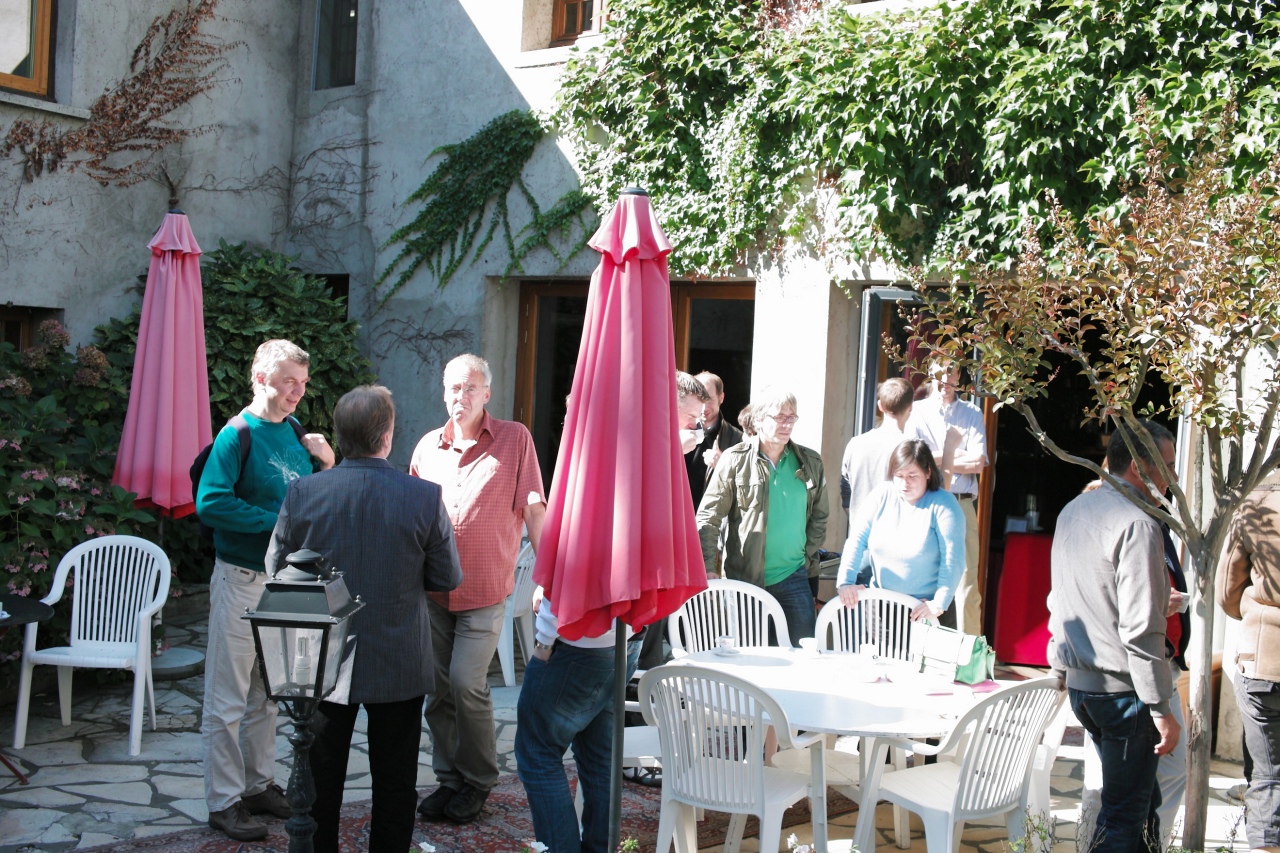
Another aspect of the Busy Weeks is that we are often in “secluded” locations, so that we don’t get distracted and are only amongst ourselves. There is no possibility of attendees to retire to their office or home. We are all in the same hotel, we all eat together, basically “forced” to talk to each other. On Wednesdays there usually is a hike. All this to say, that by now, the members consortium know each other quite well and there is also happiness of seeing some people again.

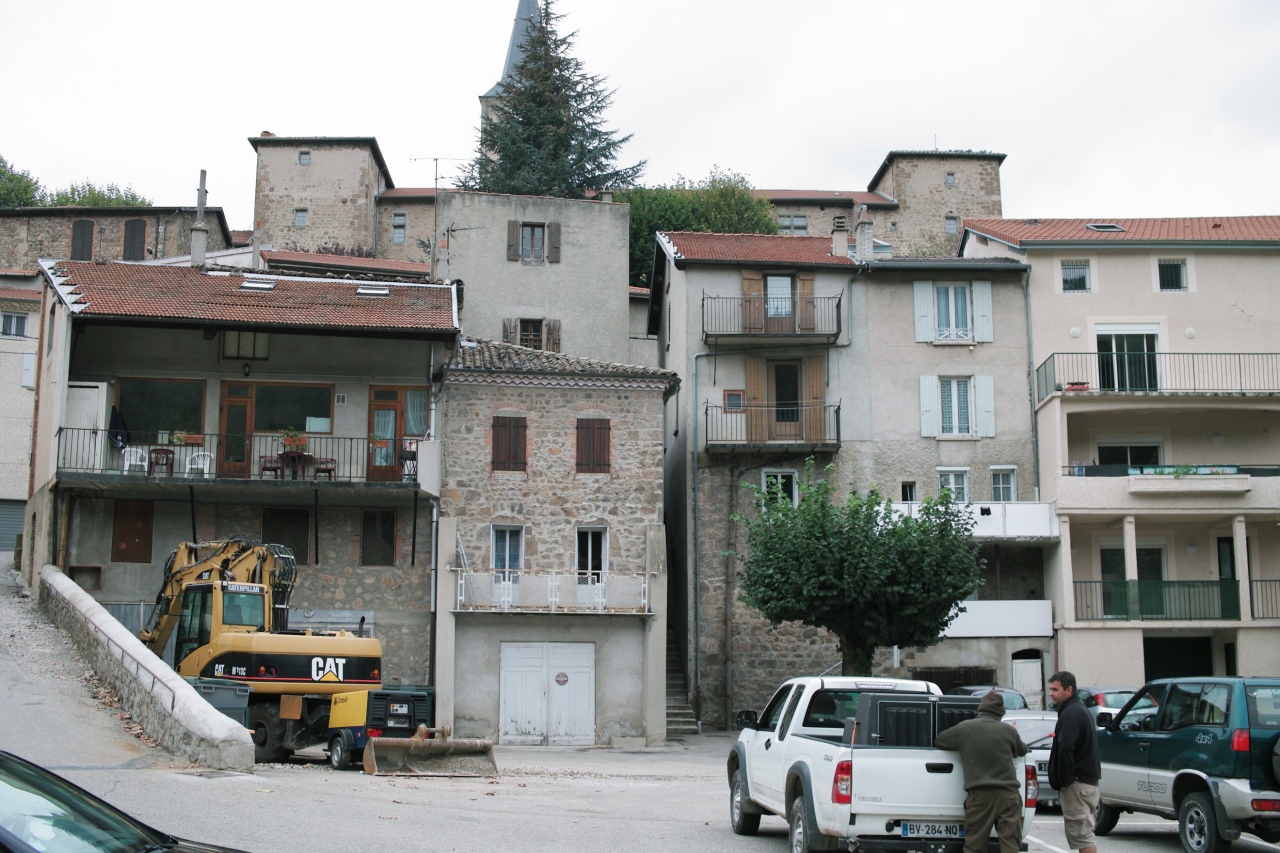
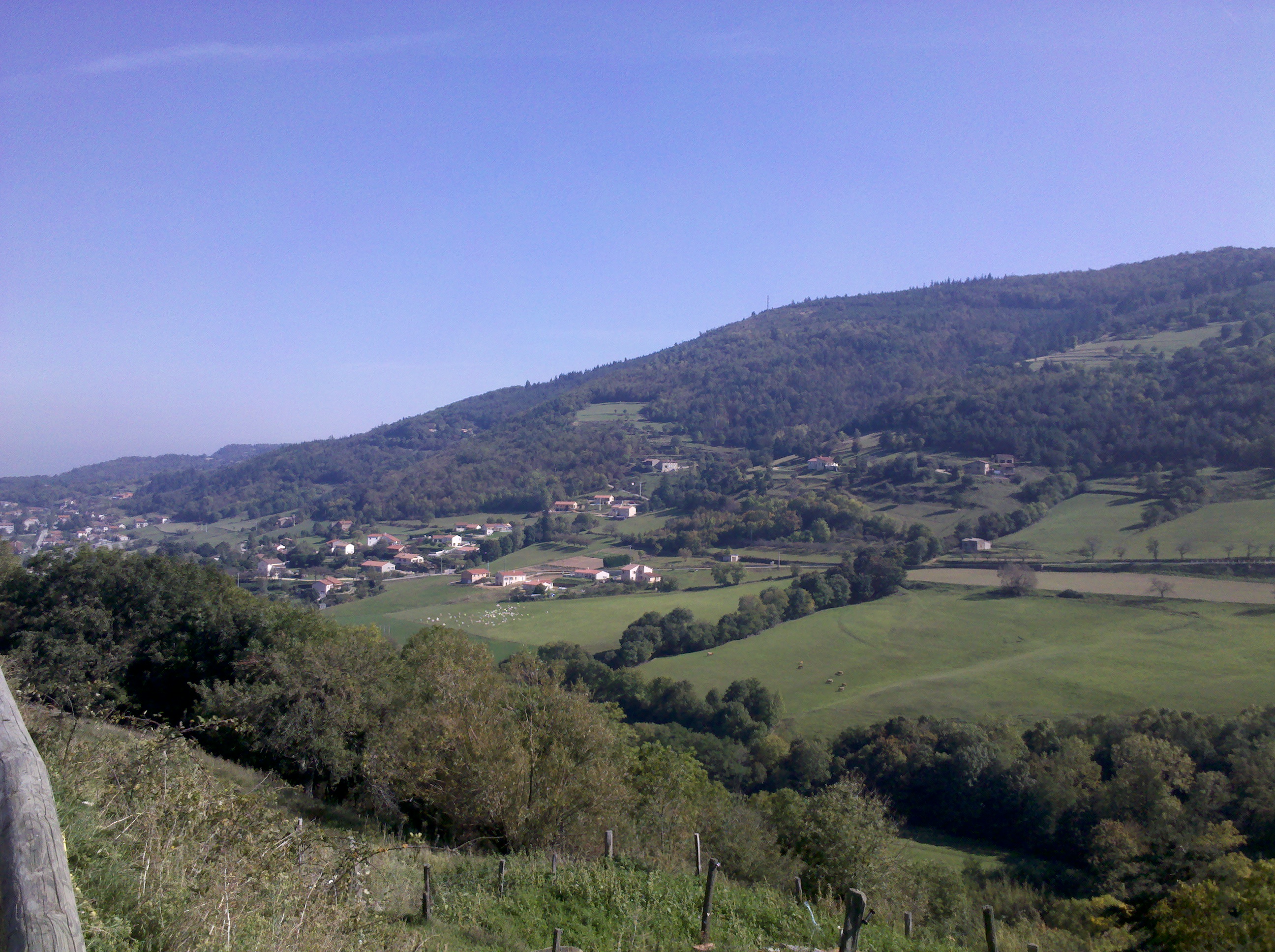
This time the Busy Week was at a hotel in Satilleu, near Lyon in the Ardeche district of the Rhone-Alpes region. The area is sort of hilly, but not extreme. The villages are not that abundant, but in the two we stopped (Satilleu and the bigger Annonay) the houses are made out of stone built close to the hill with small and windy roads curling around them. So the scenery was beautiful, but “there was nothing there”, not even some spectacular natural scene. So we spent our free time walking around, playing mini-golf (provided by the hotel), surfing the net or having some beers in the late evenings. The food in the hotel was quite good, as opposed to the last Busy Week and I looked forward to the long conversations over wine and cheese after dinner.

The Busy Week itself went fine, too. I think the tutorial was a success and it finally gave some people the opportunity to work with the pipeline for the first time and take away any initial fears of working with the data. I am very proud of all the things my institute has put out with regards to the MUSE project, so I can say that from our side it was a productive week. There were other tutorials and presentation of analysis software in different stages of execution. There were one and a half days also dedicated to science talks and suddenly it felt like a conference, too. I was looking up papers and listening to people present their results and how it could apply to MUSE observations.

So I would call this week a success. While I was totally beat at the end of it, I also was inspired to keep on working on MUSE stuff here at the institute, knowing that it was being received well.

One funny experience I don’t want to forget either is me driving the AIP people back and forth from the airport in a small bus. Maneuvering the bus through unfamiliar and narrow roads while we argue over the loudness of the radio and the comfort level for the last row participants and whether we should buy goat cheese and which freeway to take and… ah, good times.

German Astronomical Society Meeting in Hamburg


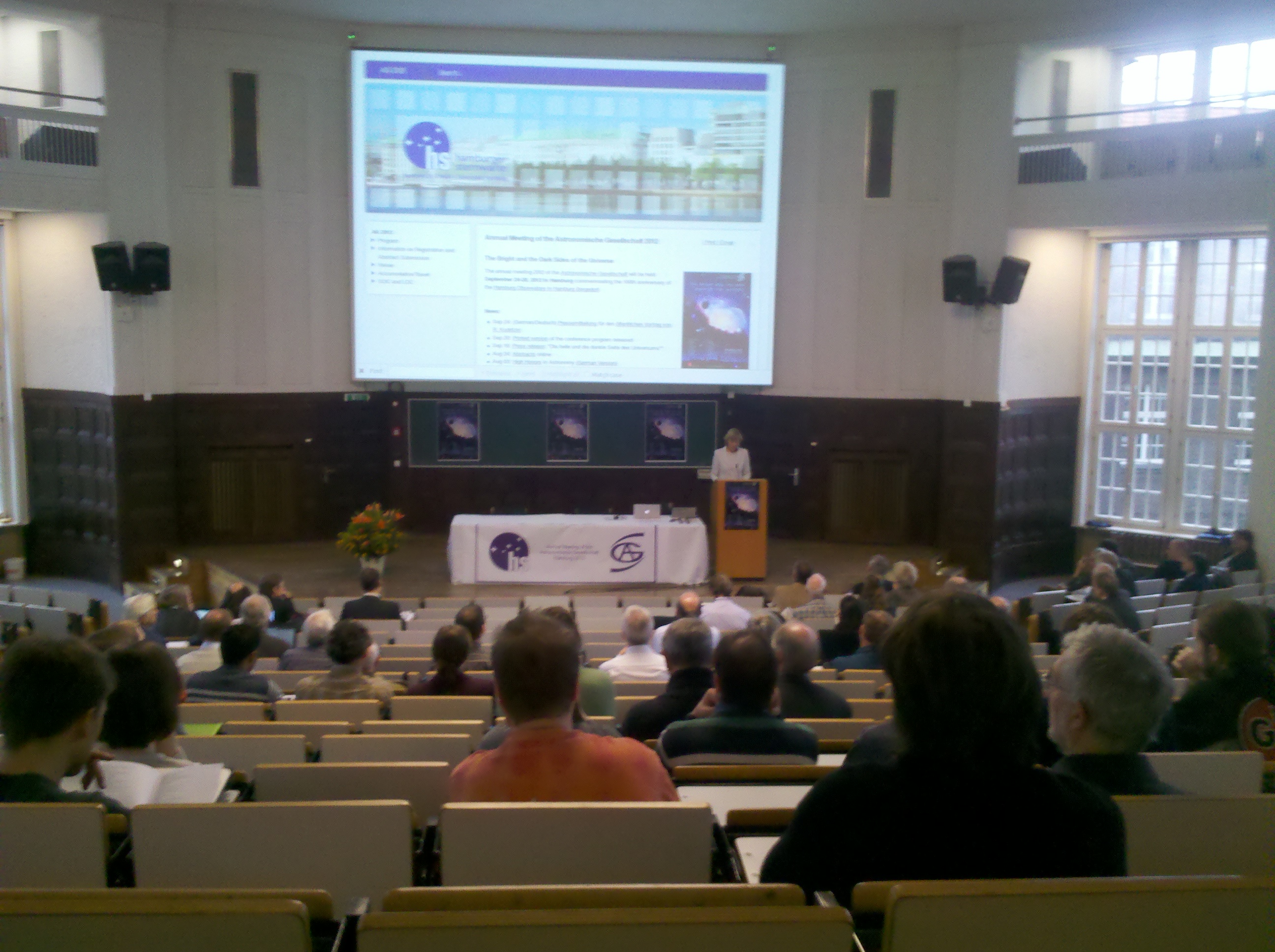
Last week (24.9-28.9) was the German Astronomical Society Meeting in Hamburg . It was done in conjunction with the 100th birthday of the observatory near Hamburg (Bergedorf).

This was my first time at such a meeting in Germany. I had been to plenty of AAS (the American version) meetings before with all that it entailed: from the eager first year in 2003 where I knew nobody, attended every session and complained that there was just too much to see to this year where I sat at a table at the entrance with friends, waved people I knew over to talk to them or schedule drinks for later in the evening and “complain” that there are so many grad students around. I was eager to compare and make friends this side of the pond.

The session that was most relevant to my interests concerned the new instrumentation being developed for the VLT. MUSE is part of 3 large instruments that are being installed at the VLT in the next year months along with KMOS and SPHERE, so the organizers of the conference thought it would be relevant to present these instruments and other new things (e.g. improvements to the interferometer) in a large sessions to the German community. As such, I did not attend that many science sessions outside of these, the one about ALMA being the exception which was very nice.

Overall, I can’t tell you that much about the science. A lot of the highlights I already knew – Sandy Faber (Karl Schwarzschild Medal) works in my field of galaxy evolution, Cecilia Scannapieco (Biermann price) works at my institute, so I know of her work. I used to work at IPAC, of which the Herschel Science Center is a part of, albeit in the US, but a lot of science highlights from Herschel were well known, too. So, if you pay attention to your field and the press releases, most of the things at these meetings are already within your scientific knowledge. Oh well, but you’re not going to such a general meeting for that, anyway. The main thing is to see people, network and get a sense of how astronomy is going in general in the country. So it was actually two sessions I attended that had nothing to do with astronomy that were quite interesting.

The first was the workshop of the Astro-Frauen-Netzwerk which is intended to be Germany’s version of the “AAS Committee on the Status of Women in Astronomy“. It featured a really nice presentation on continuing work by J. Fohlmeister on “Career situation of female astronomers in Germany” (Arxiv link), now with more representative surveys also of german men and of scientist (men and women) in the UK. Some highlights of the talk that I took home, because they stood out so much, were how german men kind of stood out with regards to the other three groups (german women, uk women, uk men). I am paraphrasing, but german men hardly found their jobs on the internet (while the other groups did) and they saw opportunities and experienced career growth when they had children (while the other groups saw childbearing as a burden). As for the rest of the workshop, I could wax poetic about matters concerning female german astronomers, but I think it doesn’t fit the scope of this blog. Let’s just say that I see these groups as an opportunity to network and help each other. I was shocked to hear that other male astronomers have problems with such a network even existing (insert appalled emoticon here!).

The second was the general meeting of the members of the German Astronomical Society. It was almost sweet how lovingly and serious everybody took their task and I appreciate all the hard work the board does. So even though this long session had nothing to do with astronomy it was interesting observing the apparent hierarchies within the society.

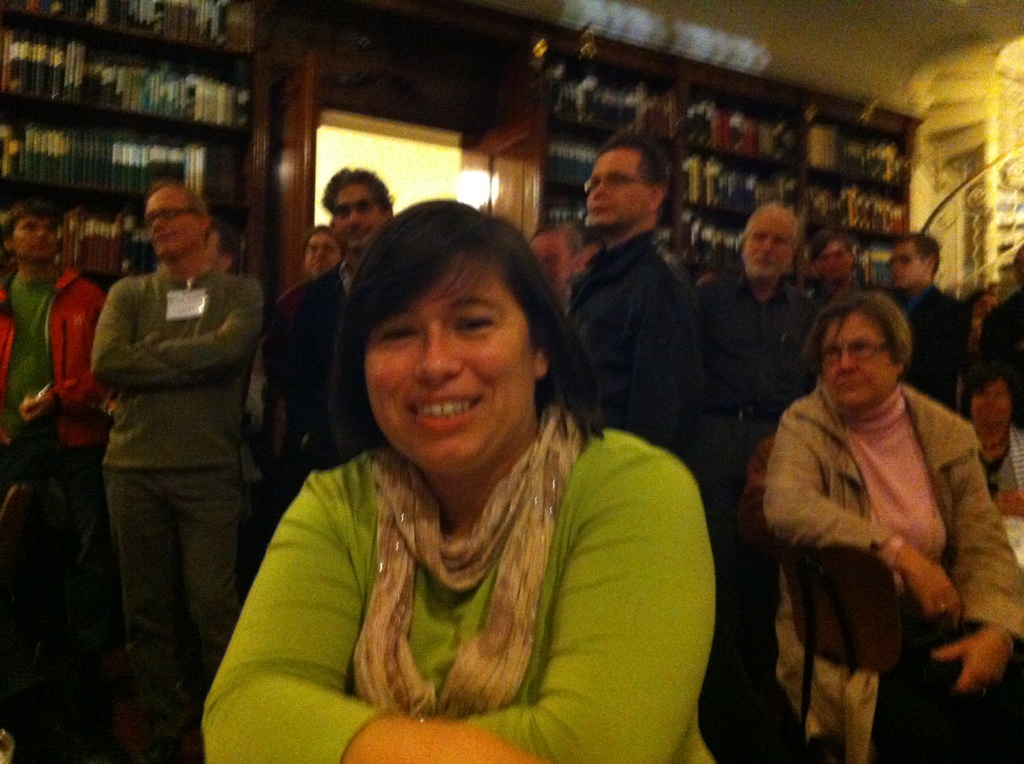
The last highlight was the conference dinner at the observatory in Bergedorf where they were celebrating their 100 year existence. The dinner experience was well thought out in that you passed various stations of starters, grill, cocktails until you at long last gathered in the library for coffee and dessert. That way, you visited the main stations of the observatory without missing interesting dinner conversations. At the library there was a long speech given by Prof. Dieter Reimers (now retired) explaining the history of the observatory. It was a well done speech interjecting lots of personal anecdotes and funny facts and I was surprised that 45 minutes of the speech had passed so quickly. Overall, an excellent evening and I am happy that I finally visited that observatory.

Lastly I have to mention two things that weren’t so great, but for which the organizers had little wiggle room or fault:

a) The ESO deadline was early on Thursday along with the NOAO deadline on Friday. This made me miss lots of sessions and I was stuck at the hotel writing and reading proposals rather than attending social events.

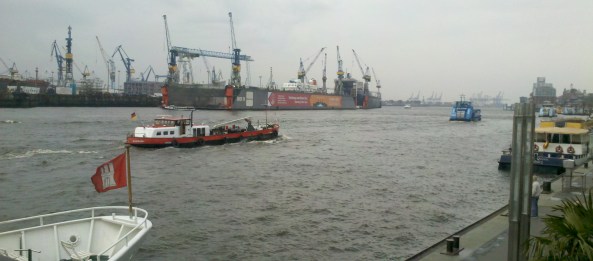
b) The weather was quite bad, it probably rained for most of the conference. I could sneak away early on Friday to buy toys for my daughter (a boat and a compass, of course) and it was the only morning where it wasn’t pouring. The image at the top of this post was taken at that time. I had been in Hamburg before, but if you ever find yourself there a harbor tour is definitely a must!

If I can, I would gladly attend the conference next year in Tübingen!

Econtalk podcast with Brian Nosek

I have a long commute to work. It takes me about 90 minutes each way if I am taking public transportation, about an hour if I take the car. There are some personal reasons on why I live so far away from work, but I am neither sad or stressed about it. Those 2-3 hours I spend on the road are wonderful times in which I either get caught up on my TED Talks, Jon Stewarts and Colbert Reports or in which I listen to podcasts when I’m in the car.

One of these podcasts is Econtalk with Russ Roberts. It deals with more than the pure money economics that is “Planet Money“, but is way more scientifically rigorous than “Freakonomics“, which is more entertainment than anything else. The podcast is quite libertarian, with a healthy does of skepticism towards the government, but it isn’t preachy or even biased. Russ does a good job of moderating the issues, he’s always well prepared and I like his insights into all aspects of economics. He’s made me be a believer of Hayek (and Mieses to some extent) and appreciate the nuances of Friedman’s policies. His podcasts with Mike Munger are entertaining, but some of the most conflicted I have been when hearing a podcast.

And because econtalk is about the social sciences in general, not just about finance, a few weeks ago he had Brian Nosek on to talk about his latest paper: Scientific Utopia: II – Restructuring Incentives and Practices to Promote Truth Over Publishability. I was very impressed with this podcast not only because of the interesting topic, but because I saw many traits of this among my astronomer friends, even though we are in the hard, natural sciences, not in the social sciences. If you can spare an hour, I implore you to listen to the podcast, I think it is very important to be aware of our unconscious biases when we are doing science and finding publishable results.

The main and salient point that Nosek raises is that we as scientists try to genuinely do good science but that does not mean that we aren’t vulnerable to some of the reasoning and realizations that leverage the incentives to be successful at science. Read: we need to make sure to get published, so we have a hidden bias to pursue publishable results (journals will not publish null results). I mean, if I get data at a telescope, I’m expected to publish a paper on that data. To massage some scientific insight out of there can often be quite difficult, but the incentive to publish is there.

Russ reads aloud two of his quotes and I think they are so good that they bear repeating:

The real problem is that that the incentives for publisheable results can often be at odds with the incentives for accurate results. This produces a conflict of interest. The conflict may increase the likelihood of design, analysis and reporting decisions that inflate the proportion of false results in the published literature.

Publishing is also the basis of a conflict of interest between personal interests and the objective of knowledge accumulation. The reason? Published and true are not synonmyms. To the extent that publishing itself is rewarded then it is in scientist’s personal interest to publish regardless of whether the published findings are true.

The sentence that published and true are not synonyms is the heart of the problem and it is a pretty depressing idea, too. We like to see ourselves as the truthseekers, but personal interests can derail this. Incentives matter, certain kinds of results are valued more than others. We are subtly influenced to take the path that is most beneficial to our career, i.e. seek out results that I can publish. But does that push our analysis in a certain way?

Nosek identifies 9 tricks or “things we do” where our bias shows:

  • – leverage chance by running many low powered studies than a few high powered ones.
  • – Uncritically dismiss failed studies as pilots or due to methodological flaws but uncritically accept successful studies as methodologically sound
  • – selectively report studies with positive results and not studies with negative results every time
  • – stop data collection as soon as a reliable effect is obtained
  • – continue data collection until a reliable effect is obtained
  • – include multiple independent or dependent variables and report the subset that worked
  • – Maintain flexibility in design and analytical models, including the attempt of a variety of data exclusion or transformation methods for to subset
  • – Report a discovery as if it had been the result of an exploratory test
  • – once a reliable test is obtained, do not do a direct replication; shame on them.

Now you may say, Tanya, that is all fine and dandy, but it only applies to the social sciences. Well, unfortunately no. I have seen the above over and over again in astronomy, too. When some observation does not agree with the model the scientists who proposed suddenly dismisses it, many projects are lying around in drawers, because “the discovery” didn’t pan out. But even worse, when an observation begins to even show signs of agreeing with the proposed, it gets sent to a prestigious journal, even if there isn’t critical statistical mass – hey it’s a pilot study, but it’s *really* important!

What do we do? Fix the journal / peer review system? Journals have own sets of incentives that encourage publications. They want attention and prestige, be at the forefront of innovations. So can’t do that. Should we maybe fix the university system? Can’t do that either, because here we face the same challenges. The way that universities gain prestige is the same as journals, so they don’t have the incentive to change either. Nosek suggests to rather start from the bottom up, from the practices of the single scientist to be accountable rather than from the top.

At the boundaries, we will have risk, we will be wrong a lot. That’s what science is supposed to do. But what happens is that by that design the discovery component suddenly outweighs the other side of science which is verification, which is kind of boring. Verification is just as important, but not as exciting! We value innovation more. Just last week this was my facebook status update:

“We had a big discussion at our conference dinner yesterday about science, its history and its impact. Yes, there was wine flowing :). One person in the group stated matter-of-factly “the biggest driver in science is discovery!”. Fortunately, I was not the only one who disagreed and vehemently at that. We need to get away from this thinking – science is incremental! It’s important that we assign glory to the people checking results, improving statistics, interpreting data, improving on some technique etc. as to the people who discover something “first”!” with a link to an ode to incremental research.

By the way, the person in the group is a brilliant scientist, I was rather perplexed by this attitude, but I am finding more and more, that it is prevalent among astronomy. We will face a big challenge is in trying to rebalance this. Can we find some incentives to make verification more interesting and provocative? It’s gonna be difficult. By the way, verification is not attacking the original scientist, disagreements over a subject does not mean that science is broken, that’s actually how science works! You gather some evidence here, somebody tries to disprove it there and then you converge on a result. Well, if that’s how science works, won’t it self correct? Isn’t then discovery the main driver still? Only eventually; it takes a very, very long time! That’s not ok! We can correct and clarify quicker and more efficiently.

So what are the suggestions to counter that thinking. In the podcast they delve into a nice anecdote about a study that was about people acting slower whenever they heard about old age. When the study couldn’t replicate, the original scholar just scowled: “well, you didn’t do it right!”. In the original paper they even reproduced the result, so obviously there was some methodology that was giving them those results. They are still talking about psychology, but even in astronomy, we have our way of doing things. What is a speck, some background variability to somebody is a Lyman alpha blob at a sigma of 2.5 at extremely high redshift to somebody else. Some people have great observing ability, positioning the slit exactly right, some are masters of getting that last little photon out of the data. But when is the science gotten from that photon reproducible? There is often so much subtlety and nuance! Failing to replicate also does not mean that the original result is false!

So the recipe is actually quite simple: be accountable! Describe each detail of the methods. I like the approach that people are putting their scripts now online via the VO or github (e.g. https://github.com/nhmc/H2) to really make their methods transparent and accessible. Some people provide diaries to their colleagues / collaborators on what they do (I know, I have and I find the ones of others extremely helpful as some sort of cookbook), if we could make this even more open it would be great – documenting your workflow is of real value! Every researcher does more research than he/she actually publishes. There may be diamonds in the rough there if all that data is open as opposed to the biased representation in the published literature.

This way of opening up methods also raises and could correct another thing: when you write a proposal, you already have the expectation of a confirmatory stance. So to correct for the strong expectation of a result you can present the tools you will use to analyze the data. This is why simulations of data in proposals are encouraged. When the data comes in, all you have to do is to run it through the already developed tools and just confirm or deny your hypothesis without fiddling, adjusting or even fudging the output. Register the analysis software in advance, it reduces your degrees of freedom, but makes you fairer, even if the data may not look as pretty. Better yet, have two competing camps work on an analysis script together!

Last, but not least, there is some fame and glory for shooting studies down. But only for the really famous ones. For the simple data analysis paper, we are often met hesitantly: “Why do you feel the need to question that result?”. But it actually is quite doable for high impact studies. This makes it so that one doesn’t constantly replicate things and will actually discover things, too, but it at least makes sure that the most “high impact” results are validated.

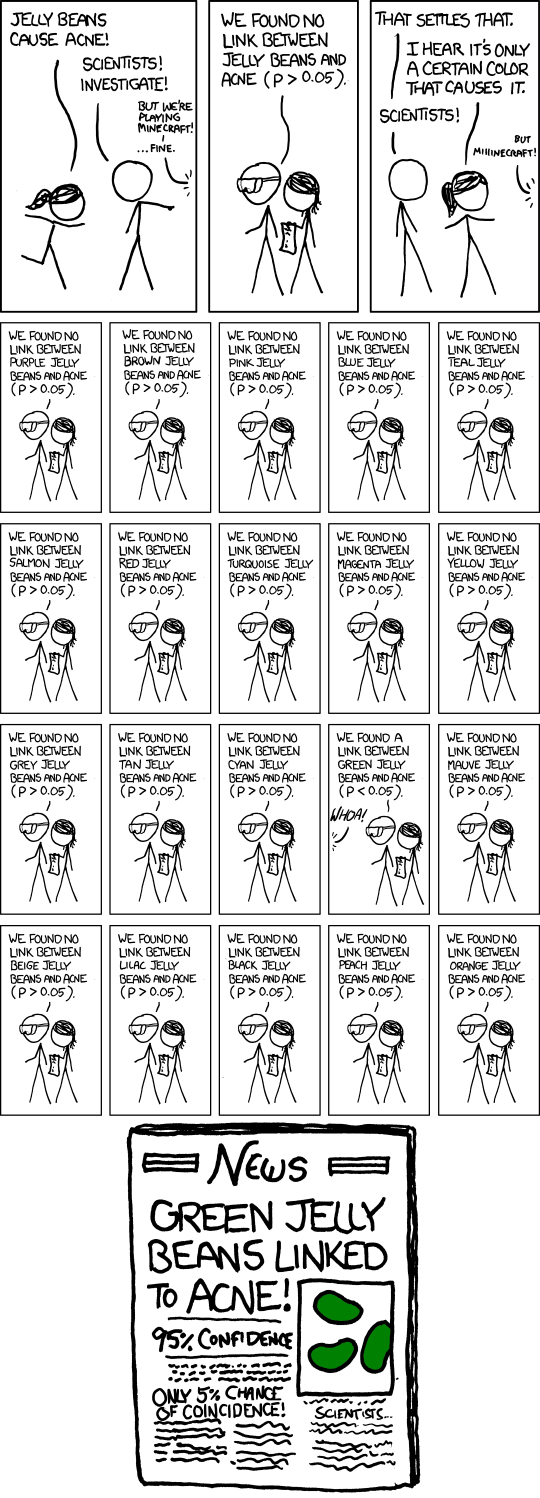
These are issues that have been of concern for years. Scientists don’t want to waste their time on things that aren’t true, so obviously they want to get at the heart of the problem. It’s actually great that people are looking critically at the research methods that scientists use. Even just knowing that we might have a skewed view in published results is valuable in it by itself. So if you made it this far, I have now made you aware of even another unconscious bias we carry around and need to account for. I leave you with a funny comic from xkcd, that a commenter on the podcast linked to – very relevant to the discussion.

Thinkshop 9 on Galaxy surveys using IFUs

My computer crashed! Now, with a new computer, I am quickly updating the blog posts which I had either written up or were in the pipeline. Please excuse the lateness…

Last week there was the 9th Thinkshop in Potsdam with the theme “Galaxy surveys using Integral Field Spectroscopy: Achievements and Opportunities“. These so-called thinkshops are yearly conferences that my institute, the Leibniz Institut für Astrophysik (AIP) organizes about once a year. They focus on a specific subject that is near and dear to a certain subject in science that the institute is doing and tries to get the best researchers in that subject to share the expertise on it.

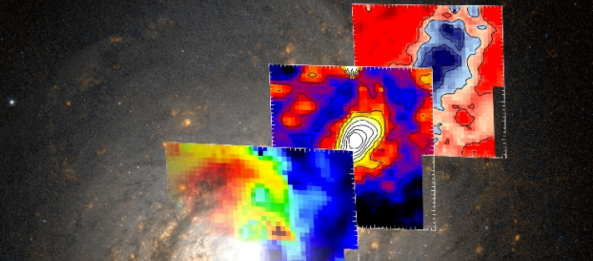
This time it was about 3D Spectroscopy and IFU surveys focusing on galaxies and their evolution (the program also shows links to some of the powerpoint presentations that were given). Considering that my research group is called “3D Spectroscopy” you’d think that I would have been in the LOC, presenting 8 posters and have a long talk on the subject. But, nah! I didn’t even register. Part of it is, that the instrument I am working on and with which I will actually to 3D science (MUSE) is still under construction and will go on the Very Large Telescope mid 2014. The other part is that I feel that such a broad subject of galaxy surveys, even under the IFU umbrella, is too broad and the individual contribution would get lost in the fold.

However, I was thankful that I was able to attend two sessions and I was happy to do so. I want to focus this blog post on the subject of surveys, mainly because AGN/feedback might not be of that much interest to the broad audience, but do really feel that in the future with all these new instruments coming online, there might be a paradigm shift ocurring in which we do observational astronomy. I will talk a bit about the different talks that were presented that day. It was a bit overwhelming, so this blog post also helps me gather my thoughts on that session, trying to read up on it on the web. Times will be exciting in the future, for sure!

September 12th – Session: Projects and Surveys

I really liked this Wednesday morning session. While there was relatively little science being discussed when presenting these surveys, it is amazing what kind of statistically complete samples are coming up. We are truly moving away from gazing at our favorite handful of objects with an IFU and going toward large 1,000-10,000 galaxy surveys that try to be as unbiased as possible in their selection criteria beyond the capabilities of the instrument that define them (field of view, wavelength range, resolution, etc.).

CALIFA – Sebastian Sanchez

http://www.caha.es/CALIFA

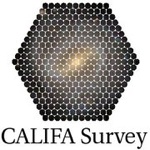
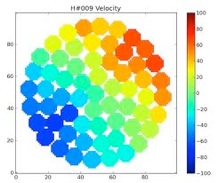
One of the biggest already undergoing surveys of about 800 nearby galaxies (z=0.005-0.03) selected from SDSS. Its observations are done with the PMAS in PPAK Wide Field mode with about 1700 spectra per galaxy. One of the thing that sets it apart is that it has no bias in the types of galaxies it is currently observing, as opposed to e.g. SAURON, which only observed ellipticals. The survey is undergoing and has observed about a third of the whole sample. The first data release is expected in November 2012. So this really constitutes a complete IFU survey of galaxies in the local Universe; and hey, who knows, maybe something new will come out, just like slow/fast rotator characteristic found in the SAURON galaxies. Let’s keep our eyes peeled for the early results!

SAMI – Julia Bryant

http://sami-survey.org/

What is special about SAMI is that it uses hexabundles. These are optical fiber bundles with independent cores (here 61), with a >75% fill factor and <0.5% cross talk ratio. Each core as a 1.6″ diameter and the whole bundle then has a 15″ diameter. Currently there are 13 bundles which are placed with the 2dF connector, but in the future HECTOR will want to place hundreds of bundles – maybe a sort of 3-dimensional 2dF. The main science drivers of SAMI are very similar to CALIFA, only that they want to observe about 3000 galaxies over the next few years (they only just had their first light). While the resolution might be a bit coarse, I think the statistical nature of this huge sample will be truly impressive.

MANGA – Kevin Bundy

http://di.utoronto.ca/~drlaw/research.html

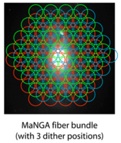
MANGA stands for “Mapping Nearby Galaxies at APO” in which they gather the individual BOSS fibers into a big fiber bundle. Well, we heard that CALIFA is doing about 800 galaxies, SAMI will do 3000, why not go for 10,000, right? As such, it would provide THE z=0 benchmark! However, this survey not is expected to go underway before sometime in 2014 and there are still enormous technical and characterization challenges to be overcome (e.g. biases in having an IFU of different sizes).

WEAVE – Reynier Peletier

no webpage

This was a really early presentation for the next generation IFU for the William Herschel Telescope. It aims to be the complement to 4MOST in the North. It would have about 1000 1.3″ fibers over a 2 degree field of view enabling it to do coarse IFU science. It is envisioned to work together with the blind HI APERITIF survey on large scale scienceSince the project is still in an early development phase many specifications were still open, but it was interesting to see what is in the pipeline for the future.

The DISK-MASS Survey – Marc Verheijen

http://arxiv.org/pdf/astro-ph/0311555.pdf

This was a summary of the project started here at AIP on the Disk-Mass project trying to measure the mass in 40 spiral galaxies beyond simple rotation curves. It is because of this idea that the PPAK Wide Field Mode was installed at the PMAS instrument. IFU technology along with ancillary data such as HI maps were needed to disentangle all the different components contributing to the mass (gas, stars and dark matter). The science results are fairly uncontroversial, gas sigma remains constant, stellar sigma declines (exponentially for almost all) and dark matter profiles resemble NFW. Well, at least we’re glad the Universe is still in order.

HETDEX – Gary Hill

http://hetdex.org/

This is a huge survey that has been in preparation for years which will image the sky blindly. We (I am part of the science team) will expect to see a million Lyman Alpha Emitters, another million OII emitters plus another huge number of random other objects. I am actually very interested in the random AGN population found this way. The 150 VIRUS fiber bundles which are used for HETDEX work on the 3500-5500 Angstrom wavelength regime, enough to find significant Lyman Alpha Emitters to test principles of Dark Energy, which is the main driver for this survey. Unfortunately HETDEX has been plagued by delays, but we expect the survey to go underway in 2013/2014 and the Pilot Survey has already been quite successful. While MUSE is deep, HETDEX is wide!

HECTOR – Joss Bland-Hawthorn

no webpage

There wasn’t that much focus on HECTOR, the instrument, in this talk. It is basically an extension to SAMI with way more hexabundles carefully placed with a starbug positioning sytem (shown with a really neat movie, but I can’t find it on the web right now). Its ultimate goal will be to have a 3D view of 100k galaxies.

However, Joss really went into the philosophy of these huge surveys. He quoted T.H. Huxley – “The great tragedy of science – the slaying of a beautiful hypothesis by an ugly fact.” One can look at that in two ways, first that the great thing about science is that we just don’t believe in beautiful things, we believe in provable theories. But secondly that the fact that something weird happening in your favorite galaxy does not necessarily mean that something like Lambda CDM is suddenly disproved. In the Universe this means that one can just look at the big picture by looking at large number of objects. And the whole means doing huge surveys, not just 20-30 object surveys being done up until now with IFUs.

MUSE – Lutz Wisotzki

http://muse.univ-lyon1.fr/

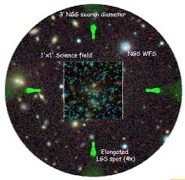
Considering that I am so entrenched in this project, it is hard to give an unbiased view on the presentation given here. The basic characteristics of the instrument were given: 300×300 cube covering the full optical range with a 2.5 Angstrom resolution with a one square arcminute field of view. But it is hard to really hit home what makes this instrument so special, how awesome it will be. When you are used to 8″x8″ fields, the enormous step to 1’x1′ is hard to fathom. People were fixated on the AO capabilities (it will have AO enhanced seeing with 4 LGS stars improving the seeing by double). But beyond that is the enormous cosmological volume the survey will cover. You will definitely hear me rave about the instrument some more in the future!

KMOS – Natasha Förster-Schreiber

http://www.eso.org/sci/facilities/develop/instruments/kmos.html

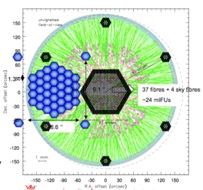
KMOS will be the new near-IR IFU survey spectrograph installed on the VLT next year. It combines the MOS concept with the IFU concept in the near-IR and will replace SINFONI, which only covers one galaxy, to 24 mini-IFUs in a 7’x7′ field of view. Unfortunately the talk focused a lot on the science doen with SINFONI in the SINS survey, that there was little time to really go into KMOS, the instrument. However, the science goals for KMOS will be similar – do large surveys of relatively high redshift (z~2) galaxies.