Been testing a bit…

Almost a day late on this one, it isn’t really Monday anymore, but I totally overslept this one. Watching my daughter compliment my noodles with bolognese sauce tends to do that to you, turns me into a fool that forgets stuff she had proposed to do… 🙂

Anyway, this week I want to continue the theme of “University education”. I know, it might be boring, for those that are more interesting in travel (pictures, yay!), conferences (pictures of people, yay!) and gossip… err, news from the world of science, don’t worry, plenty of travel coming up for me in the next few weeks. Even as we speak a conference on integral field spectroscopy in galaxy surveys is happening right now, so I’m keeping my eyes and ears open for that one.

However, last week we had another 2 days of workshop relating to “Testing and Mentoring”. Combined with the fact that over the summer with a professor colleague and mentor we’ve been grading some oral presentations and testing some students one-on-one (well two-on-one to be precise), this was quite pertinent.

Yesterday we had two oral tests scheduled. These are usually 20-30 minute affairs. The subject for these particular tests related to basic astronomy concepts, we ask you about a subject for about 8-10 minutes. We go deeper and deeper with the questions until either the time is up or we find a barrier, where you might need some “hints” or “encouragement”. The theoretic construct behind it is quite similar to Bloom’s taxonomy of learning in the cognitive domain. In terms of didactics it is basic stuff and probably you have done it yourself subconsciously, but I wanted to put it up on the blog for me as a reminder, too. The table is by Donald Clark from this website: http://www.nwlink.com/~donclark/hrd/bloom.html. It also has links to the original research paper and further reading on the subject.

Category

Example and Key Words (verbs)

Knowledge: Recall data or information. Examples: Recite a policy. Quote prices from memory to a customer. Knows the safety rules.

Key Words: defines, describes, identifies, knows, labels, lists, matches, names, outlines, recalls, recognizes, reproduces, selects, states.

Comprehension: Understand the meaning, translation, interpolation, and interpretation of instructions and problems. State a problem in one’s own words. Examples: Rewrites the principles of test writing. Explain in one’s own words the steps for performing a complex task. Translates an equation into a computer spreadsheet.

Key Words: comprehends, converts, defends, distinguishes, estimates, explains, extends, generalizes, gives an example, infers, interprets, paraphrases, predicts, rewrites, summarizes, translates.

Application: Use a concept in a new situation or unprompted use of an abstraction. Applies what was learned in the classroom into novel situations in the work place. Examples: Use a manual to calculate an employee’s vacation time. Apply laws of statistics to evaluate the reliability of a written test.

Key Words: applies, changes, computes, constructs, demonstrates, discovers, manipulates, modifies, operates, predicts, prepares, produces, relates, shows, solves, uses.

Analysis: Separates material or concepts into component parts so that its organizational structure may be understood. Distinguishes between facts and inferences. Examples: Troubleshoot a piece of equipment by using logical deduction. Recognize logical fallacies in reasoning. Gathers information from a department and selects the required tasks for training.

Key Words: analyzes, breaks down, compares, contrasts, diagrams, deconstructs, differentiates, discriminates, distinguishes, identifies, illustrates, infers, outlines, relates, selects, separates.

Synthesis: Builds a structure or pattern from diverse elements. Put parts together to form a whole, with emphasis on creating a new meaning or structure. Examples: Write a company operations or process manual. Design a machine to perform a specific task. Integrates training from several sources to solve a problem. Revises and process to improve the outcome.

Key Words: categorizes, combines, compiles, composes, creates, devises, designs, explains, generates, modifies, organizes, plans, rearranges, reconstructs, relates, reorganizes, revises, rewrites, summarizes, tells, writes.

Evaluation: Make judgments about the value of ideas or materials. Examples: Select the most effective solution. Hire the most qualified candidate. Explain and justify a new budget.

Key Words: appraises, compares, concludes, contrasts, criticizes, critiques, defends, describes, discriminates, evaluates, explains, interprets, justifies, relates, summarizes, supports.

So this taxonomy of learning is generally quite helpful in devising goals for your lecture, you might want to start at the very beginning which is pure knowledge base and let the students end up doing their own judgements about the current state of knowledge (uh… something like research 🙂 ). Here is an example of how that would work on something simple like Kepler’s laws.

Remembering: Cite the three laws, write down the formulas.

Understanding: Draw a picture with the planets relating to Kepler’s law. What is an ellipse? What is the semimajor axis? Where is the focus? What is meant by enclosed area?

Applying: Ask a simple extrapolation question or a small calculation. For example: if the velocity of a planet circularly orbiting the sun at a radius r is v, what would it be at 2r?

Analyzing: Extrapolate Kepler’s laws into other parts of astronomy. For example, Pluto’s mass was only calculated when its moon Charon was discovered in 1978. How? Why? Which one of Kepler’s laws would you use for that?

Evaluating: A bit more general, the student needs to gather knowledge from other lectures and/or formulas to make judgement calls. How are Kepler’s laws relevant in the motions of stars around the center of the galaxy? Why would they not necessarily apply? What needs to be considered for something to have “Keplerian motion”? What kind of rotation curve would you expect for a star having Keplerian motion around the center of the galaxy? What does it mean that galaxies show flat rotation curves?

Creating: Write a proposal on exactly the research on stellar motions in the center of our galaxy that the Andrea Ghez’ and Reinhard Genzel’s groups have been doing in calculating the mass of the black hole there.

Obviously the last two points would span too much time. They would be much more part of a homework, perhaps a final project – but there have been exceptional students that you can sort of lead into the thinking behind even in an oral examination. What is important is that you can see in this simple example how the taxonomy grows and how you find interesting questions to lead you through the oral exam without making it a simple question-answer game. This applies to written examinations as well – the trouble (for the examiner mostly, lol) comes when the first point is not there, but there is all sorts of knowledge about the latter points.

Anyway, now that you have the test all set up, you’re all prepared, you have trained yourself in the mannerisms of the presentation, you want to appear professional, but positive, you have a glass of water ready, some pen and paper – everything for the student and you to have a conversation, you need to grade the test.

Ah well, here is where the funny part comes. The first guy never showed up. At first we were worried he might be wandering the offices at University (we work in a research institute, we are only associated with the University for teaching duties, our offices are off-campus), but the secretary at University did not see him at the agreed-upon time either. The second woman was clearly an intelligent woman (since she followed logical arguments and actually deduced a satellite orbit during the exam), but she just didn’t study, like actually just sit down and think about the material. She was just happy that we gave her the lowest passing grade and off she went. This left me a bit sad, when I shouldn’t be. Everybody has a right to put certain classes on the backburner. Simply because one is intelligent one does not “owe it to the world” to succeed or do hard things. But still…

I also have to say that the workshop itself last week was utterly boring and the teacher was a bit incompetent. He brought a lot of knowledge to the table, but I felt he couldn’t apply it. It is weird, because it’s now the second week, I’ve complained about the lecturer on this blog, but the first training sessions relating to didactics at University were really good. I guess I was pampered and now have quite high standards. We also had the misfortune that due to scheduling conflicts our group turned out to be quite small and filled with teachers of the natural sciences (physicists, chemists, biologists, etc.). As such, some of us were actually yearning for more structure… more truths… I mean, yes we acknowledge there is personality in every subject, even in math, but the teacher as a psychologist was almost set out to invalidate any fact presented as absolute truth. Ah well, it’s not easy teaching scientists :D. I got a lot of great insights by my fellows, though. How they deal with things, certain situations familiar to all of us. Plus the anecdotes, oh the funny test answers (if you have any fun ones, please do share!), the logically impossible excuses (the fifth death of a grandmother in a semester).

It was a nice respite from my overly research driven activities around me at the moment, but alas, now it’s back to QUASARS!

E-Teaching / E-Learning

Last week I attended another round of teaching resource courses within the “Senior Teaching Professionals” program. The program is designed to help people in their early teaching phases, like postdocs and junior professors to become better and more efficient educators within today’s modern university. So far I have really enjoyed the program and the people attending. It is refreshing to meet people from all sorts of disciplines, but also grounding to hear that so many problems we have with students are similar. It also fills me with joy that they generally like teaching and that they also find the positive response of a few students such a gratifying reward that it makes them go on.

This week we talked about E-Learning and E-Teaching. While in the past the courses associated with the “Senior Teaching Professionals” have been top notch, I can’t say that with this course. Nevertheless it gave me a lot to think about and it even inspired some new ideas I might use in some lectures.

So let’s get quickly the things I didn’t like out of the way. The professor mentoring us this time was an old web pioneer, having worked on the development of HTML at CERN with Tim Berners Lee. Having spent his 15-year stint in the New Economy, he returned to academia a few years ago, where he now deals with the web in education. So for those amazing credentials his course was quite chaotic. There were a lot of buzz words, but not that much substance. Also some… well… shall I say, outdated concepts in my mind, like second life (seriously? My husband does actually own the T-shirt pictured on the right from the now defunct getafirstlife.com). He did mention that not all e-tools are applicable for all lectures, e.g. a blog instead of a final written project is just not doable in subject like math and physics, where typing in the LaTeX formulas can be much larger hassles for beginning students that what the communication aspect is worth. However, I feel he should have shown successful blog examples instead of directing us to WordPress and encouraging us to “play around”.

Now, the stuff that I liked or that sparked some ideas in my mind:

– I was not yet acquainted with the MOODLE platform we have at our University, but we thoroughly introduced it and its functionalities during the first day. It offers ease of use, all the necessary tools preinstalled and automatic / immediate access for all students enrolled in your course. The drawbacks are that the interface is a bit outdated (no drag&drop for wikis e.g.) and well, that it is a closed environment in which nobody from outside will ever be able to access it. I think it is a powerful platform that can be immensely useful, but probably not one I will use in my class, since I don’t have any fears of, say, installing a forum or wiki platform on my homepage.

– The main point of the professor was communication. But in my mind it goes beyond that, it’s about accountability to your students. To give them the opportunity of acquiring the best information out there if they wish to do so and to give them the tools to do that. Be it in the simple stuff of putting your lectures online and linking to interesting and relevant articles to the idea of giving them the opportunity to confer amongst themselves when I don’t have the time to respond to every e-mail or inquiry.

– Lots of people have spent an enormous amount of time and energy in putting the resources out there and most of them are free. Now it’s up to you to figure out if they will be applicable – that is the challenge! In the days where udacity and coursera are perhaps shifting the paradigm of learning online, we need to remember to never among all blogs, wikis, forums, hangouts, etc. forget that the personal communication makes for the real “aha-moments”. So among all accountability don’t forget offline accessibility either.

What will I implement in the end? Beyond putting lectures, homework problems and solutions on the web? I think a summary in the type of a wiki for the lecture would be good, maybe with a comment function. That way the student can help point out a relevant article or something I missed, but he/she can also gripe about something. Please, connect with me, leave comments, write me on my various interfaces; I try to be as accessible as possible. I will probably NOT apply much of social network things beyond that, (un)fortunately our advanced astrophysics classes are small enough that I can invite you for a coffee for anything needing discussion beyond a quick comment blurb or link.

Spitzer Observations of Young Red Quasars

Bit of a selfish post this week, but hey, it’s my blog and it’s not often this happens, so you won’t get these types of posts regularly…

Last week I was finally able to release to astro-ph my latest paper on red quasars to the public. I had hoped it would become a press release and for a long time it seemed quite possible, but it was not meant to be. However, it will become a web feature on the Spitzer website, so be on the lookout for it on September 20th or so. I’ll make sure I’ll link it somewhere on the webpage. Anyway, the paper had been submitted for a long time now and it was also accepted in July, but since the “press status” was not clear, I held it back. It itches in your fingers to yell to the world about it, but I guess everybody feels that way about their work.

So, the gist of the paper? Well, boys and girls, gather ’round and hear the tales of the quasars, how they grew to be so luminous in the centers of their galaxies… Last time we left you in the company of these 13 young lads (AGN or quasars as their fellows called them), they were seen to be discovering how they came to be. Their traced their birth back to the merger of two galaxies (seen in Hubble ACS observations), the instability of the two being able to funnel material to the center and ignite the black holes. Since the quasars were still obscured to some degree by that material it was easier to discern the hosts and their merger features such as tidal tails and such. Nevertheless, even accounting for that obscuration, the host galaxies seemed more disturbed than usual. In fact, there was a faint (!) correlation between the amount of obscuration/reddening and the disturbance of the hosts – a fact that we interpreted for them to be young quasars, not established like the unobscured quasars we know. There were other clues, like the X-ray slopes and high Fe complexes, implying large accretion rates or a large fraction of BALs and blueshifted OIII lines, implying winds emanating from the quasar.

So with those observations we were awarded Spitzer time. The main driver was to disentangle the different IR contributions, the cold-ish (30-200K) star formation from the host from the hot AGN contribution (3000K). The spectra would also allow us to see if we saw any PAH complexes (seen in regions of star formation) or Silicate in absorption (seen when the dust doing the absorption is cold).

So with all the spectra and photometric points, we were able to fit different models to them and gauge the contribution from each one. See the pic on the right for an example on how such a modeling works. The dots are all the photometry points we have along with their uncertainties (SDSS, 2MASS, WISE, MIPS) and the line is the IRS spectrum. The red thick line is the best fit model and the others just signify the different contributions from all, the light and dark blue lines, for example are tracers of star formation. Once we were able to disentangle the AGN from the host, we could finally get the true bolometric luminosity of the quasar. Correcting for obscuration, we were also able to get the black hole masses of the quasars, too.

Phew, lots of info, but with all that data (HST, Spitzer, IRTF, Chandra, Palomar and Keck), we now had all the ingredients to make the following assertions.

a) Our quasars are much more obscured by COLD dust than normal quasars. They are not Type 2s, which don’t show Silicate in absorption that much. This confirms the Hubble images and previous Chandra results showing much higher dust:gas ratios than normal. In fact there isn’t ANY of our quasars that shows Silicate in emission, something that is quite frequent for broad line AGN (which ours are).

b) The quasars affected by Silicate in absorption are also more likely to be accreting at a higher rate, with the most active slurpers having Super-Eddington accretion rates. These also show signs of blueshifted OIII lines, indicative of winds. These were also the systems showing high disturbances (though that is quite a weak correlation, as it was in the 2008 paper).

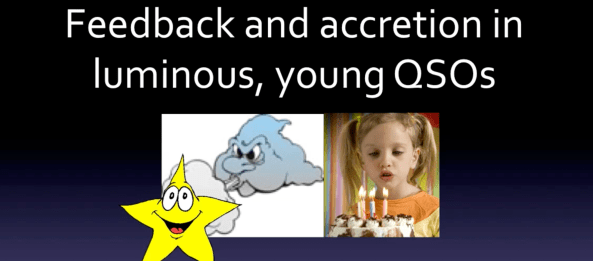
c) The highly accreting systems are below the M-L relation (mass of the black hole relates to the bulge luminosity – the so-called Magorrian relation). This is whether you count the total host after PSF subtraction or the fitted bulge – they are WAY below (see title picture!). Young quasars are undermassive in relation to their host luminosities, so in a sense they need to “catch-up”. The ignition of star formation precedes quasar activity.

d) Unfortunately, one thing we were not able to prove was any correlation with star formation rates. Most of the quasars had hosts with luminosities in the LIRG regime (10^11-10^12 solar luminosities), which signifies star formation rates of about 10-100 solar masses per year, but there was no rhyme or reason behind which galaxy got to form more stars. Oh well, not everything can fit into a nice little story.

So, what’s next? I’d probably want some ALMA time for these guys. Or better yet, I’d like to look more closely at systems that are showing the winds – those seem to be quite interesting, don’t you think? Stay tuned, I might have something up my sleeve. 😉

Astronomy as a profession

This is my first post on my blog, but it definitely entails a few things I’ve always wanted to vent out into world during my astronomy career. It was sparked by a post made by a postdoc into the facebook astronomer group that she was “quitting astrophysics”. In the post she sounded off about the field brutal and contributing little or nothing to science. Of course the work-life balance issues, especially relating to young mothers came up, albeit as a PS. It garnered quite a lot of feedback, most of it sympathetic and I will talk about the problems we have in astronomy a bit in this post. However, I will reserve my views about women in astronomy (kids, two body problem, etc.) for a later discussion, so as to not clutter up my train of though in this post.

So, a job in astronomy… yep, it’s hard to get. There are about 10,000 professional astronomers in the world give or take a few thousands depending on your definition of astronomer. Looking at it from that angle, of course it is difficult, there are far more people interested in astronomy in the world than the 10,000. Collegetimes actually took this argument ad absurdum and published it under “The 11 hardest jobs to get in America“, because there are only about 50 (tenure track) positions advertised every year.

Of course, being president of the United States also ranks as “profession” in their list and herein lies the point. There are some professions in this world that pass as dream professions for some. Many kids want to be professional athletes when they are small, but the ones that actually make it are few and far in between. My daughter at the moment wants to be a rock star / dancer. I do think astronomy is at the boundary of those dream professions, in that for some it’s a dream, they wanted to explore the Universe ever since they were kids and for others they kinda slipped into it during the later years of their studies.

This is why the facebook post irked me so much. The second sentence read: “I find the astronomy world to be a brutal place where dreams go to die.” It has been quite the opposite for me, actually and it is the dream aspect that has been keeping me going (along with encouraging words from mentors and friends, of course). I can always count on astronomy, the idea of learning about the Universe, to keep me going when it gets tough (when the 7th proposal is rejected in a row, when the paper is going nowhere, when you feel there is no job out there for you, …). Videos like this or this make me feel privileged to be part of the endeavour of finding out our place in the Universe and how it came to be. The times when I see the wonder of my students looking through a small telescope or just saying “whoa!” when they got a concept on the blackboard remimd me that I came from the DREAM side to this profession. And the dream is what keeps me going!

But enough about ranting about what makes astronomy so great, otherwise I would never shut up. Let’s get to the bad part. Unfortunately, if you want to someday hold a secure position working in research in astronomy you will have to compete with a lot of people that hold that dream and have already overcome many steps and challenges to get to vie with you for that position. The numbers are roughly the following (this is from memory from an AAS presentation from about 3 years ago, I’m only paraphrasing): Roughly speaking for every qualified applicant, there is a postdoc position. however, the position might not be the position you were originally looking for, so roughly the ratio of *willing and enthusiastic* applicants per position is about 2:1. I don’t know if that is good or bad, scary or not, but it certainly leaves me scrambling on the rumor mill pages during upcoming job seasons a lot – even with a job, heh! The situation becomes bleak when it comes to permanent positions, the ratio rises to about 4:1 and even 10:1 when it comes to top tier research schools tenure-track positions. Those are some daunting odds that rank right up there with Hubble Observing time success chances.

Would you be willing to set your personal life with all that it entails (moving, partner, kids, friends, “stuff”…) for a 10:1 shot? One that isn’t even guarateed to work out (you get denied tenure)? One where you feel that it is a closed club to enter, so why even bother to try?

I don’t know what your answer is to these questions. For me it was something different in that the questions were kinda worded wrong. In the facebook thread somebody mentioned Cecilia Payne-Gaposchkin’s quote on the matter and I felt in summarized my feelings on the matter perfectly: “Do not undertake a scientific career in quest of fame or money. There are easier and better ways to reach them. Undertake it only if nothing else will satisfy you; for nothing else is probably what you will receive. Your reward will be the widening of the horizon as you climb. And if you achieve that reward you will ask no other.” The reward is not to sit in a nifty professor’s University office, the goal is your research and I’m glad I’m part of it.

It’s the same as the xkcd comic on this page. Trying to model yourself after that great professor will most probably lead to disappointment. You do astronomy, because you love astronomy, so do what you love. Even though it’s circular logic, it’s nice to be reminded of it when you are swearing at the computer, because some code is not working. When I can sound excited about the research that I do and for that time forget that I don’t have a permanent position. Who cares about the rumor mill? I get to observe with great telescopes, travel to interesting locations and learn about how stuff works in the Universe. And I do it, because I want to, not because it’s some job

Of course I can’t feel that way always, it would be unnatural, so for those times tell myself: “Yes, it’s hard to win the lottery, but if you never play, then you will never win!” 🙂