1932 – Scarface (The Shame of a Nation)
It is a 1932 pre Hays code movie directed by Howard Hawks and co-produced by Howard Hughes. Its screenplay by Ben Hecht is loosely based on the novel of the same name by Armitage Trail (a pseudonym) and by the real life Al Capone and re-imagines some real events. It stars Paul Muni as Antonio “Tony” Camonte and some supporting cast includes George Raft and Boris Karloff. I rented it for 3,99 Eur on Apple TV.

I’ve been watching with horror on how in the last few weeks the office of president Trump has wilfully ignored court orders left and right and has deported or is in the process of deporting people that did not deserve to be deported (from expressing their opinion, to mistakes, to inconveniences, and so on…); not for nothing it’s being called a constitutional crisis. The office of the president, most notable led by Stephen Miller is employing draconian measures and cramming out weird laws to justify their actions. One is reminded of the Japanese internment camps during WWII in which American citizens of Japanese heritage were simply stripped of their rights via presidential Executive Order and Roosevelt was widely celebrated for it. Surely that could not happen today? Of course it can, our timeline is nothing special. People are easily persuaded to strip people of their rights in the name of security!
I did not expect to encounter those conundrums in this movie. It was supposed to be a gangster movie. I like those, escape into a world you know nothing about, where the ruthless rules of organized crime are as suspenseful as any relationship drama (“who’s going to betray who? is the oath of loyalty sworn going to hold?”). And hey, the gangster movie has a long tradition in America, so I wanted to know how it got its start.
With some jarring effect, Scarface doesn’t simply start after the opening credits; there are some title cards quite moralistically preaching the following: “This picture is an indictment of gang rule in America and of the callous indifference of the government to this constantly increasing menace to our safety and liberty. Every incident in this picture is a reproduction of an actual occurrence, and the purpose of this picture is to demand of the government: ‘What are you going to do about it?’. The government is your government. What are YOU going to do about it?”. At first I thought that they had to do this for a pre-Hays code film, sort of preemtive message saying “no, don’t glorify this guy!”. And sure, the movie is quite alluring showing all the riches Toni has at the height of his power, but I never saw it as glorifications, especially because you know he’s going to fall at some point. It still was banned in many states and cities.
But in the middle of the movie, it repeats that message and much clearer and much scarier. The newspaper editor and a politician argue that ordinary citizens are powerless against these gangsters unless the government does something. They keep on arguing that most of these thugs aren’t even citizens and that all of them should be rounded up and fast-tracked deported! And who if not us, the proper citizens to ask for laws to be changed in the name of security and liberty. Chilling how this could’ve been said in 2025!
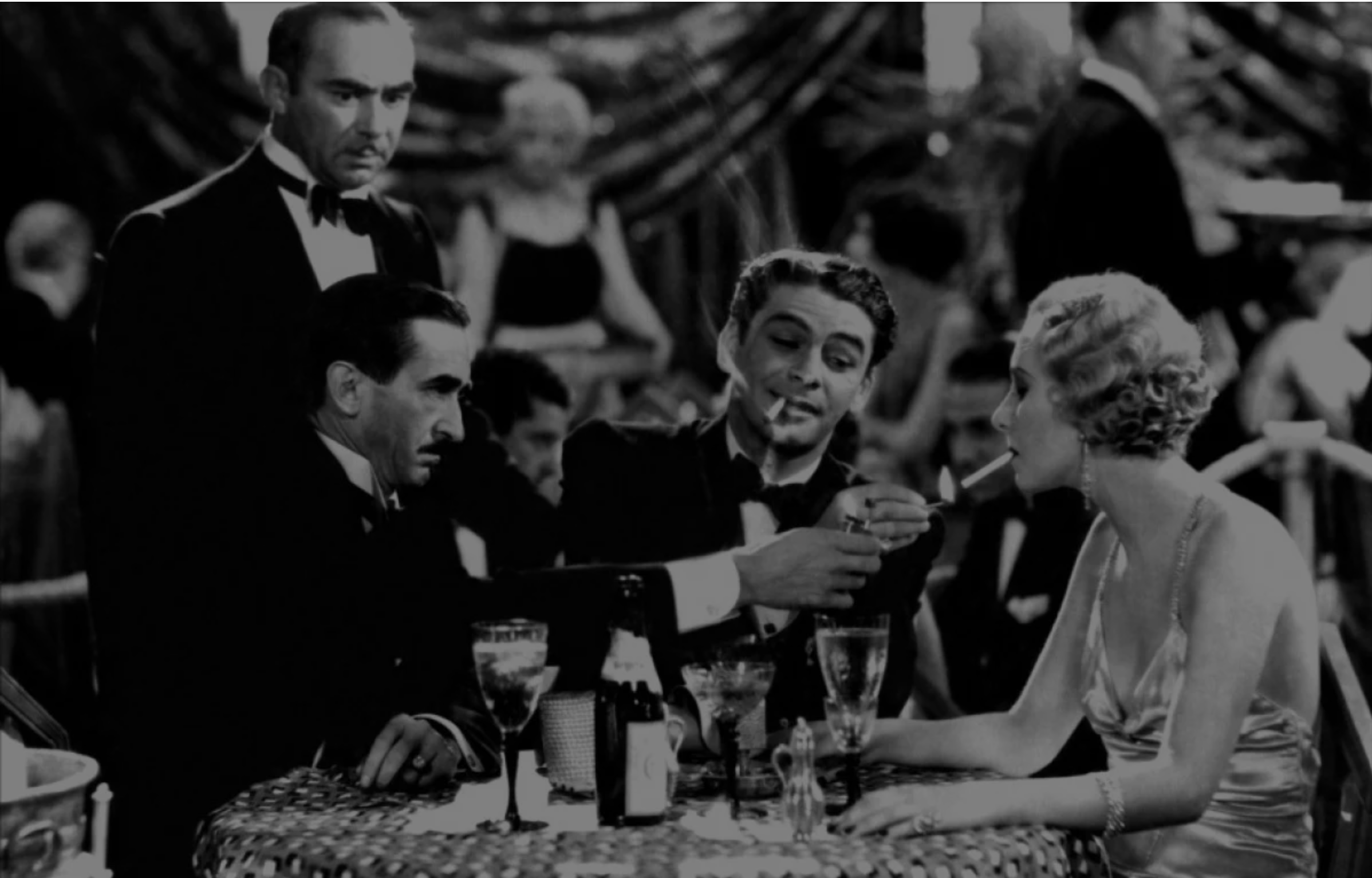
As for the rest of the movie… I felt it was quite entertaining, it’s a crisp 93 minutes and a fun watch, often unintentionally funny. The car chases were cool and the movie’s depiction of the St. Valentine’s Day Massacre was quite ingenious play with shadows. But then… it was only that – entertaining. The acting is quite stiff in some places, the flow of one scene to the next somewhat abrupt.
It is probably a product of its time, Toni must have been much cooler in 1932, perhaps like Michael Corleone in 1972 or Jordan Belfort in 2013 – we all know those men are deeply flawed and criminal, but for a second you ask yourself, what would it be like to live in those shoes for a few days? Interestingly, I found the tragic character of Rinaldo, the quiet, loyal, but deadly associate much more alluring than the loudmouth Toni. So the end did not grip me as much, I was not invested in Toni’s faith, how they finally got him, how he went out, misled by a blinking advertisement that kept telling him “the world was his”! Ah well, predictable, even pre-code!
 Tanya's Astro Blog