1929 – Die Büchse der Pandora (Pandora’s Box)
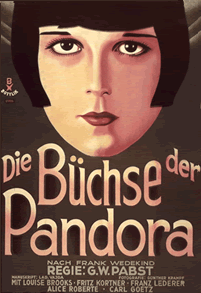
A classic Weimar era silent movie, directed by G.W Pabst. It stars Louise Brooks in its titular role as Lulu , Fritz Kortner as Dr. Schön and Francis Lederer as Alwa Schön. It is based on Frank Wedekin’s plays “Erdgeist” (1895) and the follow-up “Die Büchse der Pandora” (1904). The film explores the tragic that the natural seductiveness of Lulu brings to herself and everybody to succumbs to her allures. I saw it at filmfriend, the German library service for free (you have to enter your local library card).
Last Sunday Anora won the Academy Award for Best Picture for 2024. Well deserved, in my opinion, though I haven’t seen many of the other movies that were favored to win. What I liked was the realistic depiction of the crashing down of the “fairy tale”. Ani is firmly grounded in reality, but even then for just a second the lure of the possibility to obtaining respectability is so great… maybe, just maybe. It was all masterfully done by Mickey Madison, who wholeheartedly deserved that Oscar – the constant battle in her head of “am I gonna get mine?” and “it’s gonna work out, Vanya loves me!” and in the end “that dipshit… really hurt me”. Yes, sex workers know how society sees them, but it still hurts to be shown that with such contempt.
Also in this movie Lulu – a masterful Louise Brooks – is constantly reminded that all she is ever good for, is to seduce. Men and women alike, by the way, the movie has a whole lesbian subplot. The movie starts with a visit by her former pimp Schigolch (sorry, later it gets revealed that in may be her dad, but the way he acts throughout the movie, I’m going with pimp). She doesn’t need him anymore, she already has found her sponsor, ahem boyfriend Dr. Schön, an older man and a rich publisher. But Dr. Schön actually wants to shed her, gain some respectability, marry the daughter of the minister of the interior. And that constant push and pull between the entrancement that Lulu has on other people and the way that she brings them sorrow is the main plot of the movie. It is a tragedy throughout the movie. Nobody that crosses paths with Lulu is made whole, many end up dead or living in complete poverty. But nobody is completely innocent either, they act out of self-interest going over dead bodies to get money, love or escape the police.

The story is quite convoluted, the settings very varied – a theater production company, a wedding party, a courtroom, a confined train escaping the law, a gambling ship, a squalid room under the roof in London. It wouldn’t have worked without its main protagonist, who wholeheartedly encapsulates the myth of Greek mythology Pandora’s Box: opening the box brings misfortune, but the box also holds hope! Is the hope of love that Lulu offers along with evils that her status and her non-moralistic candor bring, a benefit or a curse? How ironic then that the movie star herself ended up in poverty, noting that “the only people who wanted to see me were men who wanted to sleep with me.”
In modern culture, the box has become “a can of worms” or a “slippery slope”. It’s often a warning against unbridled optimism, that while the hope that comes with the act is understandable, there is often a hidden evil or tragedy when you go in blind. This week’s Pandora’s Box for me has been AI in science. I heard two presentations on it, one was even on the ethics of the use of AI in science, yet at the end there were a lot of shrugs and “well, if we’re careful…”. Working on a white paper this week, I was amazed that a woman spoke up and declared that if even a sentence of the paper was written with an LLM, we should take her name off the paper. I am distancing myself from that box even more after this week, some of the things may bring hope, but its allure may damn me into a sequence of evils and tragedies I’d rather not go through.
 Tanya's Astro Blog