January 2014 – Carolin Villforth on merger rates in X-ray selected AGN

In quasar science, the birth of an AGN is a hotly studied topic. That is because of two reasons. For one it takes a violent or turbulent event for the particles in a galaxy to move to its center and make the black hole there active. Think of it this way, it would need something quite radical for the earth to move away from its current orbit and suddenly fall into the sun, even though it has about 99.8% of the Solar System’s mass. Angular momentum conservation is just too hard to break.

The other reason AGN triggering is important is that we think that the active galaxy has a big impact on the rest of the galaxy. We see this by the close correlations between the black hole mass and the host galaxy properties However, by the time we observe the galaxies this close relationship is already established, so studying the birth of AGN might bring us clues to the mechanisms that establish this relationship.

In the 1980’s aided by the great work of the IRAS satellite, David Sanders proposed that quasars are triggered by major mergers between galaxies – that’s what he saw in the ULIRGs (Ultraluminous Infrared Galaxies) with the IRAS satellite. At a certain infrared luminosity all ULIRGs were mergers and nearly all of them contained an active galaxy in their centers (summary work here)

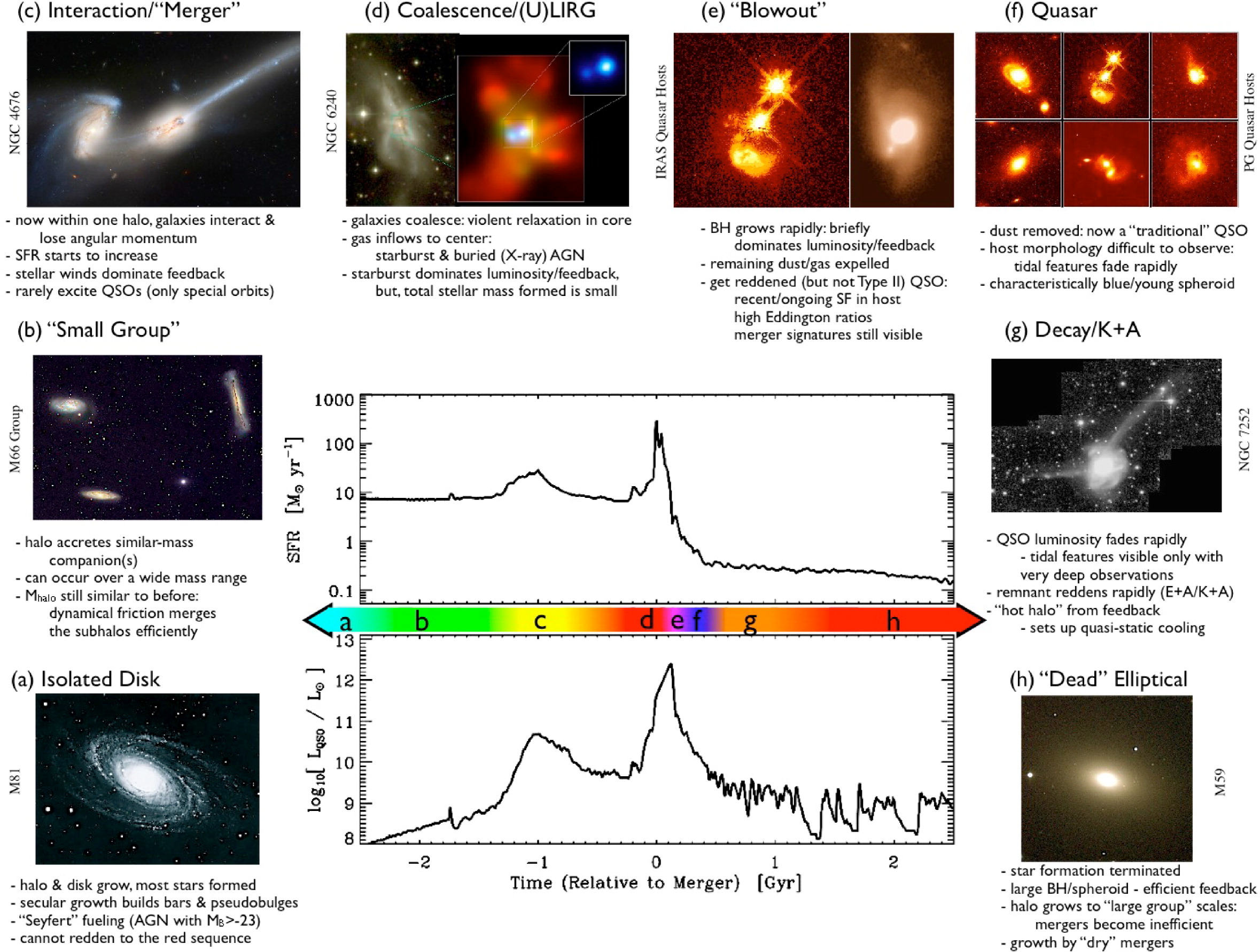
hopkins-large-fg1_online

The picture became much more muddled in the 2000s, though. The theorists could explain the formation of elliptical galaxies, their bulges, the close relationship between the black hole mass and the host’s properties, the triggering of the AGN and many more phenomena with ever improving simulations (see Phil Hopkins’ great summary in the picture above).

However, the observational picture showed various results. Optically selected hosts showed no excess of mergers when compared to quiescent (non-AGN) galaxies and only showed about merger signatures in about 30% of the quasars (Dunlop et al. 2003, Guyon et al. 2006). At redshifts below 1 they did see an increase in elliptical host galaxy with luminosity, though. X-ray selected quasars also show no excess in merger fraction when compared to quiescent galaxies either at low or high redshift (Cisternas et al. 2011, Kocevski et al. 2012). At high redshift and high luminosity their host galaxies are disks rather than ellipticals (Schawinski et al. 2012). Our work however has shown that red or infrared selected quasars, DO show a high incidence of mergers (or their signatures) up to moderate redshifts (Canalizo & Stockton 2001, Urrutia et al. 2008). Also, low surface brightness features that could be indicative of past mergers were found in many luminous quasars (Bennert et al. 2008), however, these could also be mergers with satellite galaxies, so not as wild and destructive as expected.

With that in mind, I would like to present Carolin Villforth’s recent paper: “Morphologies of z~0.7 AGN Host Galaxies in CANDELS: No trend of merger incidence with AGN luminosity” posted on astro-ph recently (1401.5477). She takes X-ray selected AGN and not only investigates the merger fraction, but also tries to see if it increases with luminosity when compared to a control sample. For that she uses the very deep data of the CANDELS survey using Hubble’s new camera in the infrared. By the way, if you are interested in CANDELS, its blog is really great and you can learn a lot from it.

asymmetry

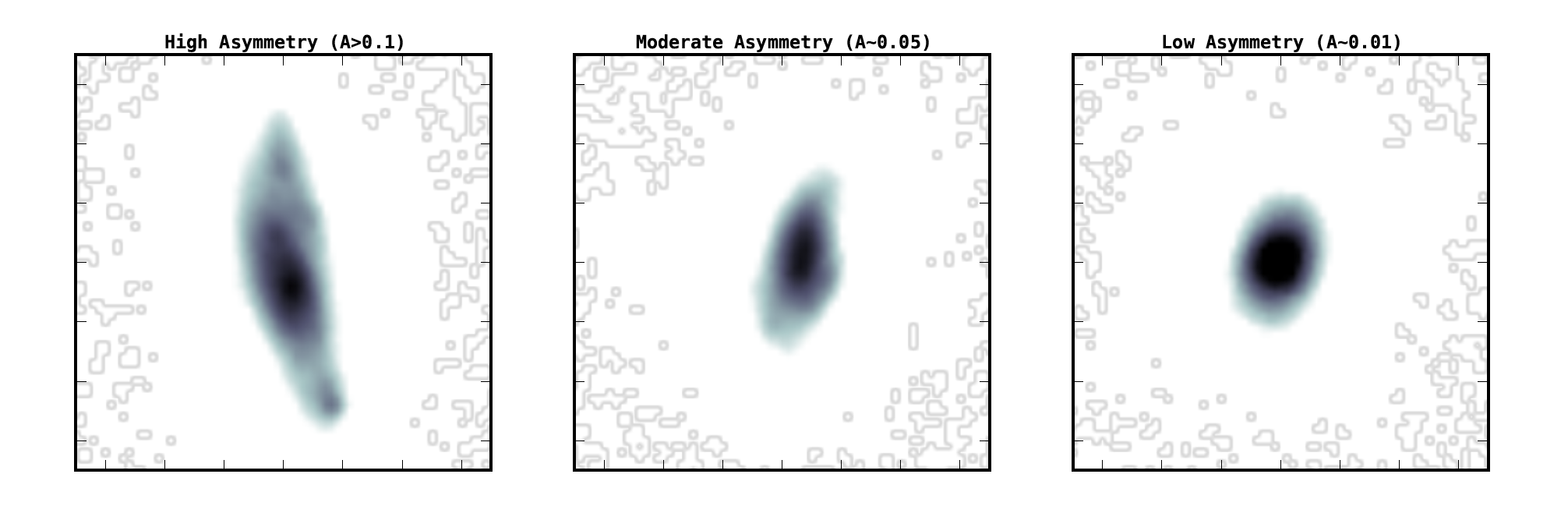
Rather than simple visual classification, she used the quantifiable asymmetry index as a tracer for mergers as you can see in the picture. She found no higher incidence of mergers when compared to ellipticals and also didn’t find any increase of merger fraction with luminosity, which leaves us a bit head-scratching, but science isn’t always neat and easily explained. I sat down with Carolin and talked with her about her paper and speculated a bit on her research. Download or take a listen below!

Looking at Orion and thinking of you

Note: This post was written at a later date, but I thought it fitting to add it at the actual date it happened.

When I was 6 years old we were driving back from the beach on a warm Sunday night in January. My parents sat in the front, while my grandmother sat with me in the back. Suddenly she leaned over and said “look! Orion!”. I had no idea what Orion was or how it looked, so she took the time to explain it to me. “It’s really quite easy once you see the three stars – that’s the belt and the bright 4 stars around it, well, that’s the frame.” I remember intently staring at it through the car window on that warm winter night. Seeing my fascination, my grandmother suggested the following: “I see you are enjoying watching the sky. Tell you what, when you look up – try to find Orion. When you do, you could think of me, I will do the same!” You see, she didn’t live near me, she was far away in Germany, I saw her once maybe every 2 years. I intently nodded. This seemed like such a cool thing, like it brought me closer, because we shared the same sky.

Over the next years she would ask me if I still looked at Orion. Not often, maybe once every 5 years or so and not lately. I always answered in the positive and that was enough for her. Little did she know that Orion became the support, the stake for my further study of the sky. I always had a long vacation in the winter so it was from Orion that I expanded out discovering the sky – upwards (westwards) towards the triangle and that smudge (Taurus and the Pleiades), downwards towards that bright star (Sirius in Canis Major) and the two bright stars that followed (Castor and Pollux in Gemini), left towards that round grouping on stars (Auriga) and that strange W (Cassiopeia). When I got my first telescope, Orion’s nebula was the first thing I tried to see. When I started observing with a CCD camera in the back of a telescope and processing images with IRAF, Orion’s nebula and the trapezium was also the first thing I recorded. Sadly, I can’t seem to find the fits file or the image I made of it anymore. Anyway, even my internet moniker, “bellatrix” derived from the fact that I looked at Orion first for everything astronomical. It was almost a sort of crux when looking at the sky – Orion, then the rest. And often, I thought of my grandmother.

Yesterday, when walking home, I showed my daughter Orion. The belt, Betelgeuse, Rigel, Bellatrix, the nebula. Of course, she was more interested in Jupiter nearby, but she acknowledged my enthusiasm. And I thought of my grandmother again. She died very early this morning. I don’t know if we will still be sharing the same sky, but I will keep on staring at it, thinking of her and the love of astronomy she unwittingly instilled in me and kept on fostering in me. I miss her so much already!

Asking “why?” or “how does it work?”

I was inspired to write this post by a recent Huffpost article by Carlos Moreno  on “Hollywood’s War on Science“. In the article, the author discusses that Hollywood mostly portrays scientists in a negative light, as mad, obsessed with power. And if the scientist is not outright EVIL, they are mostly quirky, anti-social or arrogant. Furthermore, science in general gets portrayed as something to be feared portraying what can go wrong in scientific experiments. The base of these movies and TV shows is often the fear of the unknown and sadly stands at odds with the demands of today’s world of technological and scientific literacy.

This is just something I just don’t undestand. Something must have gone awry at some point that many adults today shut down when it comes to understanding the world around us. My daughter is naturally curious how the stuff she uses everyday works and she loves playing “the why game” – answering each answer with “why?” (my second hit on google is “how to kill the why game“; so sad). But I’ve often heard the “oh, that’s a black box for me” with something technical around adults. Most of the stuff is not rocket science, the basic principles are easily accessible, but they don’t bother.

I’ve got plenty of cool counterexamples. One time, while still an undergrad, a loud party of non-scientists turned into a conversation in a circle when I began explaining the basic principles of flight, the original television, photocopier and the computer. The people were asking questions, generally fascinated to think behind the scenes of the things we use everyday. But sadly, I know that many of those people were happy that night, but never thought about that stuff again. The same probably goes for all those conversations I strike up on busses, airplanes, doctor’s offices, etc. People are fascinated with astronomy, when I talk to them about the news of the week (did you hear a Supernova exploded in a nearby galaxy and why that is exciting?). But do they take that excitement beyond their conversation with me, the strange scientist?

I don’t know, but I keep on hoping, keep on talking, keep on trying to excite without prejudice that it is wasted time. But most importantly, keep exciting kids – our world is nice as a magical place, but it is much more empowering to really understand it! I don’t think it’s futile, keep leading by example and honestly portray what it is that scientist do and why we generally are so interested and curious of the phenomena happening around us (first understanding them and then explaining them).

And at nights I will keep on working on my secret machine to take over the world! Har har har…

MUSE becoming reality and seeing first light soon

I was hired in 2011 at the Leibniz Institute for Astrophysics to help write the pipeline of the MUSE instrument. Back then it seemed so distant that the instrument would actually collect photons one day. In September of that year, we were so excited to test our pipeline on lab photons and to work with the first simulated data. This year in 2014 MUSE will begin actual astronomical observations, first light is only a few day away!

museovervlt

It has been quite exciting to slowly integrate myself within the MUSE team. While I have not done any hardcore programming on the pipeline itself (my colleague Peter Weilbacher did the excellent work of building the core and framework of the program), we have been testing, adjusting and writing lots of technical reports relating to the pipeline. Furthermore, as part of the science team, we have run many simulations, feasibility studies to test whether the science vision of our team members will be possible. Over the last 2 years, I have also written the User Manual for the pipeline, so if you are interested in MUSE data reduction, I am your gal (hint, hint for all you science collaborators out there).

Now the instrument is becoming a reality. We are already working on data taken at the VLT UT 4 telescope! They are only flats and arc lamp exposures, no on-sky data yet, but it is exciting that the mounting of the instrument went so smoothly and that data is actually coming in from Chile. Nevertheless, there are some kinks to be worked out. Beginning of February there will be a 2 week commisioning run testing out the instrument’s performance on different (calibration) objects on the sky – bright stars, galaxies and other objects.

If you are interested in this stage of the MUSE development, either because you may be interested in proposing to observe with MUSE or just because of general astronomical interest, I suggest you follow the blog over at http://muse-vlt.eu/blog/MUSE-Comm/Blog/Blog.html. We plan on being very community conscious and want to release as much information to the scientific community as possible. The intent of the blog is geared towards the professional astronomer or the very interested amateur, hopefully you will find it helpful and will propose to observe with MUSE! In the future, we plan not only to write about the instrument’s progress, but to show behind the scenes reduction and new science results relating to MUSE. Stay tuned, 2014 will be an exciting year for large datasets related to integral field (3D) astronomy!

So what do I want this blog to be in 2014?

In my last blog post I wrote that I wanted to get back to the saddle of blogging, that I always had fun writing my thoughts down. While I may not have some earth shattering insights, it really helped my order my feelings on what was happening in astronomy. But up until now, it has been sort of random ramblings. I had been pondering if maybe there should be some more structure to this blog, if it should have a theme. There are several things I have been thinking sort of formalizing this blog.

a) I’ve always wanted a more thorough look-in on some paper that was on astro-ph. Of course, I would be mostly selfish and it would be on some AGN related science most of the time. But sometimes, I find other things in astronomy really fascinating (you can’t help but be awed by the pace exoplanet science has evolved in the last 10 years, for example). So the thought was to really go in depth into one paper on astro-ph per week, maybe contact the author, make an informal interview and provide a summary of the paper – sort of like astrobites. However, this is too much work, there are only so many hours in the day. I can hardly keep up with astro-ph at all, although I really did in December and really liked it.

b) I want to become better at programming. Not because I think I am a bad programmer, but because I think I have the wrong approach. Often I program inefficiently. My mindset is often: “It works, so what if it takes 3 times as long, it is a matter of 30 seconds versus 10 seconds, I’ve got the time”. This is clearly the wrong approach and it is a detriment of the ultra-fast computers we have nowadays that we don’t learn to program memory saving and efficiently. So while vowing to delve more deeply into python, I wanted to put myself out there and just put my code out there and my thinking behind it. Maybe somebody can use the code, but mostly I would be looking for feedback on the code. I obviously would be doing some things wrong, but if I don’t put them out there, I would be doing them wrong forever, all in the name of “it works!”. However, even though I do quite a bit of coding, it could be difficult to put it in sort of blog post and I couldn’t do it quite as often.

c) I’ve been reading some astronomy and general physics books lately. I wanted to review them. Most of them aren’t in the too technical “Binney and Tremaine” formalism, but are more towards popular science. Still, I think some are quite interesting even to professional astronomers. A book review is work, often books are long and it is impossible to read one per week, sometimes even per month.

d) I enjoyed writing about the conferences I attended very much, providing some sort of summary and the take home message of the conference. Maybe highlight the motivation for organizing this conference. Or the friendships and collaborations made. Or the interesting venue. However, with the new baby, there will hardly be any travel. It is hard with breasfeeding, even with pumping milk.

e) Maybe that’s what I should write about – just the trials and tribulations now with the new baby. I wish, I had written down stuff, when my daughter was born, perhaps I am painting a rosy picture of what it was back then, maybe I am not. Just right now, I had to get up about 5 times because the little one was crying in his crib. There is this facebook group called “AWM: Astronomer, Woman, Mom” and the group is so different from other mom’s groups I have joined (either on FB or in real life). We do seem to be some weird species these astronomer moms.

So – main take-home point: I’ll just keep writing random stuff. I definitely want to write some of all of the above. But it won’t be a formalized approach or anything. Just what is passing through my head. Let’s see how it goes!